What is going on
In recent years, money has poured into artificial intelligence on the belief that it will change almost everything. This week, a lot of that confidence wobbled. Share prices of big technology companies fell hard, a famous AI start-up struggled to raise as much as it wanted, and a credit-rating agency warned about one giant’s spending.
Three words keep coming up, so here they are in plain language. A bubble is when prices rise far beyond what the underlying business can justify, because people expect them to keep rising. A correction is a fall in prices after such a run. A burst is when a correction is so deep and so lasting that it changes the industry. Nobody can say, while it is happening, which of the three it is.
This article does two things at once. It lays out, from named sources, why investors became nervous. And it explains why a market fall, even a big one, has never been the same thing as a technology disappearing. Both are true, and the interesting part is the gap between them.
The week the mood turned
TechCrunch reported that over two weeks Alphabet, Amazon, Meta and Microsoft outlined plans to spend more than $740 billion on capital expenditure this year, which Wall Street reads as AI infrastructure such as data centres and chips.[1] Earlier in the boom, investors mostly rewarded big spending. TechCrunch wrote that as the fourth quarter began, that enthusiasm seemed to be giving way to worry about spending more cash than a company brings in, mounting debt, and whether the investments will ever earn enough.[1]
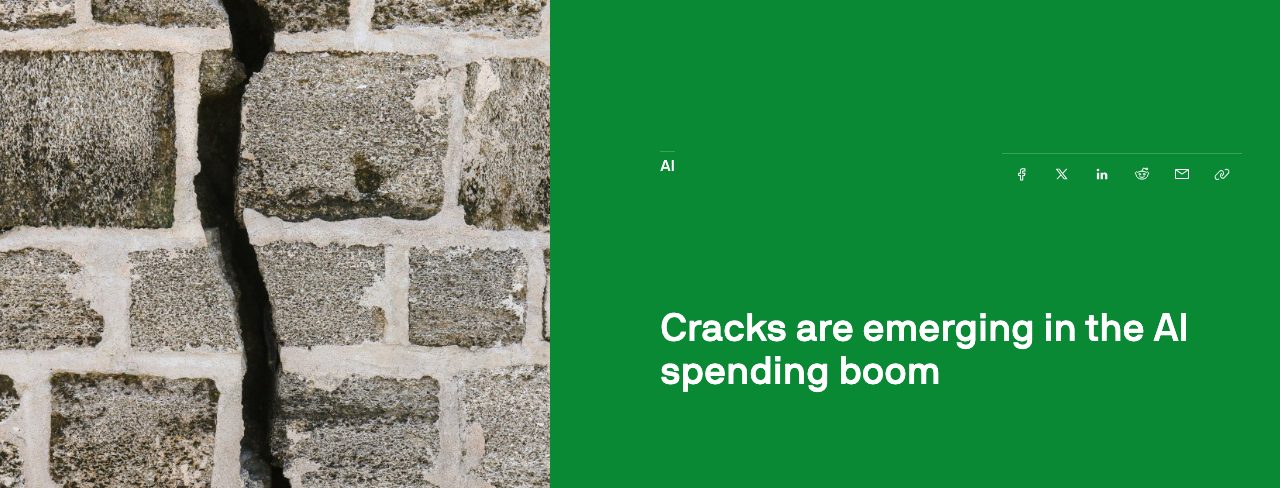
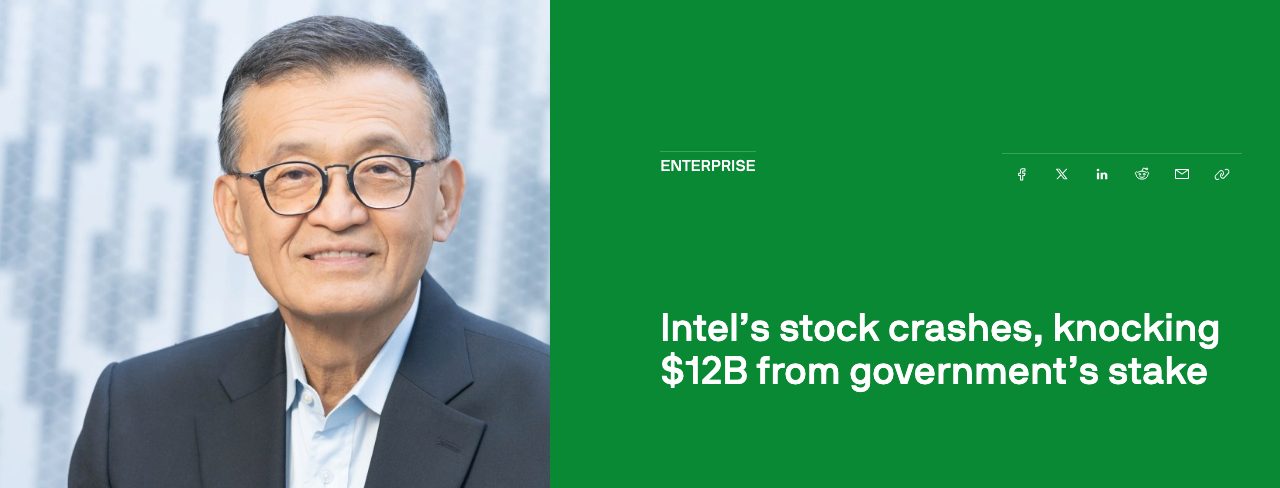
Then the market reacted. TechCrunch said the anxiety spilled across the market on Friday 30 October: the Nasdaq fell 2.9%, Nvidia dropped 4%, Broadcom more than 5% and Qualcomm 11%, and Alphabet, which fell 12% on Thursday in its worst day on record and lost $500 billion in market value, fell again.[1] Separately, TechCrunch reported that Intel crashed about 28% on Friday after warning that its fourth-quarter revenue would be $15 billion to $16 billion against analysts’ expectation of around $17 billion.[2]
−2.9%
Nasdaq, Friday 30 Oct
TechCrunch
−12%
Alphabet, Thursday
its worst day on record, about $500B of value
−28%
Intel, Friday
after a weak fourth-quarter outlook
−11%
Qualcomm, Friday
chip stocks hit
−7%
Amazon, after earnings
though AWS revenue grew 39%
−4%
Nvidia, Friday
Broadcom fell more than 5%
One-day moves as reported by TechCrunch on 30 and 31 October 2026. They are not a forecast and say nothing about where prices go next.
Why investors got nervous: spending, cash and debt
The core worry is simple. The companies are spending enormous sums, and for several of them the money going out now exceeds the money coming in. TechCrunch reported that Alphabet guided to spending up to $205 billion this year and that its quarterly capex grew to $51.4 billion; Amazon expects $220 billion; and Meta guided to as much as $145 billion.[1] CNA, carrying a Reuters report, put Meta’s range at $135 billion to $145 billion.[3]
Amazon
$220B expected this year
Alphabet
up to $205B this year
Meta
$135–145B this year
Together with Microsoft, TechCrunch says the four have outlined more than $740 billion of capital spending this year. Microsoft’s latest quarter alone was $45.2B, below the $50B it had projected.
Bars use each company’s own guidance as reported by TechCrunch and CNA (Reuters). Microsoft is left out of the bars because no full-year figure was reported.
Free cash flow is the cash a company has left after paying for its operations and its investments. TechCrunch reported that Alphabet’s was negative $9.1 billion in the third quarter, its second quarter in a row below zero; Amazon’s was negative $42.4 billion over twelve months, compared with positive $14.8 billion a year earlier; Meta’s was negative $2.1 billion in the third quarter; and Microsoft’s was positive $18.6 billion, the one exception.[1]
| Company | Free cash flow | What was reported |
|---|---|---|
| Alphabet | −$9.1B | third quarter, the second quarter in a row below zero; capex $51.4B in the quarter |
| Amazon | −$42.4B | last 12 months, against +$14.8B the year before |
| Meta | −$2.1B | third quarter; S&P expects deficits of $39B in 2026 and $71B in 2027 |
| Microsoft | +$18.6B | latest quarter; the one exception among the four |
Free cash flow is the cash a company brings in minus what it spends. Figures from TechCrunch (30 October 2026) and CNA/Reuters (Meta forecast by S&P Global Ratings).
There is a second, quieter pressure. TechCrunch noted that part of the concern is that firms with overflowing cash from their core businesses are being hit as AI threatens those businesses’ economics. Its example was Google: the success of AI Mode inside Search is eating into the money-maker, and growth in Search advertising, about half of Google’s revenue, slowed to 12%, its weakest in five quarters.[1]
Credit agencies noticed too. S&P Global Ratings revised its outlook on Meta to “negative” from “stable” on 30 October, citing uncertainty about capital spending and free operating cash flow, and said it now expects Meta to run cash deficits of $39 billion in 2026 and $71 billion in 2027.[3] Meta did not accept the reasoning: a spokesperson told Reuters the company “respectfully” disagreed with S&P’s assertion about its ability to earn from AI, and pointed to opportunities supporting a “very strong credit profile”.[3]

Where does the money come from? Not only from profits. TechCrunch, citing S&P Global Market Intelligence, said Microsoft, Alphabet, Amazon, Meta and Oracle raised a combined $326 billion in debt in 2026, triple last year’s amount.[1] CNA reported that Meta also plans to sell $97.5 billion in stock to fund the buildout.[3]
2025
The five companies raised about one third as much debt, since 2026’s total is described as triple last year’s.
2026
Microsoft, Alphabet, Amazon, Meta and Oracle raised a combined $326 billion in debt, according to S&P Global Market Intelligence.
The $326B and the “triple” are from TechCrunch quoting S&P Global Market Intelligence. “About one third” is our arithmetic from “triple”, not a reported number.
Funding for the builders is getting harder
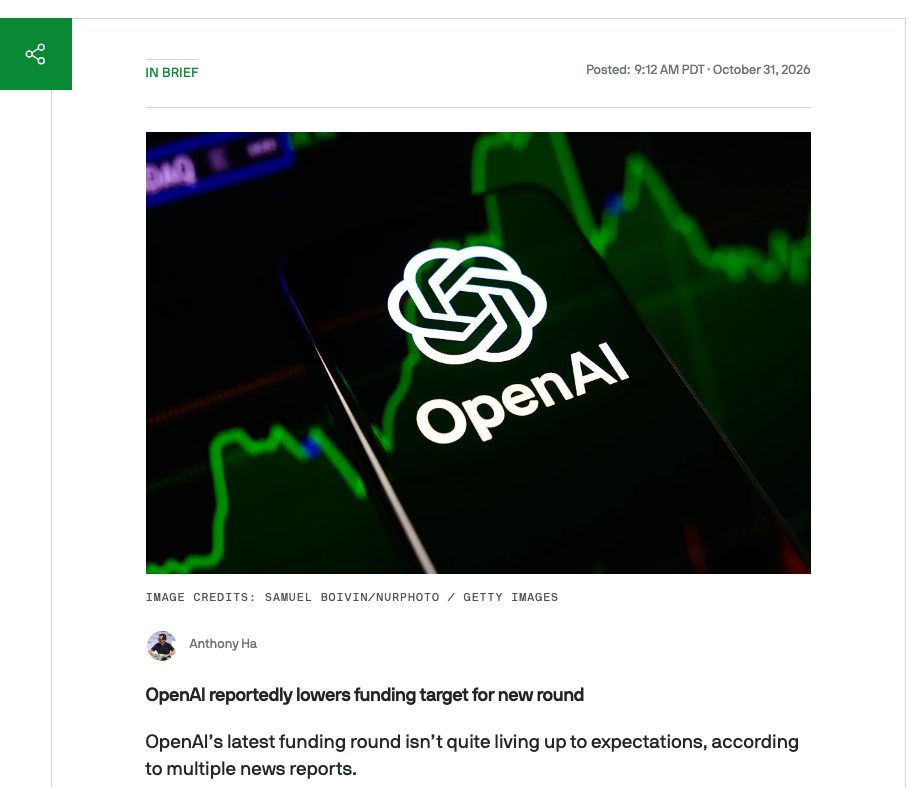
The giants can borrow against their other businesses. The pure AI labs cannot. TechCrunch reported on 31 October that OpenAI had been reported to be raising $30 billion at a $1.4 trillion valuation, then at $1.25 trillion, ahead of a planned IPO, but that the Financial Times said the target had been lowered to $20 billion, with a first close expected to be lower still.[4] A Wall Street Journal follow-up, according to TechCrunch, said OpenAI had secured $11 billion so far and that its fundraising had met with a “tepid” response from some large investors.[4]
First reported
$30B at a $1.4T valuation
Then reported
$30B at a $1.25T valuation
FT, Friday 30 Oct
target lowered to $20B
WSJ, via TechCrunch and The Decoder
$11B secured so far
As reported by TechCrunch and The Decoder on 31 October 2026, citing the Financial Times and the Wall Street Journal. TechCrunch said it asked OpenAI for comment; we saw no reply in the sources.
The Decoder, also citing the Wall Street Journal, wrote that the gap reportedly came down to fading interest from major investors during a tech sell-off driven by weak quarterly results, and that OpenAI plans to raise up to $20 billion from family offices and wealthy individuals.[5] The same piece said OpenAI is reportedly planning an IPO early next year and that rival Anthropic, which has been growing revenue faster lately, could go public as early as November.[5] TechCrunch said it had asked OpenAI for comment; the reports are unconfirmed by the company in the sources I read.[4]
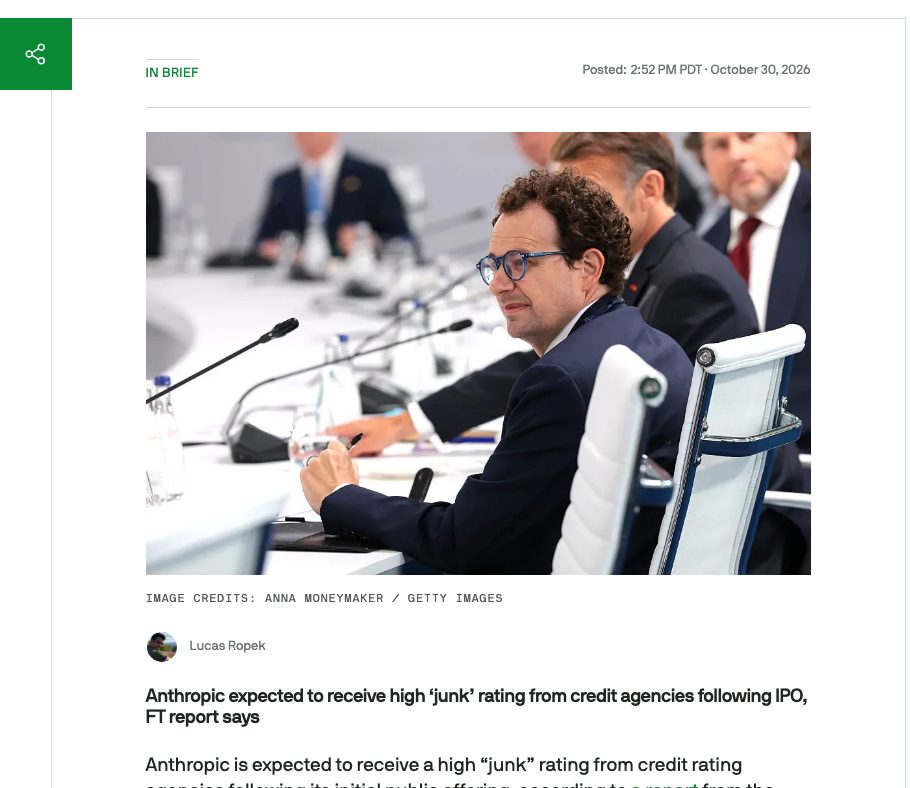
Anthropic’s own path looks less smooth than that sounds. TechCrunch, citing the Financial Times, reported that Blackstone, the anchor investor in a recent $63 billion deal to finance Anthropic’s chips, told investors it expects Anthropic to receive a “high” junk rating after its IPO, the top tier of speculative grade, having previously said it would be investment grade before 2027.[6] TechCrunch noted that this is a prediction, that Anthropic and Blackstone declined to comment, and that a junk rating would make raising money more difficult and costly.[6]
Investment grade
Top tier of “junk” (double B)
From TechCrunch (30 October 2026) citing the Financial Times. It is Blackstone’s prediction, not a rating; TechCrunch said Anthropic and Blackstone declined to comment.
The plumbing: who is lending to whom
Behind the headlines is a web of financing that explains why some people say “bubble”. TechCrunch reported, citing The Information and corroborated by Bloomberg, that Nvidia was in talks to guarantee billions in debt for AI cloud provider Nscale’s planned Anthropic data centre in West Virginia, a customer’s loans co-signed by the company that sells the chips.[7] Anthropic’s contract for the first building alone is $44.6 billion, according to Nscale’s IPO filing, and Nvidia has extended roughly $170 billion in investments and credit support to neoclouds and large customers, according to The Information.[7]

Nvidia
Reported to have extended about $170B in investments and credit support to neoclouds and large customers.
Nscale (a neocloud)
Builds the data centre; its IPO filing shows a $44.6B Anthropic contract for the first building.
Nvidia chips
The site is expected to use Nvidia’s next-generation Vera Rubin chips.
As reported by TechCrunch on 30 October 2026, citing The Information, Bloomberg, Nscale’s IPO filing and CNBC. The talks about Nvidia guaranteeing the debt were reported, not announced.
The same report is a reminder that building physical things is hard. Nscale had about 25,000 advanced chips running in August, a fraction of the nearly 500,000 it plans to deploy; Microsoft pulled out of a planned Nscale site in England after grid power for it was pushed into the 2030s; and shares of CoreWeave, Nebius and IREN had each fallen more than 30% in October, according to CNBC as cited by TechCrunch.[7]
The boom can also hurt businesses that are not AI at all. Intel’s chief executive Lip-Bu Tan said on the call that customers began signalling a PC slowdown because of memory prices and availability, and that system prices had risen significantly; TechCrunch reported that AI is “gobbling” memory and other components, raising PC prices.[2] In the same report, Intel’s data centre revenue grew 78% over the year-ago quarter.[2]
AI builds data centres
They use huge amounts of memory and other parts.
Parts get dearer
Intel’s CEO said PC prices and memory prices rose.
PC buyers wait
Intel warned of a PC slowdown and a weaker quarter.
AI side still grows
Intel’s data centre revenue was up 78% on the year.
Read from TechCrunch’s report on Intel’s results (30 October 2026). The boxes are our summary of the reported chain, not Intel’s own diagram.
We have seen something like this: the dot-com crash
History offers a useful, imperfect comparison. According to Wikipedia’s summary, the dot-com bubble peaked on 10 March 2000, when the Nasdaq Composite reached 5,048.62. Between 1995 and then the index rose 600%, only to fall 78% from its peak by October 2002, giving up all its gains.[8] Wikipedia says stocks lost $5 trillion in market value from the peak to the 2002 downturn, and that Cisco lost 80% of its stock value while Amazon also lost a large part of its market value.[8]
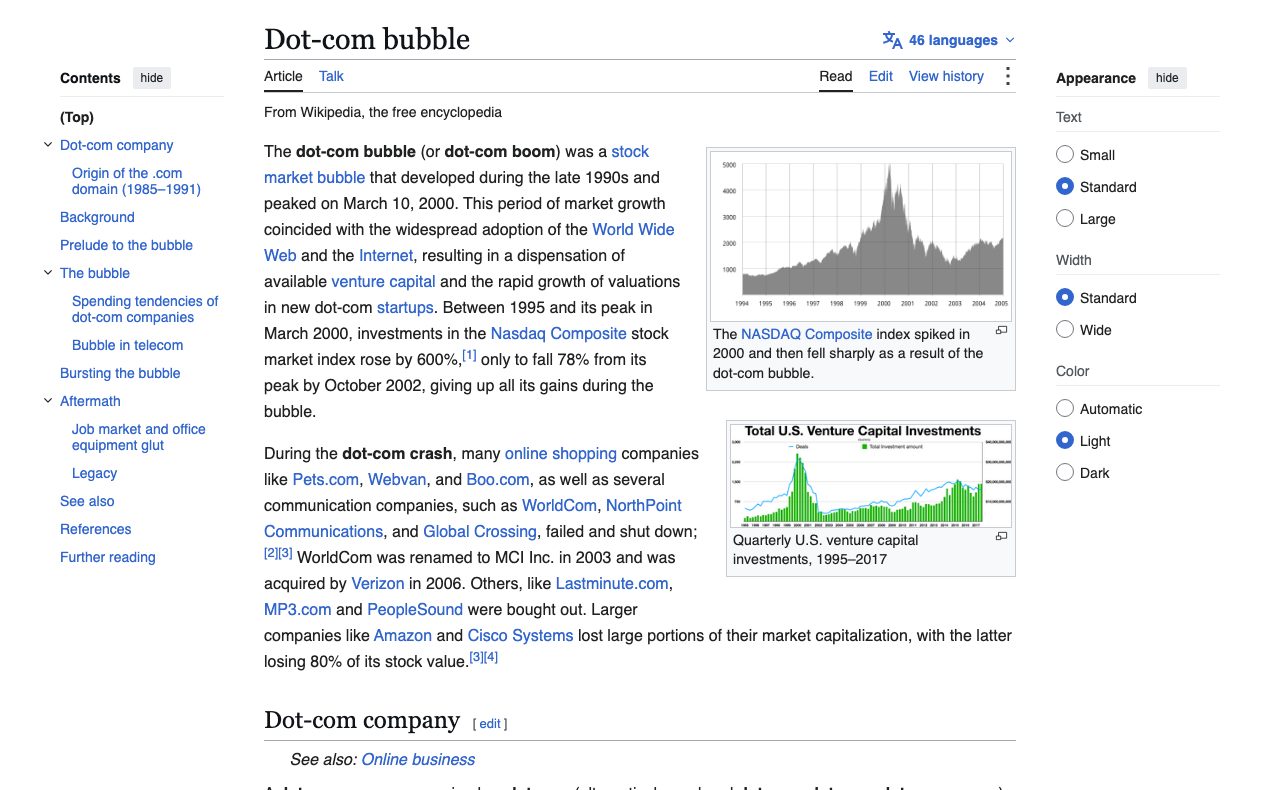
The telecom side looks eerily familiar. Wikipedia says that in the five years after the 1996 Telecommunications Act, equipment companies invested more than $500 billion, mostly financed with debt, laying fibre-optic cable and building networks.[8] Many online retailers and communication companies such as Pets.com, Webvan, WorldCom and Global Crossing failed, but Wikipedia also says many firms endured: 48% of dot-com companies survived through 2004, at lower valuations.[8]
+600%
Nasdaq, 1995 to March 2000
peak 5,048.62 on 10 March 2000
−78%
Fall from the peak by October 2002
all the bubble’s gains given up
$5 trillion
Market value lost
from the peak to the 2002 downturn
−80%
Cisco’s stock value
Amazon also lost a large part of its value
$500B+
Telecom fibre spending
mostly financed with debt, 1996–2001
48%
Dot-com firms still alive in 2004
at lower valuations
All figures from Wikipedia’s “Dot-com bubble” article, read on 1 November 2026. It is an encyclopedia summary, not a primary record, so treat the exact numbers as approximate.
The lesson I take from that account, and it is my reading and not a forecast, is that a bust removes weak companies and over-priced bets but leaves the cables, the habits and the skills behind. The fibre laid in the boom was still there when later services needed it. A crash is a repricing of who owns the future, not a vote on whether the future arrives.
1. Boom
Money pours in, prices run ahead of profits, and everything with the label gets funded.
2. Bust
Prices fall, weak firms fail, lenders pull back. Many good ideas get cheap.
3. Build
Survivors use the cheap, already-built infrastructure to find what people actually pay for.
Illustration only: a simple three-step pattern drawn from the dot-com account in Wikipedia. It is not a forecast and no data is plotted.
What a correction cannot erase
A share price is a bet on future profit. It is not a measure of whether people use the product. In the same reports that describe the fall, there are signs that real demand is still there. TechCrunch wrote that demand for AI compute remains strong and that Google, Amazon and Microsoft all saw gains in their cloud businesses, with AWS revenue growing 39%.[1] Meta’s ad revenue grew 26%, and Intel’s data centre revenue was up 78%.[1][2]
Signals that worry
- Free cash flow below zero at Alphabet, Amazon and Meta.
- $326B of new debt across five giants in 2026.
- OpenAI’s round: $11B secured against a $30B first target.
- Neocloud shares down more than 30% in October, per CNBC.
- S&P’s negative outlook on Meta’s spending and cash flow.
Signals that reassure
- AWS revenue up 39%; Google, Amazon and Microsoft all grew cloud sales.
- Meta ad revenue up 26%.
- Intel’s data centre revenue up 78%.
- TechCrunch: demand for AI compute “remains strong”.
- The Decoder: Anthropic has been growing revenue faster lately.
Lists are drawn from the cited reports. Neither column settles the question; the point is that both are true at once.
Balance matters in the other direction too. DoorDash told investors on its third-quarter call that it had seen only “several hundred” orders in total from third-party AI agents, against an average of about 3 million deliveries a day in its 2025 report, according to TechCrunch.[9] Its chief executive Tony Xu said “you never want to fight gravity” but also “you don’t want to be delusional”.[9] A technology can be real and still early, and early is exactly where bubbles form.
~3 million
deliveries a day
DoorDash’s 2025 report average, per TechCrunch
“several hundred”
orders in total from outside AI agents
DoorDash CEO Tony Xu, third-quarter call
The two numbers are not drawn to scale, because the first is a daily average and the second is a total. The gap is the point: a technology can be real and still be early.
From TechCrunch (30 October 2026). DoorDash also runs its own AI agents and said it wants a healthy relationship with outside agent makers.
Same story, or a different one?
It would be too neat to say history will repeat. There are real differences and real similarities, and I will mark which is which.
Similar: heavy borrowing, with five giants raising triple last year’s debt;[1] (in my reading) a build-out that runs ahead of earnings; and a web of suppliers financing customers.[7] In the dot-com era, telecom firms also built with debt.[8]
Different, according to the reports: several of the biggest spenders sell products that already earn large revenues; AWS grew 39% and Meta’s ad revenue grew 26%.[1] And Microsoft reported positive free cash flow of $18.6 billion even while spending.[1] That does not make the spending wise. It means the losses so far are being funded by large businesses, not only by hope.
Unknown: whether the new businesses will earn enough to repay what is being borrowed. S&P said it is unclear when Meta’s new revenue streams will contribute enough to exceed rising costs.[3] Nobody in the sources I read claims to know. Anyone who tells you with certainty that this is a burst, or that it is nothing, is guessing.
What to do with this
The honest takeaway is practical, not predictive. Prices will move, and the reports above will look different in a month. What you can control is how dependent your own plans are on a price staying high. This is general information, not advice for your situation.
If you build
If you learn
If you run a business
If you invest through funds
The message
A bubble is about prices. A technology is about what people can do that they could not do before. The first can fall sharply while the second keeps growing, as the dot-com years showed. This week’s sell-off is real, the worries about cash and debt are real, and so is the demand the same reports describe. Look past the hype in both directions.
Markets can burst and still leave the technology standing: judge AI by what it earns and what people use, not by one week’s share price.
Quick quiz
Tap a question to check your answer.
Q1What is free cash flow, and which of the four big spenders had a positive figure?
It is the cash left after running the business and paying for investments. TechCrunch reported that Microsoft was the only one of Alphabet, Amazon, Meta and Microsoft with a positive figure, $18.6 billion.
Q2What is the difference between a correction and a burst?
A correction is a fall in prices after a run-up. A burst is a correction deep and lasting enough to change the industry. Nobody can tell which it is while it is happening.
Q3What did the Nasdaq do between 1995 and March 2000, and then to October 2002, per Wikipedia?
It rose 600% by its 10 March 2000 peak of 5,048.62, then fell 78% from that peak by October 2002.
Q4Name one signal that worries and one that reassures, from this week’s reports.
Worrying: negative free cash flow at Alphabet, Amazon and Meta, or OpenAI securing $11 billion against a $30 billion first target. Reassuring: AWS revenue up 39%, or Intel’s data centre revenue up 78%.
Q5Why is DoorDash’s “several hundred” orders from AI agents worth noting?
Against about 3 million deliveries a day, it shows the technology is still early in real use, even while investment is huge.
References
The sources behind this article: original papers, official announcements and documentation. Each link was opened and checked on ; documentation without a fixed date is cited as it read that day.
- [1]
Bellan, R. (30 October 2026). Cracks are emerging in the AI spending boom. TechCrunch.
Reporting · Supports: Capex plans, free cash flow, debt raised and the 30 October share moves for the big spenders. A news report, not the companies’ filings.
- [2]
Bort, J. (30 October 2026). Intel’s stock crashes, knocking $12B from government’s stake. TechCrunch.
Reporting · Supports: Intel’s weak outlook, the memory-price effect on PC sales and its 78% data centre growth.
- [3]
Reuters, via CNA (31 October 2026). S&P Global revises Meta’s outlook to ‘negative’ on AI spending, cash flow worries. CNA (Channel NewsAsia).
Reporting · Supports: S&P’s revised Meta outlook, its deficit forecasts, Meta’s reply and the planned $97.5 billion stock sale.
- [4]
Ha, A. (31 October 2026). OpenAI reportedly lowers funding target for new round. TechCrunch.
Reporting · Supports: The Financial Times and Wall Street Journal reports on OpenAI’s lowered target and $11 billion secured.
- [5]
Bastian, M. (31 October 2026). OpenAI raises just $11 billion of its $30 billion target as big investors lose their AI appetite. The Decoder.
Reporting · Supports: A second account of the same round, plus the planned IPO and Anthropic’s possible November listing.
- [6]
Ropek, L. (30 October 2026). Anthropic expected to receive high ‘junk’ rating from credit agencies following IPO, FT report says. TechCrunch.
Reporting · Supports: Blackstone’s reported expectation of a top-tier junk rating for Anthropic after its IPO.
- [7]
Mehta, A. (30 October 2026). Nvidia weighs playing the cosigner for Nscale’s AI data center in West Virginia. TechCrunch.
Reporting · Supports: The reported Nvidia debt guarantee talks, Anthropic’s contract and the pressure on neoclouds.
- [8]
Wikipedia contributors. Dot-com bubble. Wikipedia (read 1 November 2026).
Guide · Supports: The encyclopedia’s summary of the Nasdaq peak, the 78% fall, telecom borrowing and survival rates. A secondary source.
- [9]
Mehta, I. (30 October 2026). DoorDash said it’s only received ‘several hundred’ orders from AI agents. TechCrunch.
Reporting · Supports: A reality check on how much real use AI agents are getting, from DoorDash’s earnings call.
How this article was made
Researched and drafted with the help of AI assistants, checked against the sources above, and published by Mrinal Singh Raja as general information, not professional advice. Facts come from the sources listed and may change, so please check them before relying on them. Spotted a mistake? Tell us and we will correct it. Our editorial standards explain how AI is used here.
Alphabet, Amazon, Meta, Microsoft, Intel, Nvidia, OpenAI, Anthropic, Nscale, Blackstone, S&P Global, DoorDash and the publications named are independent of MSRX, and this article is not affiliated with or endorsed by any of them. Facts were checked against the cited pages on 1 November 2026, and markets have likely moved since. The screenshots are real captures of those pages, cropped to leave out advertising, shown for identification and commentary. This is general information and not financial advice.