Asha’s Monday
Meet Asha. She is not real, but her Monday could be yours.
Asha manages projects for a mid-sized company in Pune. She wakes at ten past seven and reads one message on her phone. Overnight, her AI agent has gone through sixty-three emails, sorted them into three piles, drafted four replies and noticed that two of her meetings overlap. It has not sent anything. It has left the drafts in a folder and written, at the top: “Three things need you. The rest can wait.”
She approves two drafts, changes a sentence in a third, and tells the agent to rebook the clashing meeting. Then she does what she hired the agent to make room for: she sits down for two hours and writes the one report that only she can write. At lunchtime she walks away from the screen, and her agent compares three insurance renewals in plain language. It changes nothing. At a quarter to five she reads a one-page summary, asks two questions, and decides.
- 07:10
YouWake up. Read one message.
Your agentOvernight: sorted 63 emails into three piles, drafted 4 replies, found a clash between two meetings.
- 08:30
YouApprove two drafts. Edit one line. Skip the third.
Your agentSends the approved two. Holds the third. Rebooks the clashing meeting once you say yes.
- 10:00
YouDeep work: the report only you can write.
Your agentPulls last quarter’s numbers into a table, marks the two figures that look odd, and waits.
- 13:00
YouLunch. Actually away from the screen.
Your agentCompares three insurance renewals, lists the differences in plain words, changes nothing.
- 16:45
YouRead the summary. Ask two questions. Decide.
Your agentPrepares tomorrow’s briefing, with sources for every number.
Illustration: an imagined day, not a real user or a specific product. The point is the split: the agent prepares and proposes; you decide.
Nothing in Asha’s Monday needs science fiction. Every step is something that agents are already reported to do, as this article will show. What is new is not any single trick. It is that a machine can now be handed a goal, not just a question, can use the same tools we use, and can come back with finished work for a person to approve.
That idea is much older than the technology. People have dreamed of helpers made of metal and water for well over two thousand years. In this article we follow the dream from a wooden pigeon in ancient Greece to the offices of 2026, look at what agents actually achieve, and end where most people want to start: how you can put one to work this week, and how to keep your hand on the wheel while it does.
A word on tone before we start. This is meant to be an optimistic story, because the evidence for optimism is real, and because a busy person with a full inbox deserves some good news. But it is not a sales pitch. Where sources disagree, where the evidence is thin, or where a company is describing its own product, we say so. And in the later sections we spend real time on what can go wrong, because the people who get the most out of agents are, as we will see, the ones who check the work.
- 400–350 BCEArchytas of Tarentum is credited with a wooden pigeon driven by steam or compressed airAutomaton
- 3rd century BCEIn China, a mechanical orchestra is built for the Han emperorAutomaton
- 1st century CEHeron of Alexandria writes about devices driven by water, falling weights and steamAutomaton
- 13th centuryAl-Jazarī builds water-driven peacocks for princes in MesopotamiaAutomaton
- c. 1772Jaquet-Droz’s child android writes with a quill penAutomaton
- 1842Lady Lovelace: the Analytical Engine “can do whatever we know how to order it to perform”Idea
- 1950Turing asks “Can machines think?” and imagines teaching a “child machine”Idea
- 1966–1972Shakey, at SRI: the first mobile robot that could perceive and reason about its surroundingsRobot
- 25 Nov 2024Anthropic introduces the Model Context Protocol, a standard plug for AI and toolsPlumbing
- 9 Apr 2025Google announces Agent2Agent (A2A), so agents can talk to each otherPlumbing
- 9 Dec 2025The Linux Foundation forms the Agentic AI Foundation around MCP, goose and AGENTS.mdPlumbing
- 5 May 2026Microsoft’s Work Trend Index: how 20,000 AI users work with agentsToday
- 9 Sep 2026Gartner: “workforce amplification was the opportunity”Today
A pigeon, a steam ball and a peacock
The oldest record of a machine that seemed to act on its own is a bird. Encyclopaedia Britannica points to a wooden model of a pigeon built by Archytas of Tarentum, a Greek friend of Plato who lived around 400–350 BCE. The bird hung from the end of a pivoted bar, and the whole apparatus turned by means of a jet of steam or compressed air.[1]
We know more about the next inventor because he wrote it down. Heron of Alexandria, who worked in the first century CE, described devices driven by water, falling weights and steam.[1] Across the world, in China, accounts of automata reach back to the third century BCE, when a mechanical orchestra was made for the Han emperor. By the Tang period there were records of flying birds, an otter that caught fish, a begging monk and singing girls.[1]
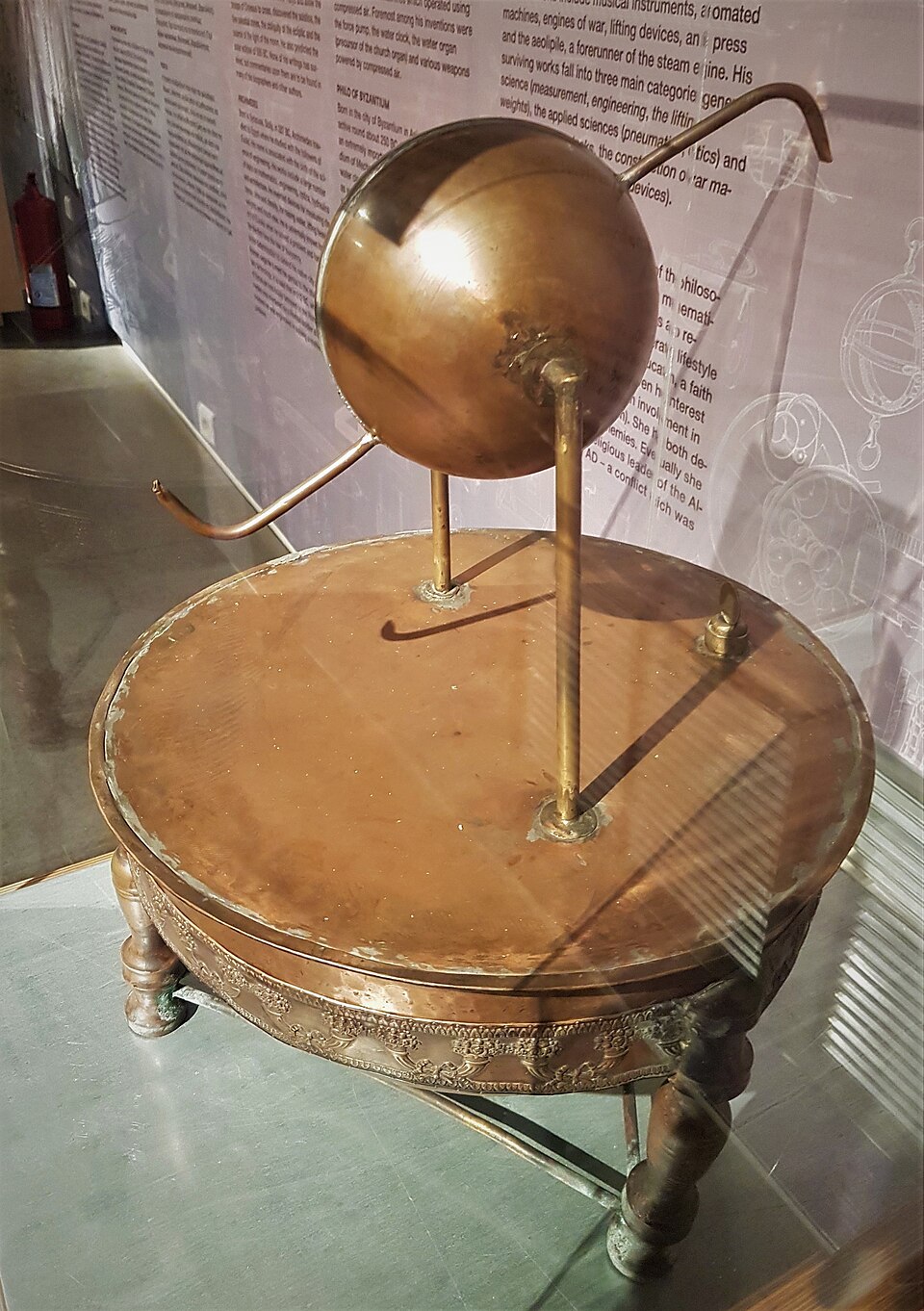
A reconstruction of a steam device
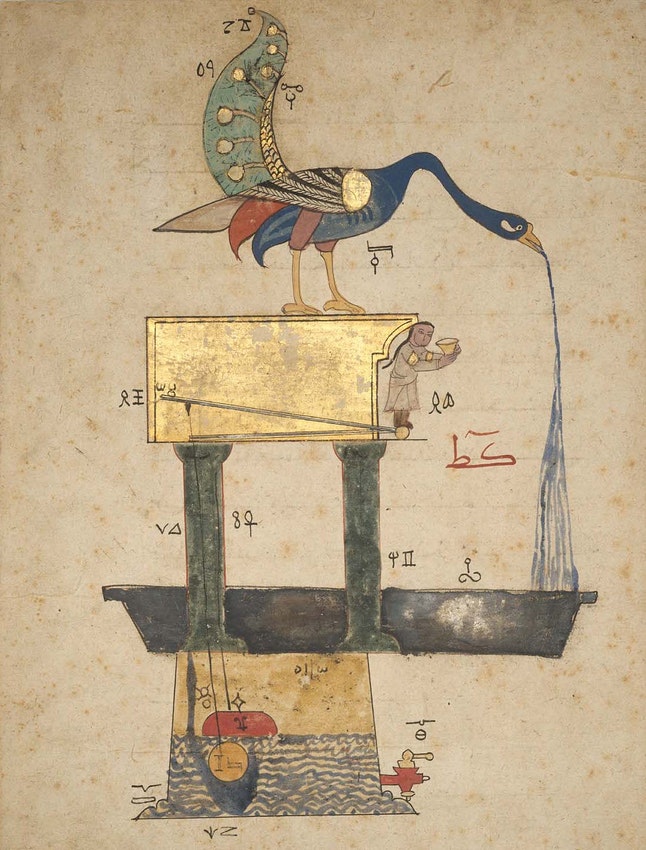
A peacock fountain automaton, 14th century
In the Islamic world, inventors were active from about the ninth century. The best documented is al-Jazarī, who worked in the thirteenth century for princes of the Artuqid dynasty in Mesopotamia and built water-operated automata, many of them moving peacocks.[1] In Europe, Britannica records that the Gothic architect Villard de Honnecourt sketched mechanical objects in a sketchbook of 1235, and that Renaissance gardens such as the Villa d’Este near Rome were filled with fountains that played music by water power.[1]
Medieval Europe added legends: Britannica notes that Roger Bacon is credited with constructing a talking head, and Albertus Magnus an iron man.[1] From the mid-fifteenth century, coiled steel springs gave machines what Britannica calls “a truly portable source of motion”, and that moved the automaton from the garden onto the dining table, in the form of ornamental sailing ships known as nefs.[1]
By the late eighteenth and early nineteenth centuries the miniatures were exquisite. The Rochat brothers made mechanical songbirds that darted out from beneath the lids of snuffboxes. And then there was the magician box, which deserves a place in any history of AI. In Britannica’s words: “A disk engraved with a question is inserted in a slot in the box, upon which the tiny figure of a magician comes to life and points with his wand at a space where the answer appears.”[1] Ask a question, get an answer: a chatbot with a wand. Of course, it could only answer the questions its disks had been engraved with. Nothing was understood. Everything had been arranged in advance.
Look closely at what these machines were for. Britannica is blunt about it: through the ages, “most automatons have been objects of fancy that are purely decorative in concept and function.”[1] They amazed guests. They did not do anybody’s work. They were performers, wound up and set going, doing one act, the same way every time.
And yet the ancient makers had grasped something important. Power did not have to come from a person. Water, falling weights, steam and, later, springs could all do the moving. What they could not supply was judgement: the ability to choose what to do next. The missing ingredient was never muscle. It was the machine’s ability to decide, and to be told what to decide.
The other ancient road: rules, zero and logic
While engineers in Greece and China built machines that moved, thinkers in India were building something that did not move at all: machines made of rules. They did not build computers, and it would be wrong to draw a straight line from a Sanskrit grammar to a chatbot. But three ideas that modern computing depends on, precise rules, a working zero and careful logic, each had remarkable early chapters in India. This section tells them as the sources we could open tell them, including the places where popular retellings go too far.
Rules: Pāṇini’s grammar
Start with a grammar. Pāṇini, who worked in the north-west of the subcontinent, wrote the Aṣṭādhyāyī, the “Eight Chapters”. Nobody knows exactly when. MacTutor, the mathematics-history archive of the University of St Andrews, calls the usual dates of about 520–460 BCE “pure guesses”, and reports that experts place him anywhere from the fourth to the seventh century BCE.[2] What is clear is the ambition. In the words of a scholar MacTutor quotes: “On the basis of just under 4000 sutras [rules expressed as aphorisms], he built virtually the whole structure of the Sanskrit language.” The sentences and compound words are explained, MacTutor says, “as ordered rules operating on underlying structures”, and Pāṇini’s constructions are “similar to the way that a mathematical function is defined today.”[2]
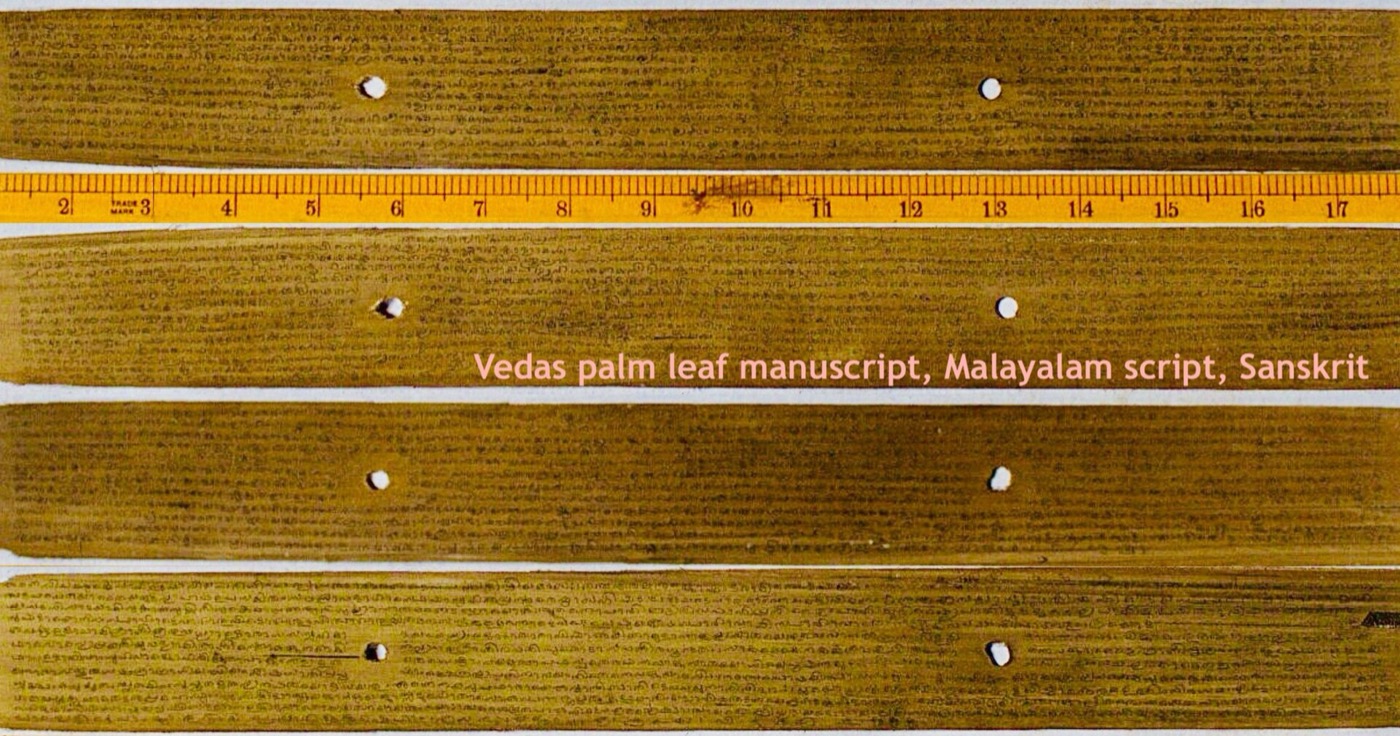
MacTutor goes further: Pāṇini “should be thought of as the forerunner of the modern formal language theory used to specify computer languages”, and his notation is “equivalent in its power” to the Backus Normal Form that John Backus discovered independently in 1959.[2] Scholars do not all agree on how strong that comparison is. A 2021 paper by J. J. Lowe, published through Oxford’s research archive, argues that Pāṇini’s system looks context-sensitive on the surface but is held in check by a rule against cyclic application, “limiting the power of his superficially context-sensitive formalism in a way entirely parallel to much work in modern phonology.”[3] You do not need the technicalities to take the point: this was a rule system precise enough for modern linguists and computer scientists to argue about its formal power. That is a long way from “the world’s first programmer”, a slogan you will meet online, and a much more interesting fact.
Counting: Piṅgala’s metres
Next, counting. Piṅgala, around the second century BCE, wrote the Chandaḥśāstra, a treatise on Sanskrit poetic metres. According to the mathematician Jayant Shah’s history of his work, Piṅgala gave “procedures for listing all possible forms of an n-syllable meter and for indexing such a list”, and “an algorithm for calculating the binomial coefficients”. Shah calls it “a purely mathematical theory, apparently mathematics for its own sake”, and notes that Piṅgala “consistently uses recursion in his algorithms”, a tradition he traces from Pāṇini through Āryabhaṭa in the fifth century CE, who gave a recursive algorithm for a table of sines, to Mādhava in the fourteenth.[4]
Because every syllable in a metre is either short or long, a list of all the metres of n syllables is, in modern eyes, a list of every string of two symbols, which is exactly what a binary counter does. That gloss is ours, and it is fair to admire it without claiming that Piṅgala invented computing. Shah himself reports a genuine scholarly dispute over whether Piṅgala’s last rule really describes the triangle we call Pascal’s.[4]
Zero: Brahmagupta’s rules, and a cautionary tale
Then, zero. In 628 CE Brahmagupta wrote the Brāhmasphuṭasiddhānta in 25 chapters, at Bhillamāla, which MacTutor identifies with today’s city of Bhinmal. MacTutor says his “understanding of the number systems went far beyond that of others of the period”. He “defined zero as the result of subtracting a number from itself”, and gave rules using “fortunes” (positive numbers) and “debts” (negative numbers), such as “A debt subtracted from zero is a fortune.”[5] He also attempted division by zero, and here MacTutor is candid: “He is certainly wrong when he then claims that zero divided by zero is zero. However it is a brilliant attempt to extend arithmetic to negative numbers and zero.”[5] A bug, as software people would say, in a very early draft of the rules.


You may also have read that a birch-bark manuscript from a village near Peshawar, the Bakhshālī manuscript, contains the world’s oldest zero, from the third or fourth century. That headline is now out of date, and the story is a good example of science correcting itself. Oxford’s report describes the manuscript as “notable for the number of zeros it contains”, found in 1881 and given to the Bodleian Library in 1902, with proposed dates over the years “ranging from as early as 200 CE to 1100 CE”. Its 2024 radiocarbon measurements on five folios give ranges between about 773 and 1032 CE, and the report explains that a second measurement on one folio “demonstrated that the initial determination was inaccurate.”[6] The honest statement today is narrower: the manuscript is, in Oxford’s words, “almost certainly the oldest extant witness of a South Asian mathematical work”, and its zeros are real, but it is not evidence of a third-century zero.

Logic: from Nyāya to Navya-Nyāya
Finally, logic. Nyāya, “Logic”, is a school of Indian philosophy that spent close to two thousand years refining how we know things. In the fourteenth century Gaṅgeśa, who lived in north-eastern India, wrote its central text, the Jewel (Tattvacintāmaṇi), in four chapters devoted to four sources of knowledge: perception, inference, analogy and testimony. The Stanford Encyclopedia of Philosophy says he is traditionally taken to inaugurate “New” logic, Navya-Nyāya, but cautions that the line between old and new “is problematic”, since “at no time is there a decisive revolution”. Among his accomplishments it lists definitions of knowledge and of natural “pervasions” (vyāpti) as the underpinning of inference, and “crisp treatments of the major types of fallacy”.[7]
Some computer scientists have suggested that Navya-Nyāya’s exact language could inform knowledge representation, the way software stores facts and the relations between them. We could not open a source that shows how far that idea has been developed, so we offer it as an intriguing suggestion and not a settled lineage. What we can say is why it resonates in the agent era: a tradition that insists a conclusion be tied to its reasons is a good match for a world in which we want agents to show their work.
- 6th–4th c. BCE (dates uncertain)PāṇiniAṣṭādhyāyī: just under 4,000 rules that build the structure of Sanskrit
- c. 2nd century BCEPiṅgalaChandaḥśāstra: procedures for listing every metre and counting them, using recursion
- 5th century CEĀryabhaṭaA recursive algorithm for building a table of sines
- 628 CEBrahmaguptaBrāhmasphuṭasiddhānta: rules for arithmetic with zero, “fortunes” and “debts”
- c. 8th–11th century CEBakhshālī manuscriptBirch-bark mathematics “notable for the number of zeros it contains”
- 14th century CEGaṅgeśaThe Jewel of Reflection on the Truth: sources of knowledge, inference and “pervasion”
Dates are as given in the sources we opened; several are debated, and the Bakhshālī range is Oxford’s 2024 radiocarbon result for five folios. Green: rules. Blue: counting. Amber: zero. Violet: logic.
| You may have read | What the sources we opened say | Our verdict |
|---|---|---|
| “Pāṇini was the world’s first programmer.” | He wrote precise, ordered rules that build Sanskrit; MacTutor calls him a forerunner of formal language theory. How powerful his system is remains debated. | Fair, but a slogan |
| “Piṅgala invented binary computing.” | He gave procedures to list and count every pattern of short and long syllables, using recursion. That is binary-like counting, not a computer. | Stretched |
| “Āryabhaṭa invented zero.” | Not supported by the sources we opened. The clearest rules for zero we could verify are Brahmagupta’s, in 628 CE. | Not supported here |
| “The Bakhshālī manuscript holds the world’s oldest zero, from the 3rd or 4th century.” | Oxford’s 2024 report dates five folios to about 773–1032 CE and says an earlier measurement on one folio was inaccurate. | Out of date |
| “Navya-Nyāya is the blueprint for modern AI.” | It is a rigorous tradition of logic and theory of knowledge. Links to knowledge representation are suggested by some; we found no source here that settles it. | Unproven |
Our own summary of what the cited sources say. It is a verdict on the claims as popularly phrased, not on the remarkable work itself.
Whether or not the arrows run straight, the lesson for our story is worth keeping. Long before anyone built a thinking machine, people in India were working out how to write rules so precisely that a reader who cannot guess can follow them, how to count every possibility, how to give nothing a number, and how to tie a conclusion to its reasons. Those are the same habits that make an agent safe to work beside today. And the Bakhshālī story shows a further one: when the evidence changes, the honest answer changes with it.
The boy who wrote, and the countess who doubted
By the late eighteenth century the tricks had become astonishing. Britannica shows an android of a child writing, made by Pierre Jaquet-Droz around 1772, now in the Musée d’Art et d’Histoire in Neuchâtel, Switzerland.[1] A boy sits at a desk with a quill pen, and, when set going, writes.

The writing automaton, c. 1772
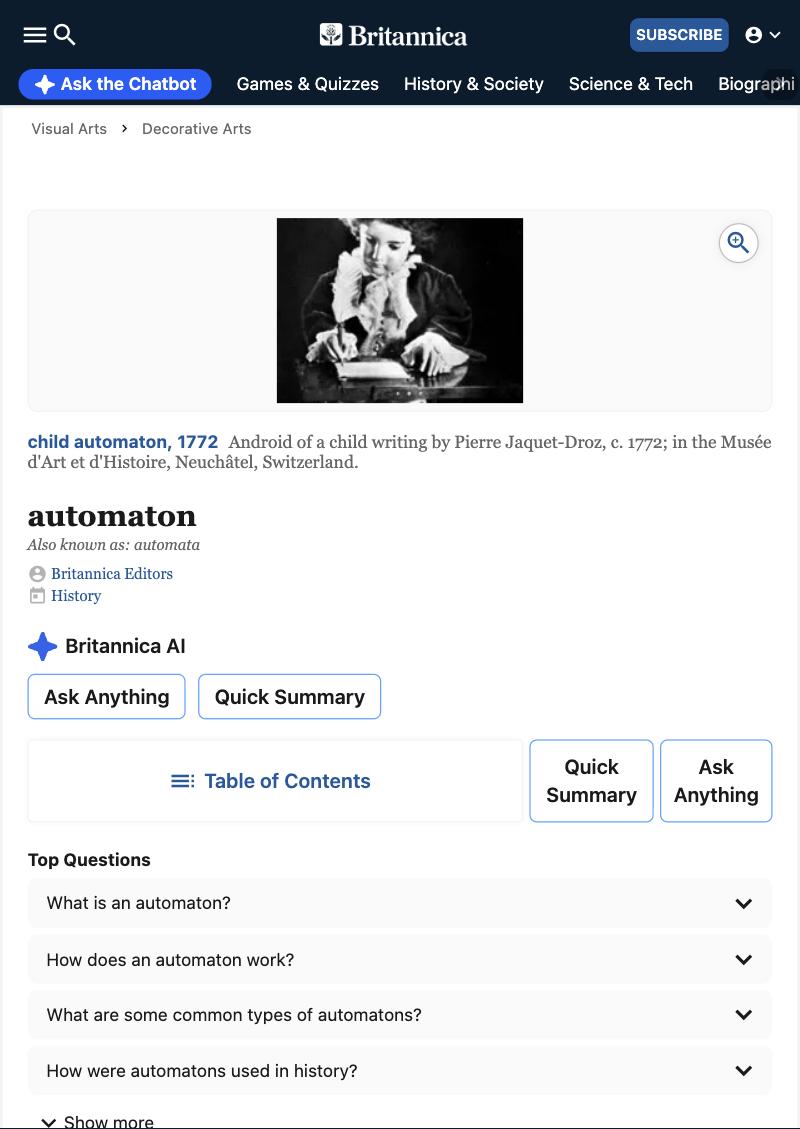
Britannica’s page on automata
It is a marvel, and a dead end. The boy can write one thing, the one his cams and gears were cut to write. Ask him for anything else and he sits there. In the nineteenth century a mathematician saw the same limit in a far more ambitious machine. Ada Lovelace, describing Charles Babbage’s design for an Analytical Engine in a memoir of 1842, wrote what became a famous warning: “The Analytical Engine has no pretensions to originate anything. It can do whatever we know how to order it to perform.”[8] We know her words because Alan Turing quoted them.
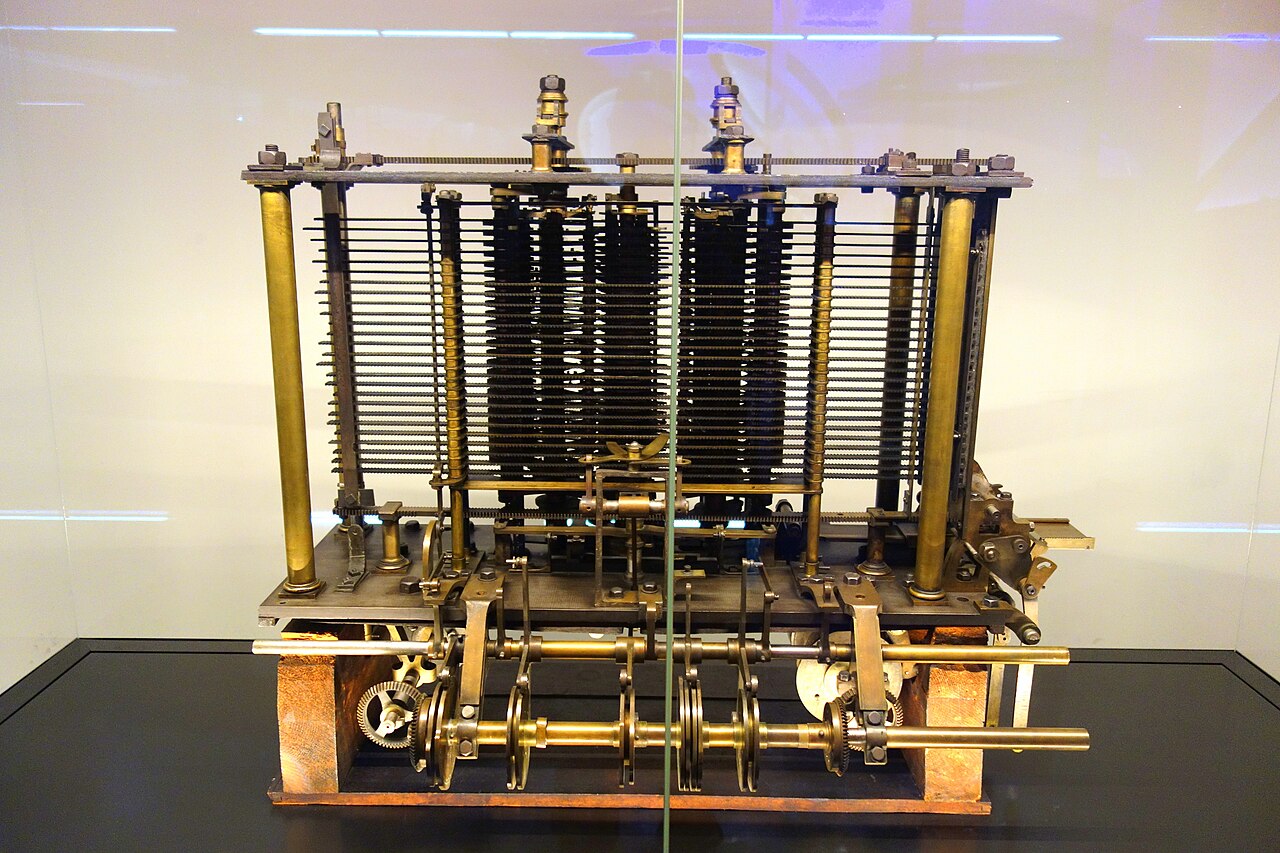

Ada Lovelace

Alan Turing
Turing did so in 1950, in a paper in the journal Mind that opens with the sentence, “I propose to consider the question, ‘Can machines think?’”[8] Lovelace’s line was one of the objections he set out to answer. And in answering, he sketched, with astonishing accuracy, the way we work with AI agents today.
Rather than program an adult mind, he suggested, “why not rather try to produce one which simulates the child’s?” and then teach it. “One must experiment with teaching one such machine and see how well it learns.” He even imagined how a machine might be instructed. Suppose the teacher says to it, “Do your homework now.” The instruction becomes one of the machine’s established facts, and “the homework actually gets started, but the effect is very satisfactory.”[8]
Read that again. A person says, in ordinary words, what they want done. The machine takes the instruction and starts the work. That is a delegation, in 1950, seventy-six years before Asha’s Monday. Turing also guessed that machines would eventually be able to improve themselves. By observing its own results, he wrote, a machine “can modify its own programmes so as to achieve some purpose more effectively. These are possibilities of the near future, rather than Utopian dreams.”[8]
The paper is best known for the “imitation game”, in which a questioner types to two hidden players, one of them a machine, and tries to tell which is which. Turing proposed it to replace the slippery question of whether machines “think” with one that could actually be tested.[8] But the passages that matter most for this article sit further in, where he turns from proving to teaching.
Turing also had a very modern attitude to being wrong. “Machines take me by surprise with great frequency,” he admitted, mostly because “I do not do sufficient calculation to decide what to expect them to do.”[8] Anyone who has watched an agent take an unexpected route through a task will recognise the feeling. It is one reason this article keeps coming back to checking.
And he wondered where to begin. “We may hope that machines will eventually compete with men in all purely intellectual fields. But which are the best ones to start with?” Some people, he noted, think a very abstract activity such as chess would be best. Others hold that it is better to “provide the machine with the best sense organs that money can buy, and then teach it to understand and speak English.” His verdict: “I think both approaches should be tried.”[8] Both, as it turned out, were.
Shakey, the shaky genius
The first machine to bring these threads together was a wobbly box on wheels. SRI International, then a research institute in California, built Shakey between 1966 and 1972, and describes it as “the first mobile robot with the ability to perceive and reason about its surroundings.” It could plan, find routes, and rearrange simple objects. In 1970 Life magazine called it the “first electronic person”. It was inducted into Carnegie Mellon’s Robot Hall of Fame in 2004, and now lives at the Computer History Museum.[9]
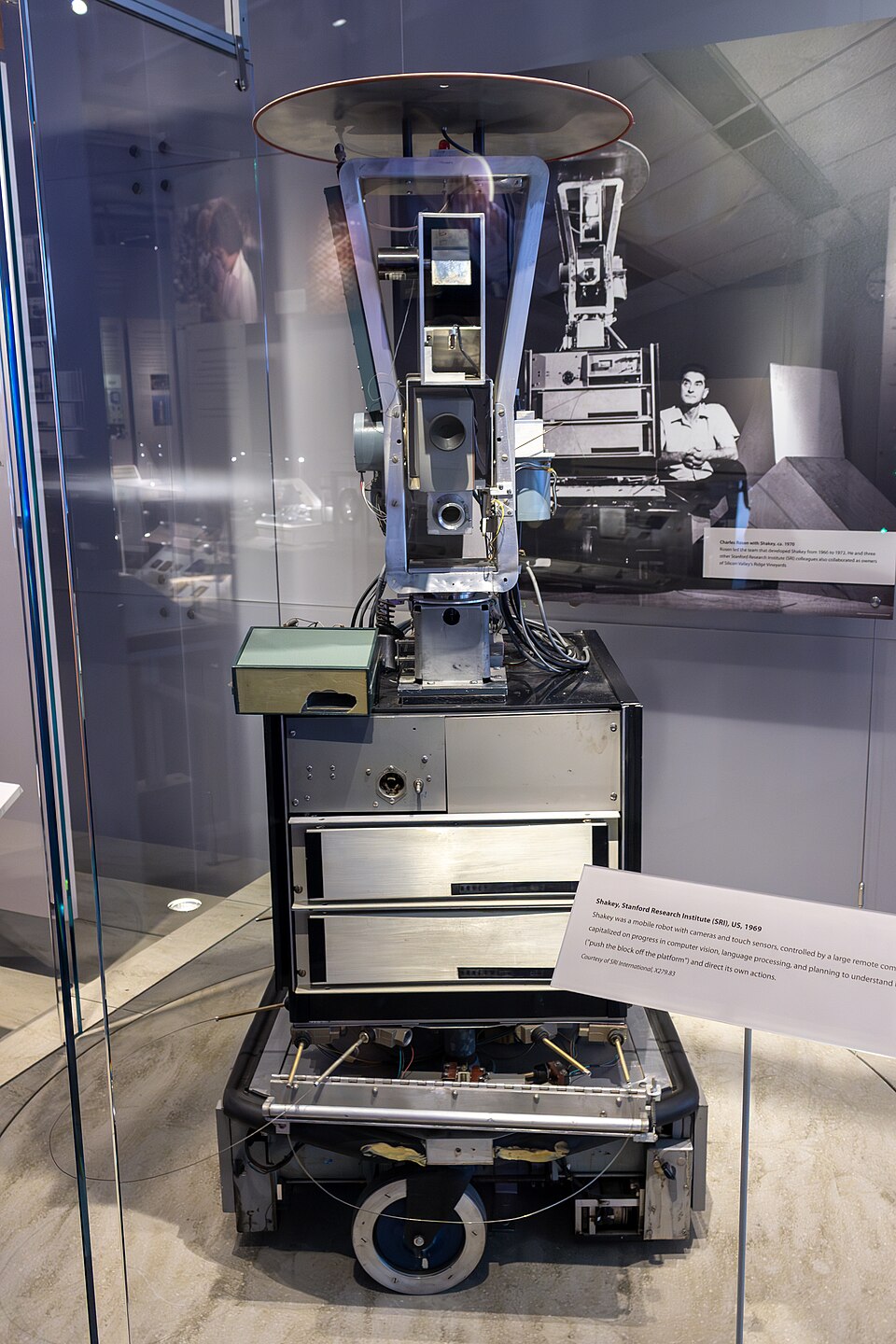
Shakey was slow, and it earned its name: it shook as it moved. But the design was right. It looked at a room, formed a plan, acted, and checked the result. We will meet the same four beats again, in software this time.
The lesson of Shakey is that intelligence for acting is a different thing from intelligence for answering. It needs a plan, a way of sensing what is really there, a check on whether the plan worked, and a way to recover when the world refuses to match the plan. That last part is the hard part, then and now, and it is why people who work with agents spend so much time on limits and hand-backs.
Between Shakey and today lies a long story of setbacks, breakthroughs and patient work that would fill a book, and we will not try to squeeze it in here. Our Agentic AI 101 and Welcome to the world of AI cover the technical journey. What matters for this story is where the road came out.
ERA 1
Made to perform
Wind it up and it repeats one act. Wonderful to watch; useless for anything new.
Peacock fountains, the writing boy
ERA 2
Made to reason
Machines that plan a route, weigh options and change course when the world changes.
Shakey, 1966–72
ERA 3
Made to work with us
Systems that take a goal, use real tools and hand back finished work for a person to approve.
The agents of 2026
From answering to acting
For a few years, the AI most people met was an assistant: you type, it replies. Gartner, the research firm, is precise about what that is and is not. AI assistants, it says, “simplify tasks and interactions for users but depend on human input and do not operate independently.” They are “the precursor to agentic AI.”[10]
An agent is the next step. Gartner’s wording: “Adding task specialization capabilities evolves AI assistants into AI agents. These AI agents have the capacity to operate and perform complex, end-to-end tasks.” Its example is a cybersecurity agent that scans network traffic, system logs and user behaviour in real time, then “assesses and initiates a response as appropriate.”[10]
| AI assistant | AI agent | |
|---|---|---|
| Who starts the work? | You ask; it answers. | You set a goal; it plans the steps. |
| What does it touch? | Mostly words on a screen. | Real tools: calendar, files, databases, other apps. |
| When you walk away… | It waits for your next message. | It keeps going until the job is done or it needs you. |
| What comes back? | A reply to read. | Finished work to check, with a trail of what it did. |
| Who is in charge? | You, every turn. | You, at the gates you choose. |
The split follows Gartner’s definitions (assistants “depend on human input and do not operate independently”); the rows and wording are our own summary.
Gartner also warns about a marketing trap. “The most common misconception is referring to these AI assistants as agents,” it says, “a misunderstanding known as ‘agentwashing.’”[10] It is a useful phrase to keep in your pocket. If a product only answers questions, it is an assistant, however grandly it is named.
How an agent works, in five beats
Under the hood, agents follow Shakey’s old rhythm. You give a goal. The agent breaks it into steps. It uses tools to carry them out: a calendar, a spreadsheet, a search, another program. It checks whether the result is what you wanted, adjusts, and tries again. And at the moments that matter, such as sending, paying or sharing, it stops and asks you.
One goal, five beats: booking a team offsite
Here is how the loop would look on a real job. Asha says: “Find and shortlist venues for a one-day team offsite in November, for twelve people, within our budget.” That is the goal.
- Plan. The agent splits the job: find dates when twelve calendars are free, search venues, check prices and travel times, compare.
- Act. It reads the team’s calendars through a calendar tool, searches venue listings, and collects prices.
- Check. Two venues turn out to be too far away and one is over budget. The agent drops them and searches again.
- Gate. It comes back with a shortlist of three, the reasons, and the sources for each price. Nothing has been booked or paid.
- Decide. Asha picks one and says “book it”. Only now does the agent take the irreversible step, and it tells her exactly what it did.
This is an illustration, not a specific product’s output. The point is the shape: the machine does the legwork, and the person holds the decisions that cost money or affect other people.
Three questions to spot the real thing
When a product claims to be an agent, ask three questions. Can it use real tools, or does it only chat? Can it carry out several steps on its own towards a goal? And can you see, afterwards, exactly what it did? A yes to all three means you are probably looking at an agent. A no to any of them means you are probably looking at an assistant, which may still be useful, but is a different animal.
The plumbing of teamwork
A clever agent is not much use if it cannot reach your files, your calendar or your company’s systems. For a while, every connection was hand-built. On 25 November 2024, Anthropic, the maker of Claude, described the problem in one sentence: “Every new data source requires its own custom implementation, making truly connected systems difficult to scale.” Its answer was the Model Context Protocol (MCP), “a new standard for connecting AI assistants to the systems where data lives, including content repositories, business tools, and development environments.” Block and Apollo were named among the early adopters.[11]
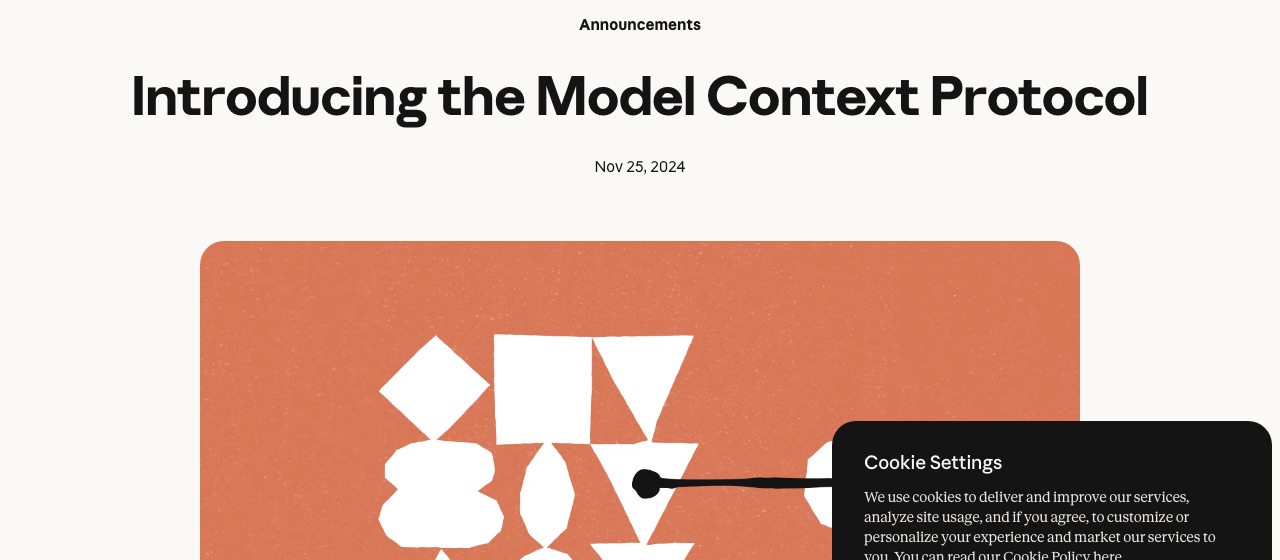
The easiest way to picture it is a wall socket. Before standard sockets, every appliance came with its own plug and every house needed its own wiring. With one standard, any appliance works in any room.
Before: every pair needs its own cable
4 × 5 = 20 custom connections
After: one standard plug
4 + 5 = 9 connections
Illustration with made-up apps and tools to show the arithmetic. The problem it draws is the one Anthropic describes: every new data source needing its own custom implementation.
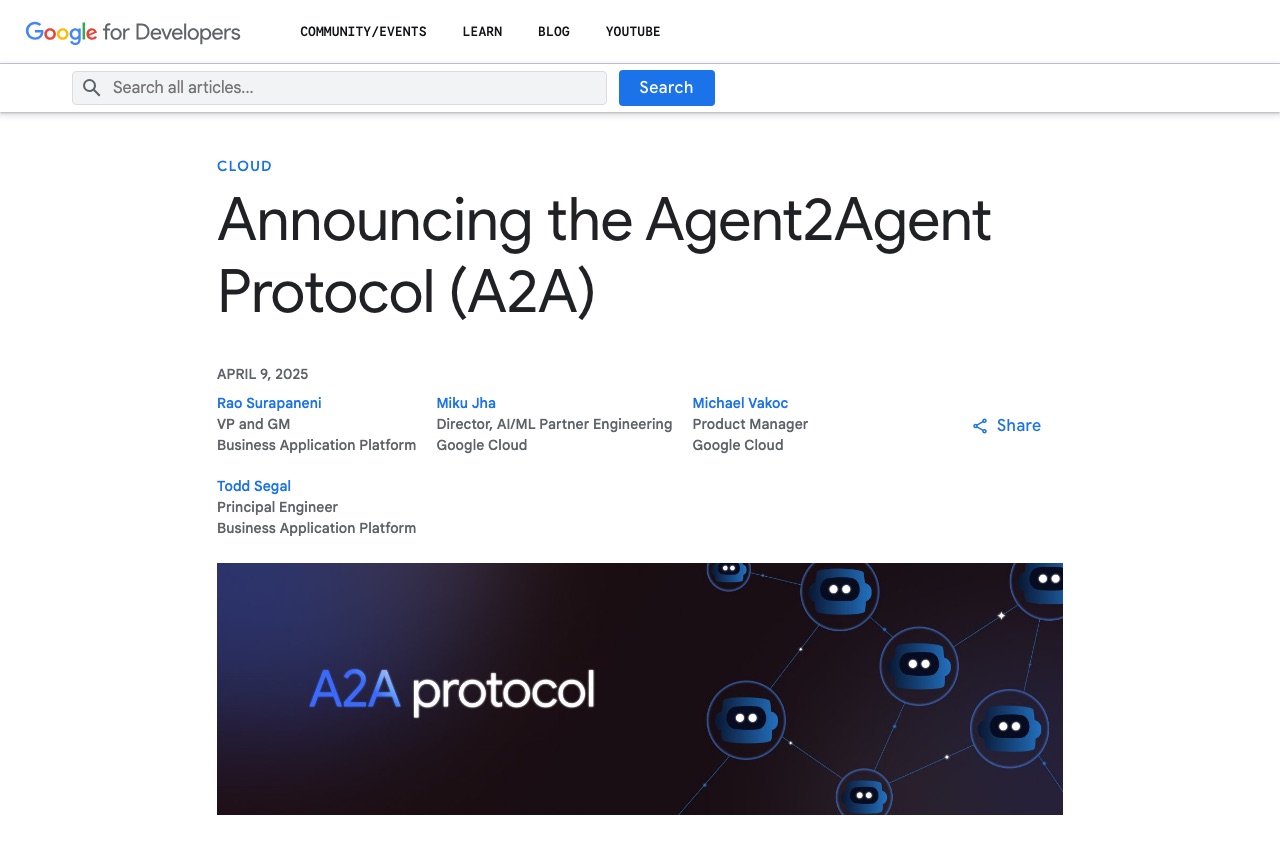
About four and a half months later, on 9 April 2025, Google introduced a companion idea: Agent2Agent (A2A), for agents to talk to each other. Its announcement calls A2A “an open protocol that complements Anthropic’s Model Context Protocol (MCP), which provides helpful tools and context to agents.” Its example is a hiring manager who asks their agent to find candidates for a role. That agent collaborates with specialised agents to source candidates, presents suggestions, then coordinates more agents to schedule interviews and facilitate background checks.[12]
Hiring manager
“Find candidates for this role.”
The manager’s own agent
Plans, delegates, brings back suggestions
Sourcing agent
finds candidates that match the criteria
Scheduling agent
lines up interviews
Background-check agent
handles the checks, with consent
The example is Google’s, from its A2A announcement: the agent collaborates with specialised agents to source candidates, then coordinates further agents to schedule interviews and facilitate background checks. The drawing is ours.
Standards work best when nobody owns them. On 9 December 2025, the Linux Foundation announced the Agentic AI Foundation, anchored by three founding contributions: Anthropic’s MCP, Block’s goose, and OpenAI’s AGENTS.md. Its platinum members are Amazon Web Services, Anthropic, Block, Bloomberg, Cloudflare, Google, Microsoft and OpenAI. At that point, it reported, there were “more than 10,000 published MCP servers”, and AGENTS.md, a simple file that gives coding agents a project’s house rules, had been adopted by more than 60,000 open source projects. MCP itself had been taken up by Claude, Cursor, Microsoft Copilot, Gemini, VS Code and ChatGPT.[13]

A few years ago, no two rival companies would have agreed on how their AI should talk to the world. That Anthropic, OpenAI, Google, Microsoft and Amazon now sit in one foundation is itself a piece of the future arriving. It also explains why an agent you use at work could soon reach the same tools as an agent you use at home.
Back to the offsite, under the bonnet
Return to Asha’s offsite. Her agent reads calendars and email through connectors that speak MCP: each one is a small program that offers a tool, such as “list events” or “search messages”, in the standard way. If a venue’s booking system ever offered an A2A-style agent of its own, Asha’s agent could ask it about availability directly, agent to agent, rather than scraping a web page. That last step is our imagination, using the pattern Google’s hiring example describes, not a claim about any real venue.
Why standards matter to you
You will never read a protocol specification, and you do not need to. But standards change your life in three quiet ways. First, they reduce lock-in: a tool built once for the standard can be used by many agents, so you can switch assistants without losing your connections. Second, they lower the cost of connecting things, which is why small firms can now reach tools that once needed a team of integrators. Third, and this is the one to keep in mind, they multiply the number of things an agent can touch. More connectors mean more doors, and every door needs a lock. That is the reason the risk section below spends so long on permissions.
Who is on the job today
So what are agents actually doing? The honest answer has two halves: a growing list of real examples, and a lot of forecasting that should be read as forecasting. We will keep the two apart.
Assistants and agents that plug into tools
Claude, Cursor, Microsoft Copilot, Gemini, VS Code and ChatGPT are all named as having adopted MCP, the shared plug for connecting AI to tools and data.
Source: Linux Foundation
Documentation agents
Novo Nordisk’s NovoScribe drafts regulatory documents from expert-approved text, for people to review.
Source: Anthropic case study
Security agents
Gartner’s own example of a task-specific agent: one that scans network traffic, logs and behaviour, then starts a response.
Source: Gartner
Hiring and scheduling agents
Google’s example: a manager’s agent works with sourcing, scheduling and checking agents.
Source: Google
Everyday work assistants
Microsoft studies how people use Copilot at work, and how the most advanced users delegate multi-step workflows to agents.
Source: Microsoft
Local, open agents
goose from Block is an open source, local-first agent framework built on MCP.
Source: Linux Foundation
For our own reporting on the newest agents, see our brief on OpenAI’s Dots, an always-on agent, and our article on Meta’s Muse, an agent aimed at everyday consumers.
Look across the cards and one pattern repeats. The agent prepares: it drafts the report, compares the options, scans the logs, lines up the interviews. A person approves. Nobody in these examples claims that the person has gone away. If you want a mental model, think of hiring a very fast intern: you would give the intern the research and the first draft, you would not give them the company credit card on day one, and you would read what they wrote before it went to the client.
A case study: ten weeks to ten minutes
The most striking example in our sources comes from medicine. Novo Nordisk, the maker of Ozempic, has to produce enormous amounts of paperwork before a medicine reaches patients. The centrepiece is the clinical study report, which summarises a drug trial and can run to 300 pages. According to Anthropic’s case study, writers averaged only 2.3 of these a year.[14]

Novo built a platform called NovoScribe, with Claude Code, on Amazon Bedrock and MongoDB Atlas. It combines retrieval of expert-approved text with the details of each case to draft regulatory documents. The headline claim: time spent producing clinical study documentation fell “from 10+ weeks to 10 minutes.” A Novo director is quoted saying Claude cut writing times on these reports by 90% “so we can get documentation directly into human hands for review and approval.”[14]
BEFORE
10+ weeks
to produce clinical study documentation; writers averaged 2.3 clinical study reports a year, each up to 300 pages.
AFTER (as Anthropic reports it)
10 minutes
for the same documentation, drafted by NovoScribe, then handed “directly into human hands for review and approval”.
How fast is this spreading?
Here we have to be careful, because forecasts are easy to mistake for facts. In August 2025 Gartner predicted that “40% of enterprise applications will be integrated with task-specific AI agents by the end of 2026, up from less than 5% today.” That is a prediction, made a year ago, not a measurement of what has happened. It came with a five-stage picture of where agentic AI is heading, which we show below.[10]
END OF 2025
Assistants everywhere
Most enterprise apps have an embedded assistant. It helps, but “does not operate independently”.
BY END OF 2026
Task-specific agents
Up to 40% of enterprise apps include one, up from less than 5%.
BY 2027
Agents that team up
One-third of agentic implementations combine agents with different skills.
BY 2028
Ecosystems across apps
Networks of agents work across applications; a third of user experiences shift to agentic front ends.
BY 2029
A new normal
At least 50% of knowledge workers will develop new skills to work with, govern or create agents on demand.
These are Gartner’s predictions, published on 26 August 2025 (updated 5 September 2025), not measurements. Gartner also says the most common misconception is calling assistants “agents”, which it names “agentwashing”.
Gartner’s most optimistic scenario is that agentic AI could drive approximately 30% of enterprise application software revenue by 2035, surpassing $450 billion, up from 2% in 2025. It is a “best case” figure and should be read that way.[10]
In the next section we meet six of these agents up close.
Six agents you can meet today
Theory is useful; a name and a face are better. Here are six working agents from six corners of the working day: engineering, customer service, sales, the desktop, company knowledge, and the always-on chief of staff. For each we say what its maker describes, how it works, what it reportedly achieves, and where to look twice. They are a spread of kinds, not a league table, and they change fast, so check the maker’s page before you decide anything.
1. Devin: the engineer that tests its own work
Cognition’s Devin is the agent many people picture when they hear “AI software engineer”. Its home page puts it plainly: “Devin runs in the cloud or on your machine, tests in its own browser, and won’t stop until the PR is ready to merge.”[15] (A PR, or pull request, is a proposed change to a codebase that a colleague reviews before it goes in.)
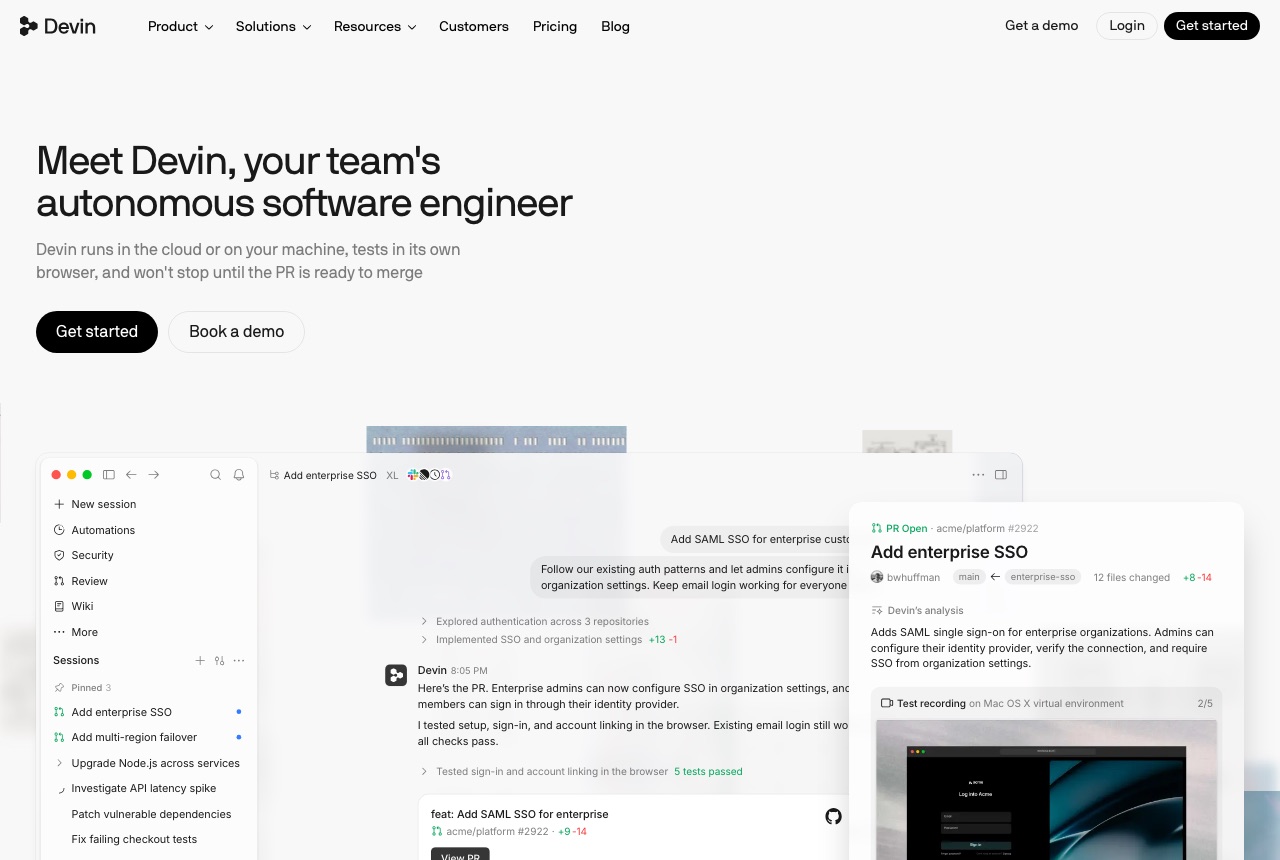
The company says Devin “spins up its own Windows, Mac, and Linux virtual machines as needed to build, test in its browser, and record itself clicking through what it built.” Hand it a big task and it “splits it across parallel cloud agents, manages them, and reports back”, even “when your laptop is closed”. You can tag @Devin in Slack or Teams, where it “reads the thread, responds to follow-ups, and gets to work”, and you can set up automations so that it “handles bugs, failed CI, and other alerts as they land.” (CI, or continuous integration, is the set of automatic checks that run on every change.)[15]
What is it good at? Cognition’s documentation calls Devin “an autonomous AI software engineer that can write, run and test code” and offers an honest rule of thumb: “if you can do it in three hours, Devin can most likely do it.” Its list of strengths is practical rather than grand: tickets from Linear or Jira, bug reports, code migrations and refactors, framework upgrades, unit tests, pull-request review and documentation.[16]
The same page is candid about the human’s job, which is to brief and to check: “Write clear prompts with explicit completion criteria”, and “Make tasks easy to verify—e.g. checking that CI passes.”[16] That is the delegation card from earlier in this article in engineering dress. Notice, too, where the work ends: a change that is “ready to merge”. Some retellings of tools like this say they push fixes live “completely unsupervised”. Cognition’s own pages describe something narrower and wiser: work that arrives as a pull request, with automated checks, for people to review.
Fact sheet · Devin (Cognition)
- What it is
- An “autonomous software engineer” (Cognition’s words)
- Works in
- Its own cloud virtual machines and browser; also on your machine; Slack and Teams
- Good at
- Bug tickets, migrations, tests, pull-request review, documentation
- Human gate
- A pull request “ready to merge”; clear completion criteria; easy-to-verify tasks
- A good first job (ours)
- One well-described bug that already has a failing test
- Look twice at (ours)
- The “three hours” rule is a rule of thumb from the maker, not a guarantee
2. Salesforce Agentforce: the agent that lives inside the customer system
Salesforce calls Agentforce “the AI agent platform that delivers 24/7 autonomous support at enterprise scale”, and its pitch is a clean one: “Lose the rigid chatbots and hold times. Extend agents anywhere customers are: On the web, on the phone, or in apps. Let humans do what they do best, and let Agentforce do the rest.”[17]
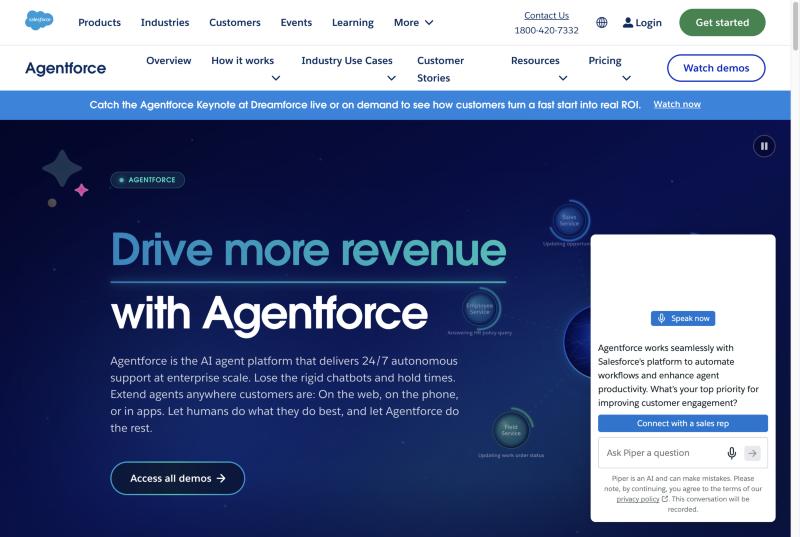
The page lists six kinds of job: customer service (“answering questions, resolving cases, managing orders and troubleshooting issues”), employee support, appointment scheduling, sales development (“autonomously answering product questions, handling objections and booking meetings for sales reps”), product recommendation and event support. Each is a narrow role with a clear finish line, which is exactly what the evidence in this article says agents do best.[17]
The platform side is where Salesforce is most specific. An Agent Builder lets a team “configure Agentforce, Subagents, Actions, and Instructions in a few clicks”; Agent Script “gives builders precise control to create business-ready agents that deliver reliable results”; Agentforce Voice brings the same agents to phone calls; Observability lets you “monitor, analyse, and optimise agent performance in near real time”; MCP support connects agents to outside tools; and Multi-Agent Orchestration lets you “build a collaborative AI agent team”. You have met the last two ideas earlier in this article, in the plumbing section. Salesforce also says that “over 18K companies already run on Agentforce”, which is the company’s own count.[17]
What about the human gate? Salesforce’s FAQ describes agents that handle tasks “proactively within set guardrails” and that, “when faced with complex issues beyond their scope, they can escalate the matter to human agents.”[17] There is a lesson in the design. An agent that lives inside a company’s customer system can only reach what that system lets it reach, which makes its limits easier to set and to inspect. That is our reading, not Salesforce’s claim, but it is a good rule of thumb for any agent you deploy: the smaller and clearer its world, the easier it is to trust.
Fact sheet · Agentforce (Salesforce)
- What it is
- An AI agent platform for sales, service, HR and more
- Works in
- Salesforce, on the web, the phone and in apps
- Good at
- Cases, customer questions, appointments, lead follow-up, help desks
- Human gate
- Set guardrails; escalation to human agents; observability tools
- A good first job (ours)
- Answering the ten questions your customers ask most
- Look twice at (ours)
- “Over 18K companies” is Salesforce’s own count; ask for references in your industry
3. 11x: the digital sales development rep
11x’s slogan is “Digital Workers, Human Results”. Its site names two workers: Alice, whom customers quote as handling outbound prospecting, and Julian, which answers inbound calls.[18]
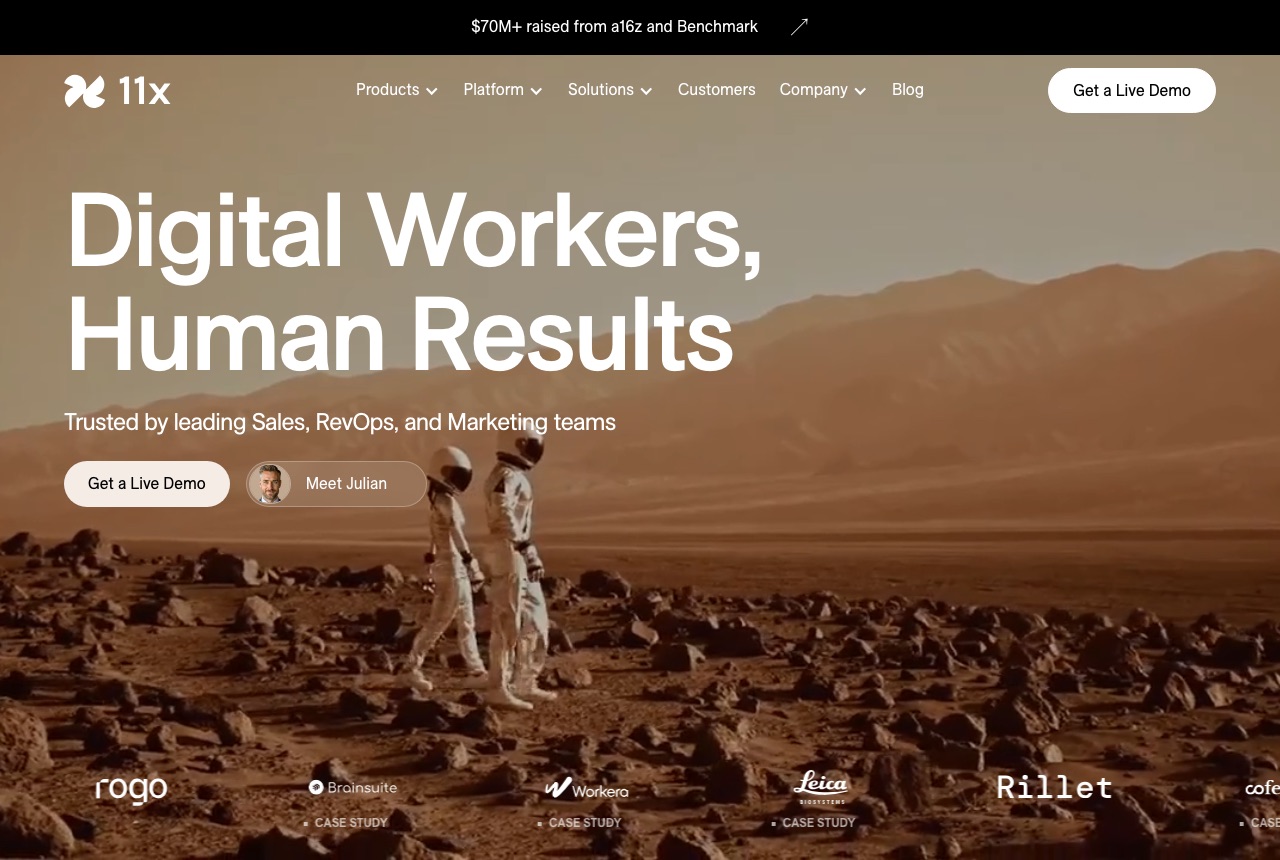
The platform, as described on the page, works in four beats. Identify: “Filter millions of signals across 50+ data sources to surface buyers who match your ICP” (ICP means ideal customer profile). Research: “Enrich every prospect automatically, from company news and tech stack to org changes and competitive signals.” Personalize: “Every message is written for your specific prospect. No templates or generic pitches.” Engage: “Run multi-channel sequences across email, phone, chat, social networks, SMS and WhatsApp. Every channel picks up where the last left off.”[18] Read those four beats slowly and you will see the same loop as in section 6: plan, act, check, hand back.
The results on the page are worth reading with care, because of who says them. The site shows figures such as “1.5x increase in qualified meetings”, “$1M+ pipeline generated in first 3 months” and “35% of pipeline generated by 11x within first 3 months”, alongside quotes from customers: one says qualified meetings rose “5x”, another reports “a 9.7% reply rate for outbound emails … nearly double the industry average”, another says it is “converting over 50% of demos to subscriptions”.[18] These are testimonials that 11x chose to publish. They show what is possible, not what is typical.
A note on manners, because an agent that writes to strangers at scale carries a different kind of risk from one that drafts your own email. Unsolicited messaging is regulated differently in different countries, and people rightly resent being spammed by machines. A sound practice for any outreach agent is to be honest that a message is automated, to respect opt-outs at once, and to keep a person responsible for who is contacted and why. Take your own advice on the rules where you operate.
Fact sheet · 11x
- What it is
- “Digital workers” for sales, RevOps and marketing teams
- Works in
- Email, phone, chat, social networks, SMS and WhatsApp
- Good at
- Finding and researching prospects, personalised outreach, answering inbound calls
- Human gate
- Not detailed on the page we read; ask the vendor how approvals and opt-outs work
- A good first job (ours)
- Reviving a list of old leads with messages a person has approved
- Look twice at (ours)
- Every headline result is a chosen customer quote, not an independent test
4. Claude Cowork: the agent that works across your files and apps
Anthropic describes Claude Cowork in three sentences: “Claude Cowork completes tasks you can steer from anywhere. Give it a goal, and it works across your files and tools. You come back to polished work for your review.” (Claude is Anthropic’s AI; we also have a beginner’s guide to using Claude.)
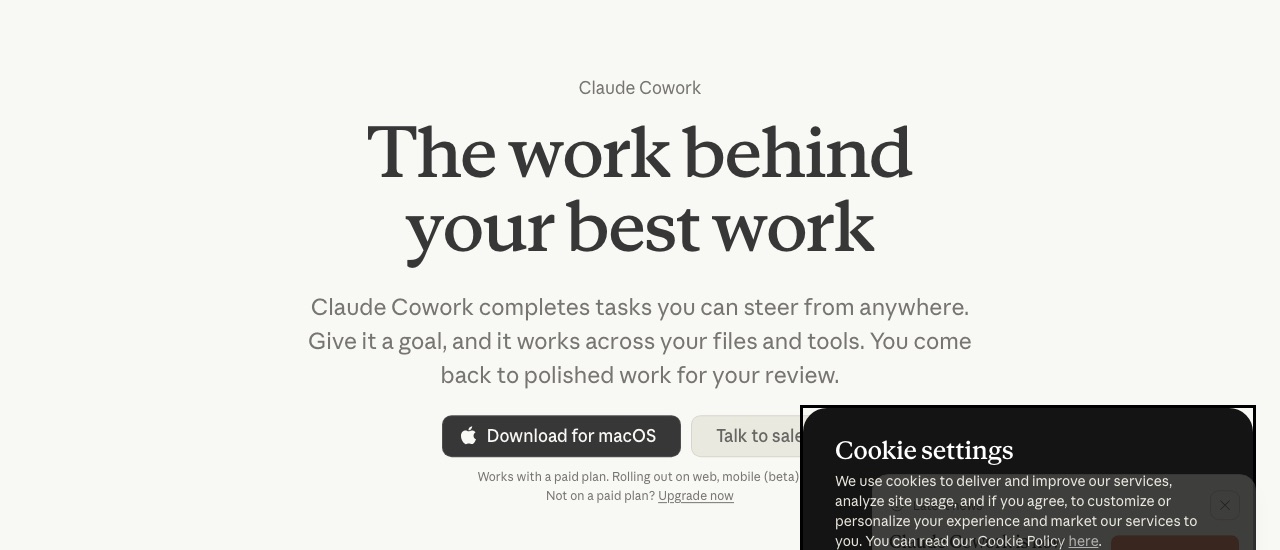
Cowork is worth a careful look because Anthropic’s help pages are unusually specific about how it is built, and the details matter. Sessions can run in the cloud or on your own computer. In a cloud session, “the agent loop and code execution run in an isolated, temporary sandbox on Anthropic-managed infrastructure”. In a local session, “the agent loop runs natively on the device”, with access “gated by an application-layer permission system” that enforces your connected-folder rules, and “code execution runs in an isolated virtual machine (VM)”: “a dedicated Linux VM, isolated from the host operating system by the platform’s hypervisor.”[19]
Then comes the distinction that many summaries blur. When there is no direct connector to a tool, Claude can use your computer as a person would: “clicking, typing, and navigating your screen.” And for that, Anthropic says plainly: “Computer use has no sandbox between Claude and your applications.” Its safeguards are per-app permissions (“Claude asks before accessing each application”), a blocklist, some sensitive apps blocked by default, and an action review that “scans for signs of prompt injection”. It adds a caution that we would like every agent maker to copy: “this capability is still early, and attacks are constantly evolving—stay cautious.”[20]
In short: code runs in a VM; computer use does not. Anthropic advises against using computer use for “managing financial accounts or investments”, “handling legal documents or contracts”, “processing medical or health information” and “interacting with apps containing personal information of others”, and recommends starting “with simple tasks like research or organizing rather than complex multi-step workflows.” It was available on Pro and Max plans only when we read the page, on macOS and Windows, and it is in beta.[20]
Fact sheet · Claude Cowork (Anthropic)
- What it is
- A task agent: “Give it a goal, and it works across your files and tools”
- Works in
- Claude Desktop, folders you connect, connectors, a built-in browser; computer use (beta)
- Good at
- Multi-step document and desktop work; Anthropic suggests starting with research or organising
- Human gate
- Per-app permission, blocklist, action review, a VM for code; you can stop it at any point
- A good first job (ours)
- Organise a folder of downloads and summarise what is in it
- Look twice at (ours)
- Computer use has no sandbox: keep banking, health and legal apps closed
Made by Anthropic. MSRX is independent of Anthropic.
5. Glean: the company’s memory, with permissions attached
Glean sells what it calls enterprise AI “that understands your company”. Its headline: “Complete context that makes AI work at enterprise scale.” The demo question on its home page is the kind a busy manager actually asks: “What changed last week that’s hitting support, sales, and churn?”, answered from tools such as Slack, Google Drive, Jira, Confluence, SharePoint, GitHub and Salesforce.[21]
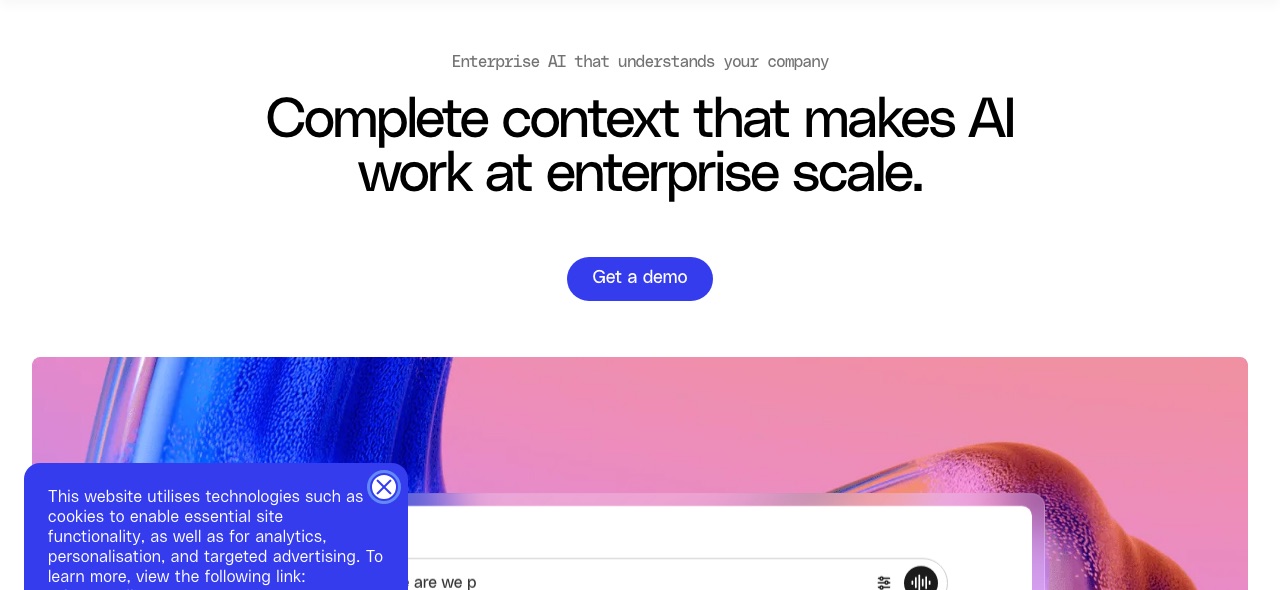
The idea behind it is simple and powerful: an agent is only as good as the context it can see. A general assistant knows the internet; Glean’s pitch is an agent that also knows your documents, tickets and chats. Its agents page describes “an agentic engine” that lets agents “reason through tasks, plan next steps, and take action using enterprise context”, an agent builder for “reasoning-based agents and complex workflows”, orchestration that will “trigger agents from key events, route tasks between agents, and connect to external systems”, and “275+ app connectors for personalized and permissions-enforced enterprise search.”[22]
The phrase to hold on to is permissions-aware. Imagine a company brain that could read everything, including the salary spreadsheet and the private legal memo, and answer anyone’s questions from it. That would be a disaster. Glean says the opposite: “Users only see what they’re allowed to see.” It also promises “full observability”: “Track every query, answer, and action.” The site lists compliance credentials including ISO 42001, HIPAA, TX-RAMP Level 2, SOC 2 Type II, ISO 27001 and GDPR, which are the company’s own statements; for the last, the audit reports are what to ask for.[21] Its agents page adds monitoring of “adoption, error rates, upvotes, downvotes, and ROI”, so that owners can “double-down on what’s working and fix what isn’t.”[22]
Fact sheet · Glean
- What it is
- An enterprise AI platform with search, an assistant and agents built on your company’s context
- Works in
- Your company’s connected work apps (Slack, Drive, Jira, Confluence, SharePoint, GitHub, Salesforce and more)
- Good at
- Pulling scattered files and chats into one answer, brief or research summary
- Human gate
- Permission-aware access; every query, answer and action tracked; agent governance
- A good first job (ours)
- “Summarise everything we know about customer X, with links”
- Look twice at (ours)
- An agent that reads everything is only as safe as your permissions are tidy: tidy them first
6. OpenAI dots: the always-on chief of staff
The newest of the six arrived on 29 September 2026. OpenAI calls dots “remarkably capable, always-on agents built to handle everything.” They are, it says, “frontier intelligence that have your back”: “Powered by GPT‑6 Astra, they have their own cloud computer, learn from feedback over time, and can work towards your goals 24/7. Through our ecosystem of plugins, they can readily connect to over 4,000 apps.”[23]
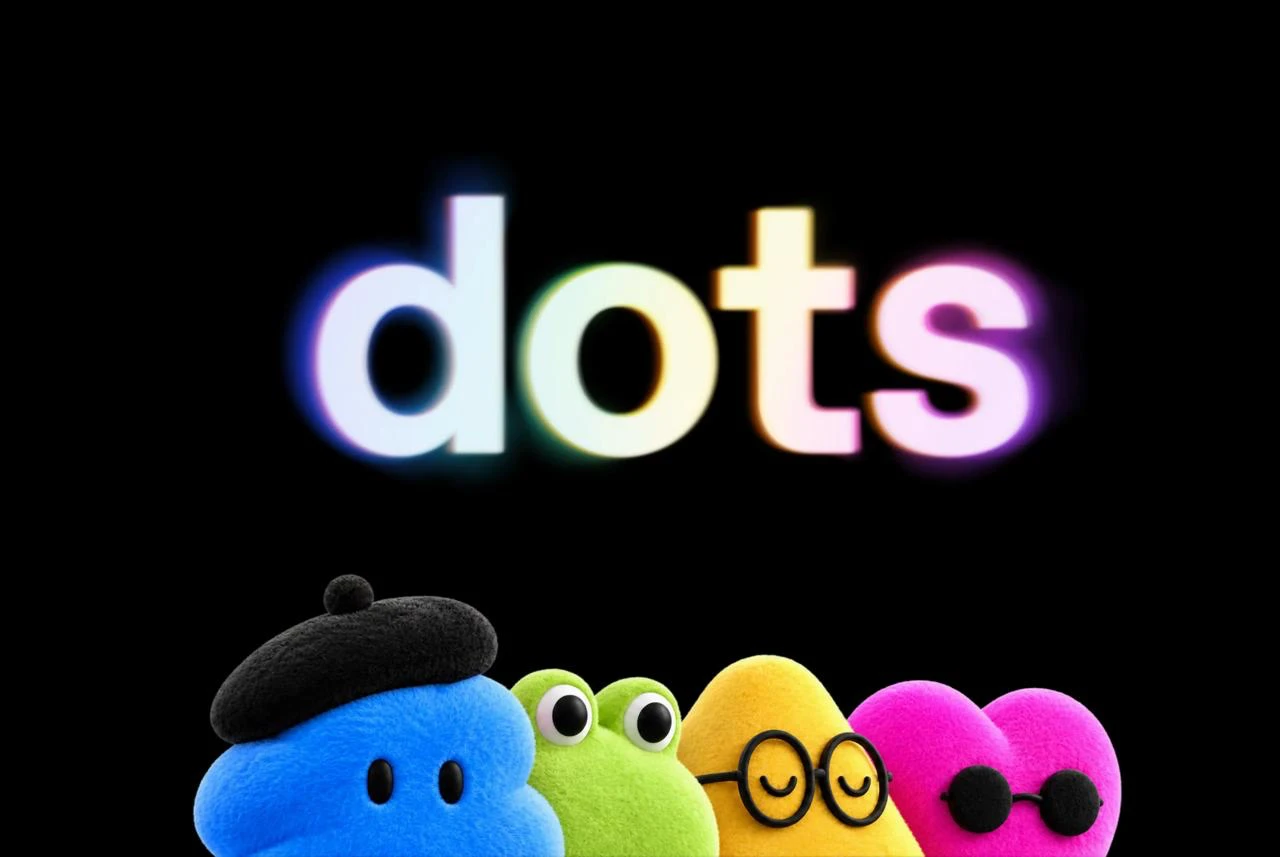
You reach a dot through ChatGPT, Slack or Teams, or “hop on a voice call”. You start with a “primary dot”, give it a name and make it your own, and OpenAI says it envisions “teams of dots working together” later. The company’s picture of a good day: “A bug appears in Slack, and dots immediately start investigating. A new design arrives, and dots turn it into a working app while the team focuses on customer feedback.” And the example we like best is a small one: “an early tester’s dot noticed he’d forgotten to invoice a publication, prepared the invoice, and sent it after his approval.”[23] Notice the last four words. Even the marketing example has a human gate in it.
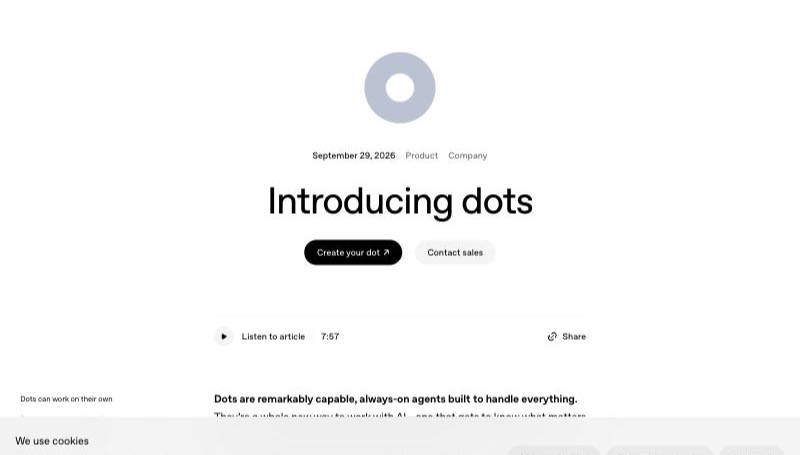
On safety, OpenAI’s companion post says each dot works on its own cloud computer, separate from the user’s, and that supported website sign-ins keep passwords out of the model’s context. While you are not working with a dot, it can do “proactive research” with read-only tools that, OpenAI says, cannot send messages, change app content or control a browser or computer. Before actions such as sending emails or changing files, a separate system called Auto-review checks the planned steps against your instructions, your Custom Rules and safety requirements. Purchases with saved cards need your approval, permanently deleting data needs confirmation every time, and changing a password or moving money between financial accounts is handed back to you.[24] OpenAI adds: “Dots can still make mistakes, so always review consequential work.”[23]
Availability, according to OpenAI: rolling out across Pro, Business Premium and Enterprise plans in eligible markets, with the first dot included in the plan “at no extra cost”.[23] It is a day old as we write. We found no independent testing of dots in the sources we read, and our news brief records one live-demo hiccup reported by an attendee, so treat the rest as promise, not proof. It arrived weeks after Meta’s Muse, which we cover in our article.
Fact sheet · dots (OpenAI)
- What it is
- “Always-on agents built to handle everything”, powered by GPT‑6 Astra
- Works in
- Its own cloud computer and browser; ChatGPT, Slack, Teams; 4,000+ apps through plugins
- Good at
- Ongoing projects: investigating bugs, preparing documents and invoices, keeping a plan in sync
- Human gate
- Auto-review; approval for purchases; deletions confirmed; password changes and money moves handed back
- A good first job (ours)
- Weekly: watch a shared inbox and prepare the follow-ups for your approval
- Look twice at (ours)
- Brand new, with no independent testing found; start on the lowest rungs of the permission ladder
Made by OpenAI. MSRX is independent of OpenAI.
Choosing between them
Put the six side by side and a pattern appears. They differ in where they work (a cloud computer, a customer system, your desktop, your company’s knowledge), in who they serve (an engineer, a service team, a sales team, an individual, a whole organisation), and in how they hand control back. What they share is the loop you met in section 6, and, in every case that we could read, a stated place where a person approves, reviews or takes over.
| Agent | Best first job | Where it works | The human gate, as its maker describes it |
|---|---|---|---|
| Devin | A bug ticket, a migration, tests | Its own cloud virtual machines and browser; Slack and Teams | A pull request “ready to merge”; clear completion criteria; you can follow and take over |
| Agentforce | Customer questions, meeting booking, HR or IT help desks | Inside Salesforce, on the web, the phone and in apps | “Set guardrails”; escalation to human agents; observability tools |
| 11x | Finding and contacting prospects; answering inbound calls | Email, phone, chat, social networks, SMS and WhatsApp | Not detailed on the page we read; its published results are customer testimonials |
| Claude Cowork | A goal that spans your files, documents and apps | Your desktop, folders you connect, connectors, a built-in browser | Per-app permission; a VM for code; Anthropic warns off finance, legal and medical use of computer use |
| Glean | Finding and pulling together company knowledge | Your company’s connected work apps | “Users only see what they’re allowed to see”; every query, answer and action tracked |
| OpenAI dots | An always-on chief-of-staff style helper | Its own cloud computer; ChatGPT, Slack and Teams | Auto-review; approval for purchases; deletions confirmed; passwords and money moves handed back |
A summary of what each maker says on the pages we read on 30 September 2026. The columns are our own; “best first job” is our suggestion, not a vendor claim. Not a ranking, and not a recommendation.
Before you choose any agent, ask five questions. What job is it for? Narrow beats vague. What can it touch? List the files, apps and accounts, and remove what it does not need. Who approves what? Decide which steps need your yes, using the permission ladder in section 14. Can I see the trail? If you cannot read what it did, you cannot check it. What does a mistake cost? If the answer is “a lot”, keep a human in the loop or choose a different job.
And a word about what is not on this list. There are many more agents than six, in every field, and new ones every week. Do not read the omission of a product as a judgement on it. Read the six as six doors into the same room.
Agents in India today: from a village WhatsApp to UPI
India is a good place to watch this story unfold, because the hard problems here are the everyday ones: many languages, patchy connectivity, and services that have to work for people who have never used an app to ask for help. It is also a very large market. At the India AI Impact Summit in February 2026, OpenAI’s chief executive Sam Altman said India accounts for “more than 100 million weekly active ChatGPT users”, second only to the United States, and that Indians account for the most students using ChatGPT. The same round-up notes a $1.1 billion state-backed venture fund for AI and advanced-manufacturing start-ups, a 17-billion-parameter model called Param 2 from the government-backed BharatGen consortium that “works across 22 languages”, and Sarvam’s teaser of its Kaze smart glasses.[25]

100 million+
weekly active ChatGPT users in India, second only to the US
Sam Altman, Feb 2026, via TechCrunch
24.51 billion
UPI transactions in August 2026, worth ₹29.82 trillion
AI in Asia, Sep 2026
22+
Bhartiya languages covered by Bhashini’s website-translation plugin
Bhashini (Government of India)
10 lakh+
users of the FarmerChat assistant since October 2024
Digital Green India, via Rural Voice
11
Indian languages in Sarvam’s voice models, used by Swiggy for ordering
Indian Retailer, Mar 2026
50,000+
Copilot licences each at Cognizant, Infosys, TCS and Wipro (200,000+ together)
Microsoft, Dec 2025
20 million+
monthly active users of Flipkart’s Super.money, which is rolling out shopping agents
StartupTalky, Sep 2026
350M+
conversations that Sarvam says its voice agents have handled
Sarvam’s own page
Each figure is as stated by the source under it, on the date shown, and several are the organisation’s own claims. They measure very different things and should not be added together.
What follows are eight examples, different in kind, from a government language mission to a shopping agent that may one day buy gold for you. Each teaches something about doing this well. As before, we say who is making each claim.
The language layer: Bhashini
Before any agent can help someone in India, it has to understand them, and that is the job of Bhashini. It is run under the Ministry of Electronics and Information Technology as the National Language Translation Mission, with the tagline “Harnessing technology to transcend language barriers”. Its home page lists services such as automatic speech recognition, text to speech, neural machine translation and transliteration; says its translation plugin can turn a website into “22+ Bhartiya languages”; and shows work in sectors from e-governance, health and agriculture to justice, fin-tech and education. It also announces a Sansad Bhashini initiative offering “AI-powered multilingual translation, transcription & summarisation for Parliament”.[26]
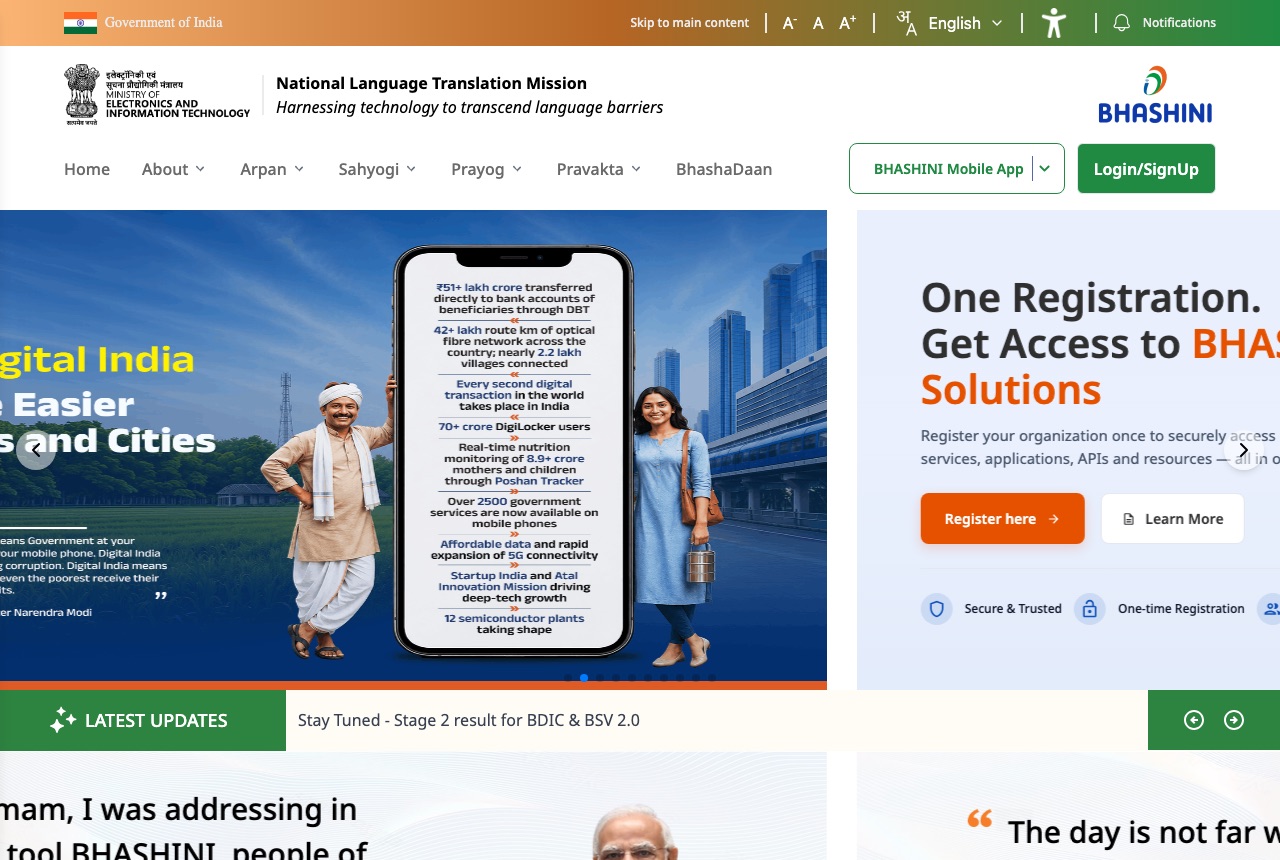
The site quotes the Prime Minister on what this could mean: “At Kashi-Tamil Sangamam, I was addressing in Hindi, but through AI tool BHASHINI, people of Tamil Nadu were listening to my address in Tamil simultaneously”, and “The day is not far when an address will be delivered in one language, and the public will listen in their own language in real time.” Both are shown as remarks from Mann Ki Baat on 31 December 2023.[26] For an agent, that is the essential ingredient: the ability to listen and reply in the language a person actually speaks.
Services it lists
Sectors where it says it is at work
From Bhashini’s own home page, read on 30 September 2026 (its list of AI services and the sectors under “How we’re making an impact”). Bhashini is a language layer that other tools, agents included, can build on.
हिन्दी
Hindi ●
বাংলা
Bengali ●
தமிழ்
Tamil ●
తెలుగు
Telugu ●
मराठी
Marathi ●
ಕನ್ನಡ
Kannada ●
മലയാളം
Malayalam
ગુજરાતી
Gujarati
ਪੰਜਾਬੀ
Punjabi
ଓଡ଼ିଆ
Odia
A sample of ten of India’s languages, in their own scripts. ● marks the six named in the report on Swiggy and Sarvam’s voice ordering; it is not a list of what any product supports. Jugalbandi covered 10 of India’s 22 official languages in 2023, and Bhashini says its plugin covers 22+.
Jugalbandi: a “chatbot plus plus”, in a Haryana village
In May 2023 Microsoft’s Source Asia published a feature from Biwan, a farming village in Haryana about two hours by car south of New Delhi. One farmer needed help applying for pensions for his aged parents. Another wanted to know why his government assistance payments had stopped. A university student needed a scholarship. “They all turned to Jugalbandi”, the report says, a generative AI chatbot for government assistance that “can understand questions in multiple languages, whether spoken or typed.”[27]
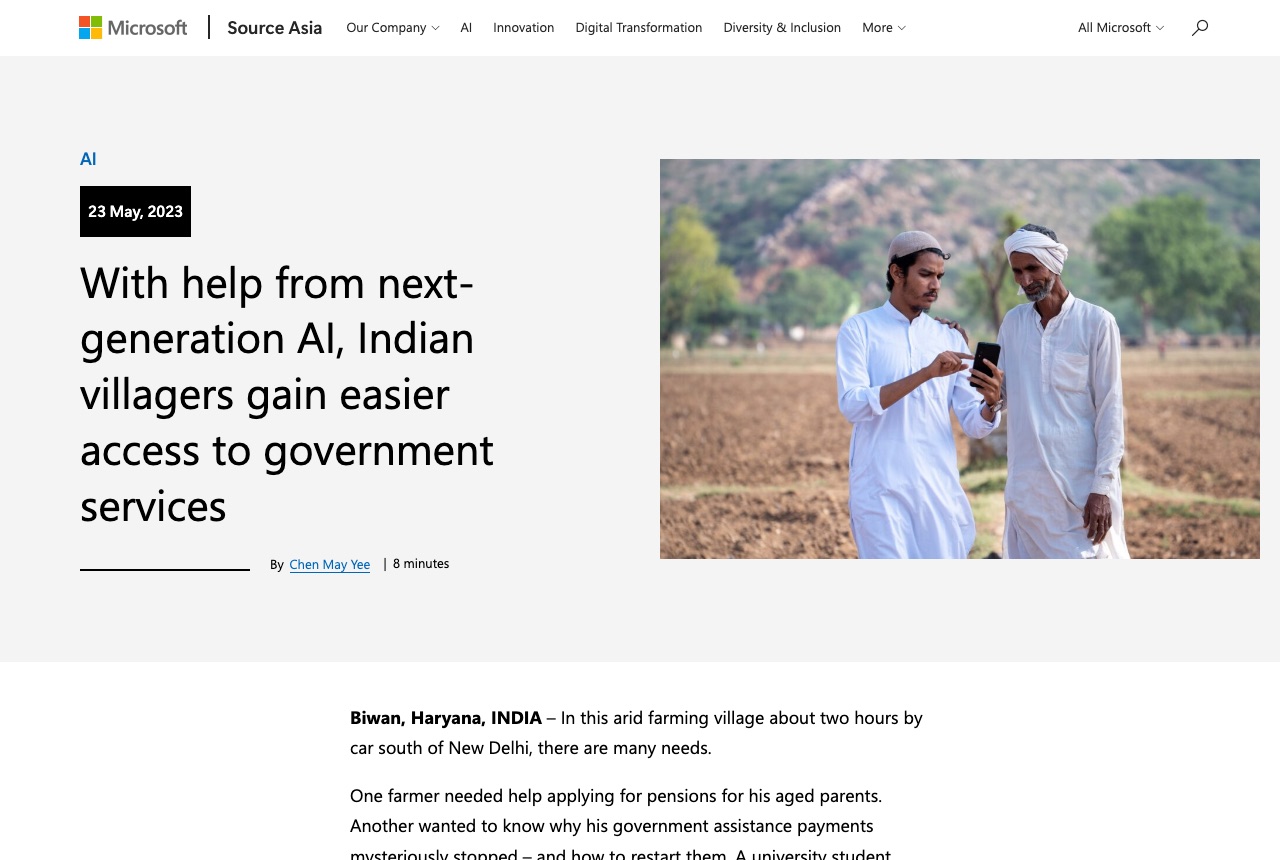
The pipeline is a good picture of how such tools work. A villager sends text or a voice note on WhatsApp; AI4Bharat’s speech recognition turns it into text; a Bhashini model translates it to English; a GPT model, through Azure OpenAI Service, finds the relevant government programme; and the answer travels back, spoken in the villager’s language. At the time it covered 10 of India’s 22 official languages and 171 of roughly 20,000 government programmes. An AI4Bharat officer called it “chatbot plus plus because it’s like a personalized agent”, and the honesty of its builders is worth quoting: “Sometimes these models do make errors. They are probabilistic machines... People still play an important role to see what works and what doesn’t work.”[27] That is the article you are reading in one sentence.
STEP 1
A voice note
A villager asks a question on WhatsApp, in their own language.
STEP 2
Speech to text
AI4Bharat’s speech recognition writes down what was said.
STEP 3
Translate
A Bhashini model turns it into English.
STEP 4
Find the scheme
A GPT model, through Azure OpenAI Service, finds the relevant government programme.
STEP 5
Translate back
The answer returns in the villager’s language.
STEP 6
Speak the answer
AI4Bharat’s text-to-speech sends a voice reply on WhatsApp.
The pipeline as described in Microsoft’s May 2023 report; the drawing is ours.
FarmerChat: advice with a human check
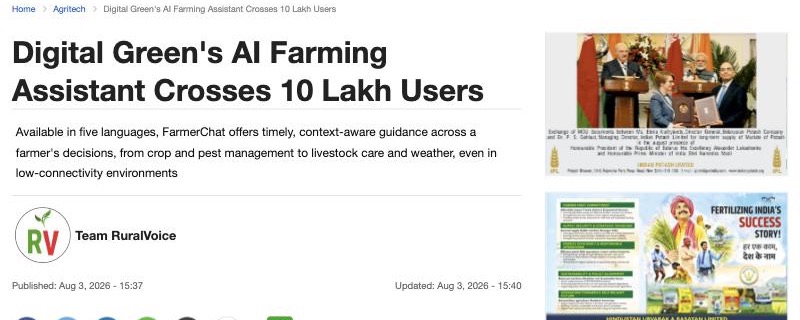
A more recent example is FarmerChat, from Digital Green. Rural Voice reported on 3 August 2026 that Digital Green India had announced that the assistant had “crossed 10 lakh users in India since its launch in October 2024”, alongside a redesigned FarmerChat 2.0. Farmers ask by voice, photo or text, in five languages, about crop planning, pests and diseases, livestock care, weather and inputs, and the app now suggests the questions a farmer should be asking for their crop, place and season.[28]

What stands out is how it is kept honest. The report says the assistant combines fine-tuned language models with retrieval from expert-validated datasets and feedback from people, and adds: “its outputs are not left unchecked: local agronomists and veterinarians regularly validate the responses farmers receive, feeding corrections back into the models.” The figures reported from Digital Green are striking, and they are the organisation’s own: in-person advice can cost about ₹3,300 per farmer a year and FarmerChat has brought that to ₹33; more than 30 lakh queries answered; women about 45% of users; and, according to a third-party evaluation by 60 Decibels, around 60% of active users act on the advice and 91% report greater confidence in their decisions.[28] FarmerChat is an advice assistant rather than an agent that acts on a farmer’s behalf, but it shows the pattern good agents will need: a narrow job, local knowledge, and people checking the answers.
10 lakh+
users since October 2024
30 lakh+
queries answered in India
≈45%
of users are women
≈60%
of active users act on the advice (60 Decibels)
91%
report more confidence in farming decisions (60 Decibels)
What one farmer’s advice costs per year
As reported by Rural Voice from Digital Green India, with the outcome figures attributed there to a third-party evaluation by 60 Decibels. Bar lengths are drawn to scale.
Sarvam: voice agents in Indian languages
Sarvam, a Bengaluru company, describes itself as “India’s Full-Stack Sovereign AI Platform”. Its products include voice agents, content and document agents, and work agents, and its site lists text-to-speech in 11 Indic languages, speech recognition in 12, and translation across 23.[29] Its voice-agent page pitches “one platform to build, launch and scale voice agents that carry your customer context into every call”, agents that “call APIs during a live conversation” and “move from answers to completed actions”.[30]
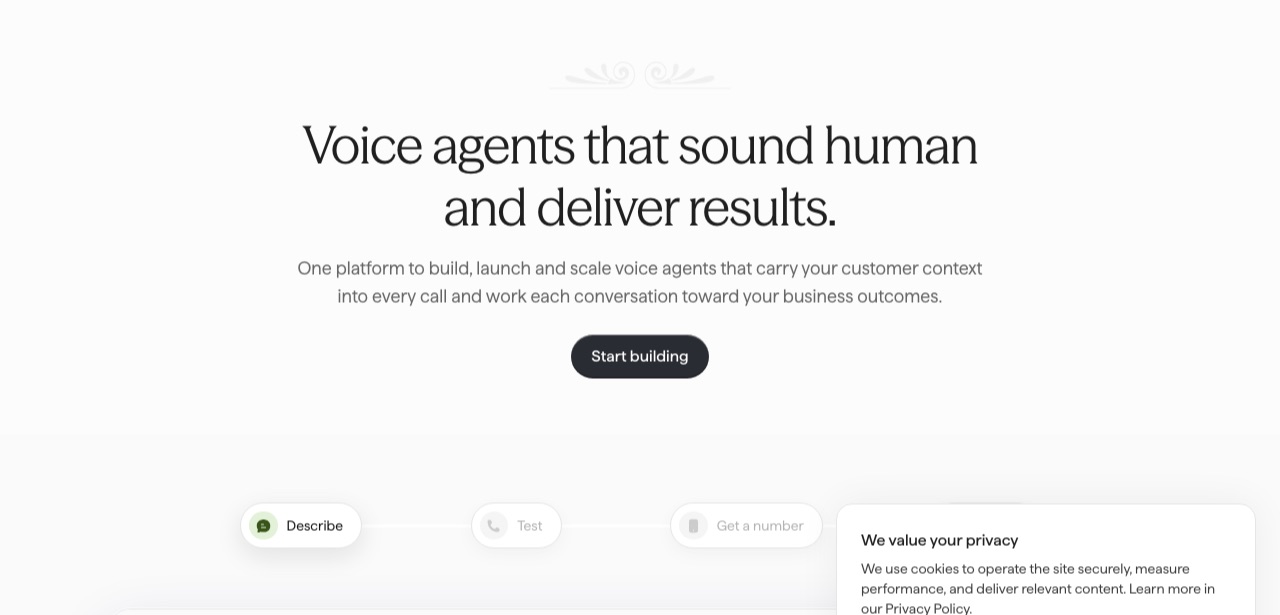
The page claims “350M+ conversations”, latency under 500 milliseconds and “under 5 minutes to go live”, and quotes Tata Capital’s chief digital officer: “We are reaching more customers with greater relevance, breaking access barriers, and deepening engagement.” All of that is Sarvam’s own material. It is worth noticing, too, that Sarvam’s home page puts “human at the core”: it says forward-deployed engineers “work alongside your teams to deliver production-ready agents”.[30] A phone call in your own language, answered at any hour, is one of the clearest ways an agent could help millions of people, and also one where a person should always be reachable when the conversation goes wrong.

Shopping by voice, and by agent: Swiggy and Flipkart
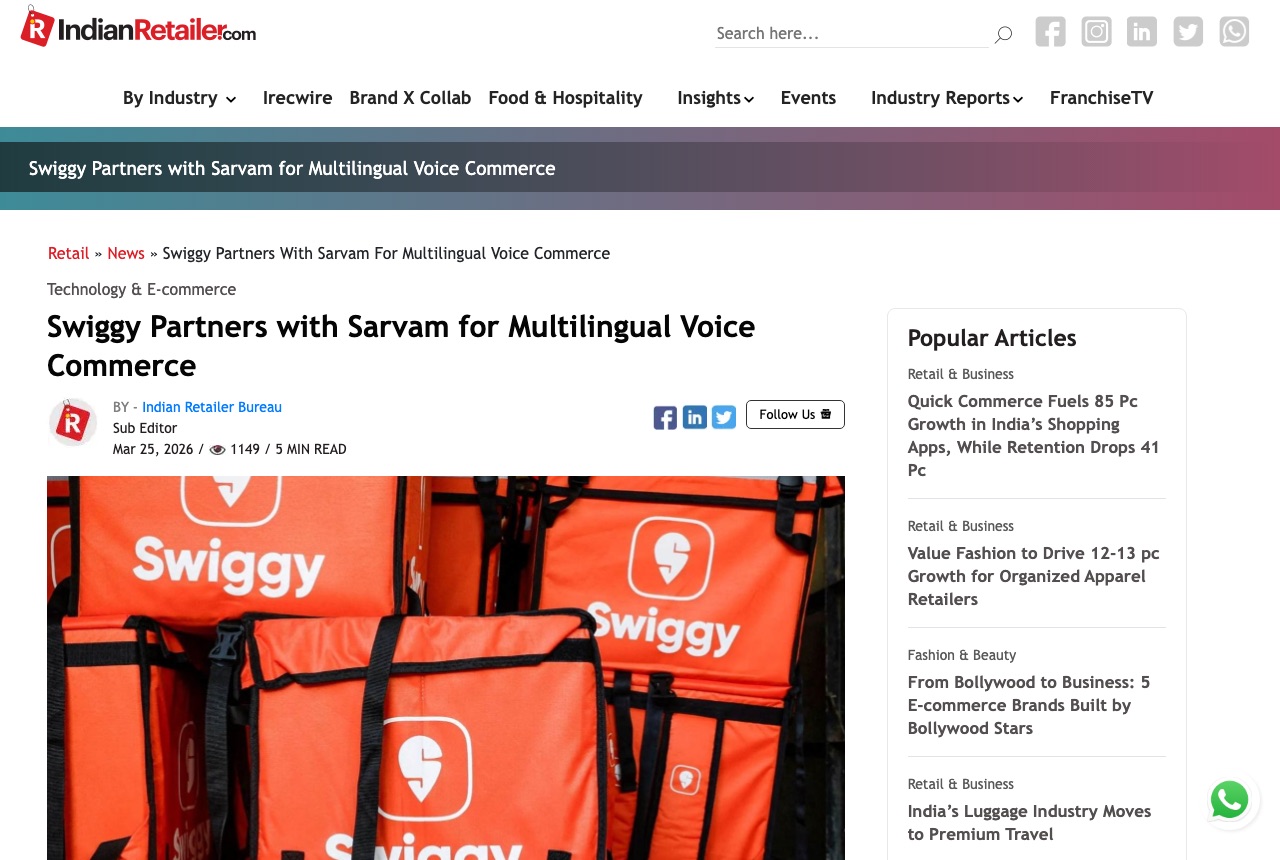
The first place ordinary people may meet agents is a shopping app. In March 2026 Swiggy announced a partnership with Sarvam for multilingual, voice-led commerce across Food Delivery, Instamart and Dineout. It has two parts: people can place orders “through phone calls without requiring an app or internet access”, and Swiggy connects to AI-native platforms including Sarvam’s chat app, Indus. Sarvam’s voice models support 11 Indian languages, including Hindi, Tamil, Telugu, Kannada, Bengali and Marathi, with payments through Razorpay. Swiggy’s chief technology officer said the company had already rolled out MCP integrations, the shared plug from section 7, and that “soon, users will be able to simply ask their AI assistant in their preferred language to order food or groceries, and reserve tables, with the AI agent seamlessly handling discovery, ordering, and checkout.” Sarvam’s co-founder Pratyush Kumar said: “India is a voice-first nation.”[31]
A different kind of agent is arriving through Flipkart’s finance app, Super.money. According to StartupTalky on 11 September 2026, its consumer agents can shop on Flipkart on a customer’s behalf and buy gold when the price falls to a level the customer specifies, with bill payments and investments planned. Its chief executive, Prakash Sikaria, said the company intends to cover all its customers within two months, is putting about 20% of its technology budget into agentic work, and expects 30–40% of revenue from agentic use cases in three to four years. The first agents are free, with subscriptions likely later, and the platform has more than 20 million monthly active users.[32] Notice the shape of “buy gold when it hits my price”: it is a rule you set, which the agent then watches for you. The article we read describes no safeguards, so ask what confirms a purchase before you delegate one.

UPI: teaching money to trust a machine, carefully
Money is where India’s agent story is most interesting, because India’s Unified Payments Interface (UPI) is how so many people pay. In October 2025 TechCrunch reported a pilot by the National Payments Corporation of India (NPCI) with OpenAI and Razorpay that let people shop and pay directly inside ChatGPT, starting with BigBasket for groceries and Vi for mobile recharges. Users “pre-authorize the amount transacted through chatbots through two-factor authentication”, it reported, using UPI Reserve Pay and UPI Circle, with Axis Bank and Airtel Payments Bank as partners, and Razorpay said “AI companies will not get access to the payment data”.[33]

A September 2026 report by AI in Asia looks ahead. It says NPCI was expected to present a “Unified Agent Protocol” at the Global Fintech Fest in Mumbai on 8–11 September, letting registered AI agents make UPI payments within limits the user sets. It notes the existing ceilings that the design reuses, ₹10,000 for a Reserve Pay block of up to 90 days and ₹15,000 a month for a delegated user, both “reportedly under review”, that UPI carried 24.51 billion transactions worth ₹29.82 trillion in August 2026, and that the liability framework and Reserve Bank of India approval were still unfinished.[34] We could not find a confirmed launch, so treat the protocol as expected, not live.
STEP 1
You set the fence, once
Pre-authorise an amount with two-factor authentication.
STEP 2
The agent shops
It picks groceries or a mobile recharge inside the chat.
STEP 3
The rails check the limit
Existing UPI tools cap what can be spent: reported ceilings of ₹10,000 (Reserve Pay, up to 90 days) and ₹15,000 a month (UPI Circle).
STEP 4
The payment data stays out
Razorpay said the AI companies do not get access to it.
Drawn from the 2025 pilot described by TechCrunch and the September 2026 report by AI in Asia. The limits were reported as under review, and the liability rules and regulator approval were not yet published, so this is a sketch of the design, not a description of a live service.
Look at the design, because it is the whole safety lesson of this article in one picture. The system does not ask you to trust the agent. It asks you to set a fence, once, and lets the payment rails enforce it: an agent that can only spend what you pre-authorised cannot spend more, whatever it decides. That is rung 4 of the permission ladder in section 14, “act inside a fence”, applied to money. The open questions, who is liable if an agent misbuys and what the regulator will allow, are exactly the ones our AI governance guide tells organisations to settle before they deploy, and that guide also explains India’s own AI governance guidelines.
At work: India’s IT services firms
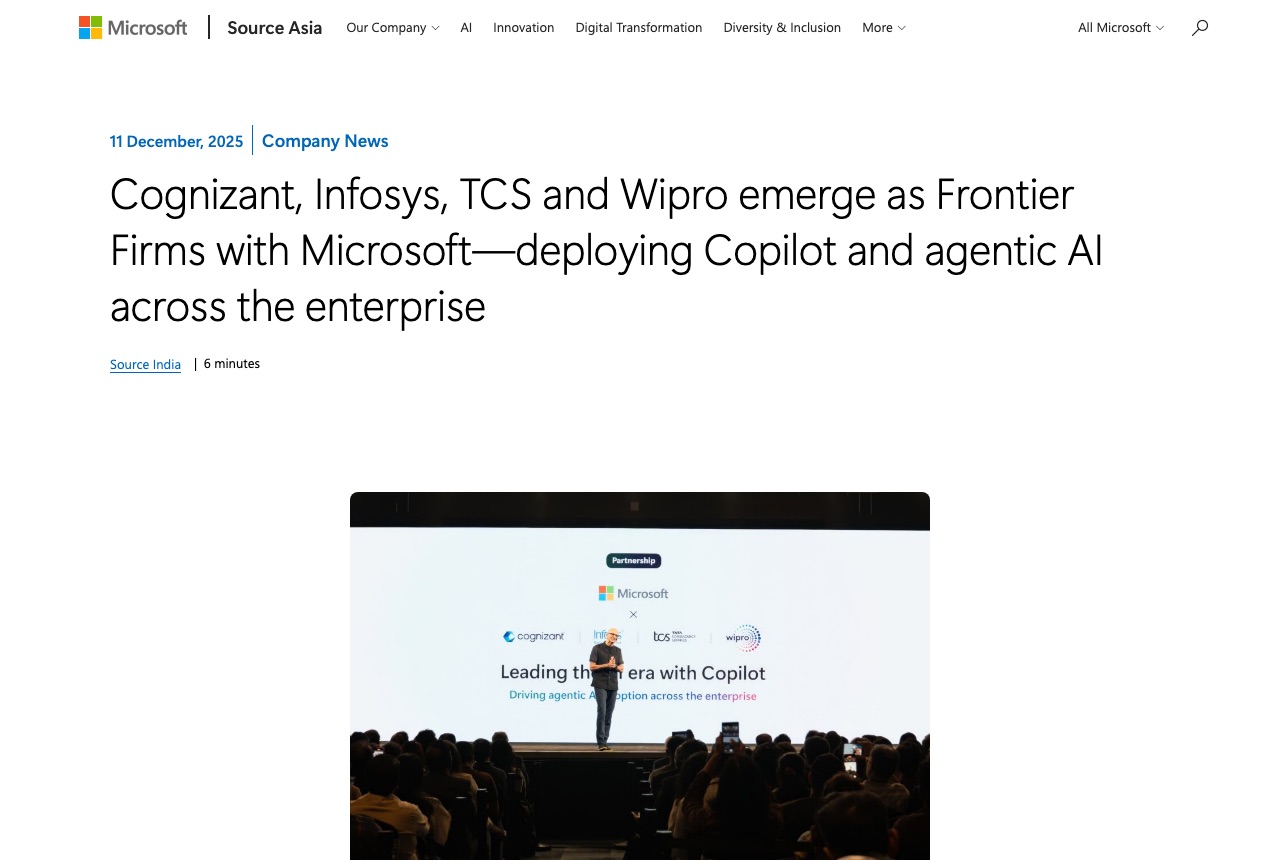
India is also where much of the world’s software and back-office work is done, so how its IT companies adopt agents matters well beyond India. On 11 December 2025 Microsoft announced, in Bengaluru, that Cognizant, Infosys, TCS and Wipro would each deploy “over 50,000” Microsoft 365 Copilot licences, “collectively surpassing 200,000”, and described the four as “Frontier Firms” that are “redesigning their workflows around human-agent collaboration” across delivery, sales, finance, HR and customer engagement. It came a day after Microsoft announced plans to invest US$17.5 billion in cloud and AI infrastructure, skilling and operations in India over four years.[35] That is a vendor’s announcement, and a licence is a seat, not proof of daily use; but it shows how quickly a whole profession is being asked to learn to work beside agents, and why the skills in this article matter to Indian readers in particular.

- Cognizant50,000+
- Infosys50,000+
- TCS50,000+
- Wipro50,000+
Together: over 200,000 Copilot licences
Microsoft’s announcement of 11 December 2025 says each company will deploy “over 50,000” licences; it does not give exact counts, so the bars show the stated minimum. A licence is a seat, not proof of daily use.
What the examples have in common
Language first: each meets people in the language they speak, by voice as much as by text. Human checks second: farmers’ answers are validated by experts, villagers are told the bot can err, Sarvam puts engineers beside its clients, and UPI puts a limit between the agent and your money. And third, an honesty about numbers that is worth copying: most of the impressive figures above come from the builders, the companies or their reporters, and we have said so each time. Put the three together and you have a recipe for an Indian agent that people can trust: speak their language, keep an expert or a limit in the loop, and be honest about what has been proved.
6:30 am · Amma’s groceries
She speaks the week’s list to the phone in Marathi. The agent shows the order and the total, and waits for her to say yes.
9:00 am · Board-exam revision
A student asks for a chapter explained in Hindi, then a ten-question quiz. The agent keeps a list of what she gets wrong.
11:30 am · The kirana counter
Ravi’s agent matches yesterday’s UPI credits with the sales list and shows him the three that do not match.
3:00 pm · The field
A cousin photographs a spotted leaf. An advisory assistant answers in Kannada, and a local expert has checked what it says.
6:00 pm · Price watch
Dad’s agent has found the phone at the price he set. It asks: “Buy?” He says not until Friday.
9:00 pm · Diwali trip
The family agent lists three train options and a backup if the ticket is waitlisted. Nobody has booked anything yet.
Imagined: a made-up family in a made-up town, built from the examples in this section. In every scene a person says yes before anything is spent, sent or signed.
How people really work with agents
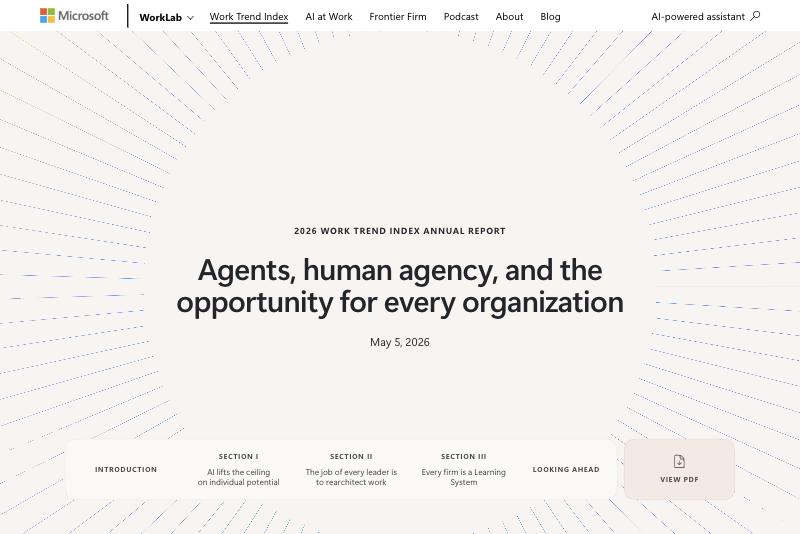
The best data we found on the human side comes from Microsoft’s 2026 Work Trend Index, published on 5 May 2026. It combines an analysis of “trillions of anonymized Microsoft 365 productivity signals” with a survey of 20,000 workers who use AI, across ten countries.[36]
What people ask for
In a privacy-preserving analysis of more than 100,000 Microsoft 365 Copilot chats from one week in February 2026, 49% of conversations supported “cognitive work”: helping people analyse information, solve problems, evaluate and think creatively. The rest split among working with people (19%), producing work (17%) and finding information (15%).[36]
- Thinking work: analysing, solving, evaluating, creating49%
- Working with people19%
- Producing work17%
- Finding information15%
Source: Microsoft’s 2026 Work Trend Index. Microsoft 365 Copilot Chat, one week in February 2026, more than 100,000 privacy-protected chats. The percentages are each activity’s share of classified user goals, “not time spent, not session count”. This is chat use, not a count of autonomous agents.
Two cautions before we draw conclusions. These are Copilot chats, not a count of autonomous agents at work, and the shares are of classified user goals, “not time spent, not session count.” Even so, the picture is striking. Nearly half of what people ask an AI for is not typing or looking things up. It is thinking.
Time for what matters
Among the AI users Microsoft surveyed, 66% said AI let them spend more time on high-value work, and 58% said they were producing work they could not have a year earlier. The report also singles out “Frontier Professionals”, the most advanced users, who use agents for multi-step workflows and build multi-agent systems. They are 16% of those surveyed.[36]
Microsoft’s framing is worth quoting, because it captures the promise of this whole article: “as agents take on more of the execution, humans increasingly have more agency—more room to direct the work, make the calls, and own the outcomes.”[36]
Four ways of working with AI
Microsoft describes four modes, depending on how much the person engages and how much the AI does: delegation, collaboration, asking and exploration. What set the Frontier Professionals apart, it says, “isn’t which mode they use; it’s knowing which mode a task calls for.” Routine execution, research and synthesis get delegated; humans stay involved “by setting direction and taking responsibility for how outputs are used.”[36]
Delegation
Hand off routine execution, research or synthesis. Check the result.
Collaboration
Work back and forth, turn by turn, each adding to the other’s draft.
Asking
Get an answer or an explanation, then carry on yourself.
Exploration
Wander through an idea, a market or a problem to see what turns up.
Microsoft names these four modes and sorts them by how the person engages and how much the AI does. Its diagram is conceptual, and it does not say how many people use each. The one-line descriptions here are our own plain-English reading.
The habits of the best
The most striking finding is what the most advanced users do not hand over. Frontier Professionals were more likely than other users to say they intentionally do some work without AI to keep their skills sharp (43% against 30%), and to pause before starting work to decide what should be done by AI and what by a person (53% against 33%). Across all users, 86% said they treat AI output as a starting point, not a final answer, and that they “stay responsible for the thinking.” When asked which human skills matter more as AI takes on more work, the top answers were quality control of AI output (50%) and critical thinking (46%).[36]
Deliberately do some work without AI, to keep skills sharp
43%30%Pause first to decide what AI should do and what a human should
53%33%
Source: Microsoft’s 2026 Work Trend Index survey of 20,000 AI users in 10 countries; “Frontier Professionals” are 16% of those surveyed. Self-reported answers.
Microsoft also offers a way to think about your own role. As AI matures across a workforce, it argues, the most effective users “won’t be the ones who do more things faster. They’ll be the ones who redefine their value around what only humans can do: setting clear intent—defining the desired outcome and quality bar—and designing how the work gets done across humans and AI.” Then it flips the question: it “stops being ‘What tasks define my job?’ and starts being ‘What outcomes am I now positioned to drive?’”[36]
That is a hopeful sentence, and it is worth trying on for size. Take your own week. Which tasks do you do because someone has to, and which outcomes do you do because they are the reason you are there? An agent is best at the first list. The second is yours.
What agents are good at, and where they stumble
Put the evidence together and a rough division of labour emerges. It is our synthesis, not a finding of any one source, and it will move as the technology does. Agents are at their best on work that is routine (the same steps every week), information-heavy (lots of text, numbers or files to gather and compare), and checkable (you can tell quickly whether the result is right). That describes a great deal of modern office life: summarising, drafting, reconciling, scheduling, look-ups and first passes. It is exactly what Microsoft’s advanced users say they delegate: “routine execution, research, and synthesis.”[36]
They stumble where the task is ambiguous (what does “good” mean here?), high-stakes (an error is costly or cannot be undone), or personal (the value lies in it coming from you). They can also be confidently wrong, as Turing’s admission that machines “take me by surprise” hints. In those areas, the sensible pattern is the one Microsoft’s data shows: the human sets the direction, checks the work and owns the result, and the agent supplies speed and stamina.
Tomorrow: you at the head of the team
Now we can look ahead, in three steps. The first is on the calendar. Gartner predicts that by 2027 one-third of agentic AI implementations will combine agents with different skills to manage complex tasks, and that by 2028 networks of specialised agents will collaborate across applications, so that users can “achieve goals without interacting with each application individually.”[10]
The second step is about you. Gartner predicts that by 2029, at least 50% of knowledge workers will “develop new skills to work with, govern or create AI agents on demand for complex tasks.” Its analyst adds: “As agentic AI matures, standardized protocols and frameworks will enable seamless interoperability, allowing agents to sense their environments, orchestrate projects and support a wide range of business scenarios.”[10] Notice the shift in the job description. The person moves from doing every step to directing and governing a team of helpers. Turing’s teacher becomes a manager.
Now (2026)
The agent as a junior colleague
- Takes a goal, uses tools, returns drafts
- You set limits and approve the important steps
- Best at prep, first drafts, look-ups and admin
Reported
Next (2027–2029)
Teams of agents, with you as their lead
- Agents with different skills combine on one job
- Agents work across apps, not inside one
- Half of knowledge workers learn to direct or govern agents
Gartner’s predictions
Later (our imagination)
A quiet layer of helpers around every life
- Your agent negotiates with the clinic’s, the school’s and the bank’s
- Small firms run with the reach of large ones
- People spend the saved hours on what only people can give
Imagined, not forecast
A day in the imagined 2030s
The third step is the one we are free to dream about, so we will. What follows is fiction. Nobody has promised any of it. But it is built entirely from the trends above: agents that use standard tools, talk to one another, and work for people who can see and undo what they do.
Asha wakes in a hotel in Bengaluru. Her flight home was delayed overnight, and her agent has already moved it, told the hotel and rescheduled a call. The message says, in one line: “All fixed. Nothing needed from you.” That afternoon her agent and her clinic’s agent agree an appointment slot that suits her calendar and the doctor’s, and remind her to bring last year’s report.
Across town a teacher’s agent turns one lesson into three versions for three reading levels. The teacher spends the hour she has saved beside the child who needs her most. In a small shop, the owner’s agent chases late invoices, reorders stock and drafts the tax paperwork. The owner reads, signs and gets home in time for dinner. In the evening Asha’s agent gives her a two-minute summary of the day, flags the one decision it thinks she should sleep on, and goes quiet.
Wake-up
Your agent has already moved your flight after a delay, told the hotel, and left one line for you: “All fixed. Nothing needed from you.”
Clinic
Your agent and the clinic’s agent agree a time that suits your calendar and the doctor’s. You get one message, and a reminder to bring last year’s report.
School
A teacher’s agent turns a single lesson into three versions for three reading levels. The teacher spends the saved hour with the child who needs it most.
Small shop
The owner’s agent chases invoices, reorders stock and drafts the tax paperwork. The owner reviews, signs and goes home in time for dinner.
Evening
Your agent gives you a two-minute summary of your day, flags the one decision it thinks you should sleep on, and then goes quiet.
Imagined. This is fiction built on the trends in this article: nobody has promised any of it, and every step assumes a person can see and undo what their agent does.
Look at what stays human in this picture: the doctor’s judgement, the teacher’s attention, the owner’s signature, Asha’s decision. Look at what changes: the waiting, the chasing, the form-filling, the endless coordination. That is the bright version of this story, and it is not naïve. It rests on a simple idea that Gartner’s analyst put memorably: that “work automation” was never the point, and “workforce amplification was the opportunity.”[37]
Further out: the quiet layer
Push the dial further, into a world we can only sketch, and the most likely change is not a robot on every corner. It is a quiet layer of helpers behind ordinary life, most of them invisible, all of them talking to one another in the standard languages we met earlier. Imagine a city where your agent, the bus company’s agent and your office’s agent settle the morning’s logistics before you have finished your tea. Where a rare disease is spotted sooner because a hospital’s agents can compare notes, with consent, across hospitals. Where a farmer in a village asks a spoken question in her own language and gets a weather-and-market plan that would once have needed an adviser and a bus ride.
Imagine a scientist whose week is no longer eaten by searching, formatting and chasing permissions. Her agents read the new papers overnight, flag the three that matter, re-run last month’s analysis with the new data, and draft the methods section. She spends Thursday thinking about the question nobody has asked yet. Imagine a young person with a learning difficulty whose study companion never loses patience, never sighs, and explains fractions a seventh different way. Imagine a small manufacturer, four people and a warehouse, with the back office of a firm forty times her size.
None of these is a prediction. They are extensions of things the sources describe today: agents that draft and check, agents that coordinate with other agents, agents that let a small team punch above its weight. Gartner’s best-case scenario puts agentic AI at roughly 30% of enterprise application software revenue by 2035[10], which is a way of saying that the layer we are imagining would be big business as well as good story. Whether it turns out warm or cold depends less on the technology than on the rules we build around it.
The Symphony of the Shift: a story from the 2060s
What follows is fiction, from start to finish. It is our attempt to picture the bright version of the road this article has walked, using only ingredients that exist today: agents that use tools, agents that work with other agents, and people who stay at the centre.
By the dawn of the 2060s, the argument about whether machines would take over had gone quiet, the way arguments do when the thing they feared turns out to be something else. What had arrived instead was the hybrid workplace: a place where people and their agents worked in a rhythm so ordinary that children found it hard to imagine anything different. Humans had not been replaced. They had been unlocked.
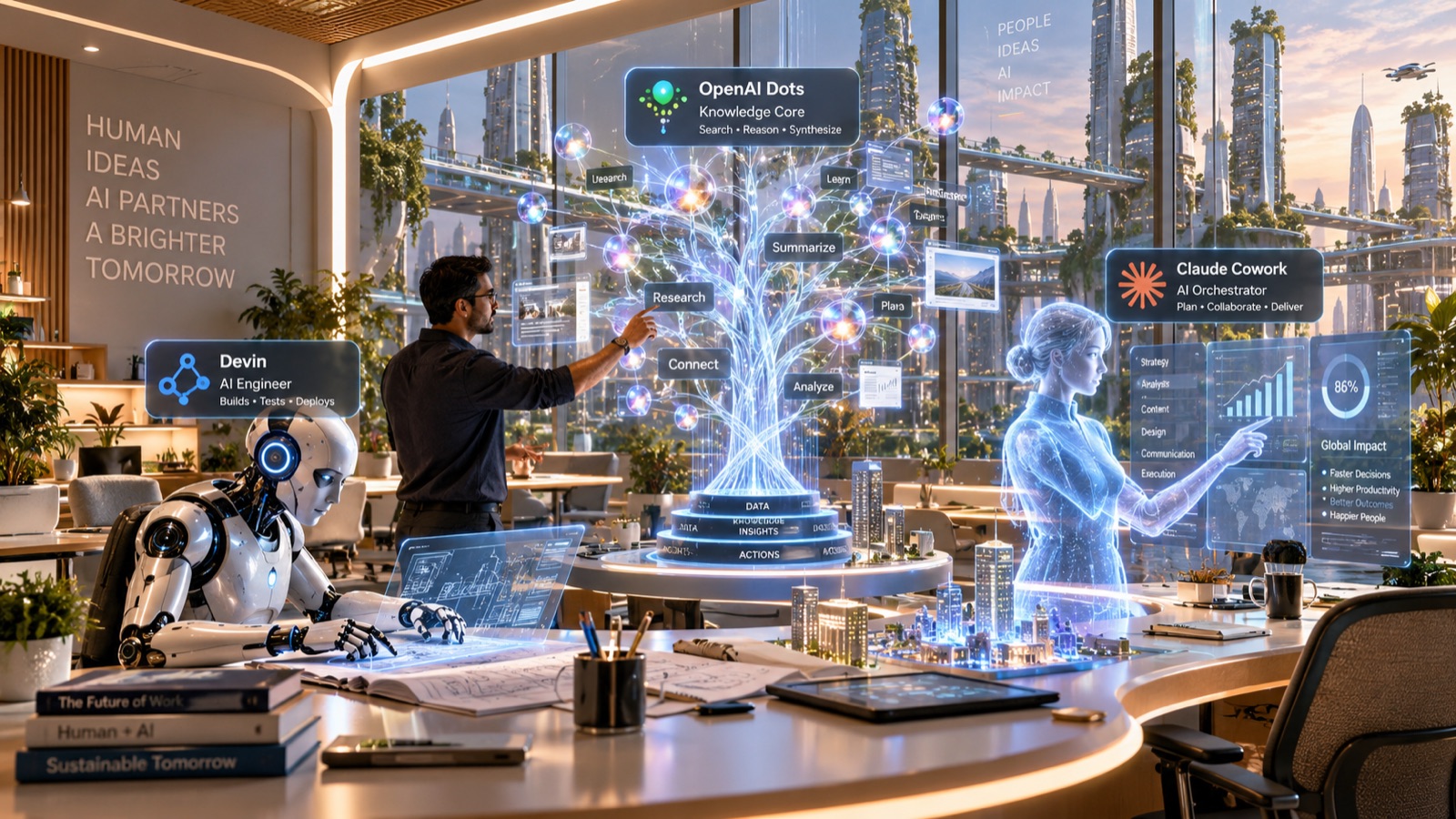
Step into the central studio of a design firm in a vertical-garden city, and the first thing you notice is what is missing: the clatter of keyboards, the anxious refreshing of inboxes, the sigh of someone hunting for a file. In their place there is a low, purposeful hum.
An architect named Leela stands before a canvas of light. She is not calculating loads or reading building codes; her agents are. To her left hovers a translucent figure she calls Lumen, an heir, in this story, to the knowledge engines of the 2020s, which reads centuries of architecture as fast as she can sketch and quietly slides greener materials into the drawing. At the next desk a matte-white robot runs stress tests on carbon-fibre models. Overhead, a loose swarm of tiny lights, each one a specialist, pulses softly as it routes the day’s supply-chain news onto the project board.
It is tempting to call this a hierarchy. It is closer to an orchestra. The agents have real independence: they run their own virtual computers, navigate software, and solve tangled problems in the background, and when a bottleneck appears they do not stop and wait; they find another path. But an orchestra needs a score, and the score is human. Leela decides what the building is for: who will live in it, what the street should feel like at dusk, which trade-off the city can live with. The agents explore the thousand ways of getting there.
HumanDecides why the building should exist, and for whom
AgentsExplores thousands of ways to build it, and prices each one
HumanListens to the neighbourhood and reads the room
AgentsChecks every draft against building codes in every region
HumanChooses which trade-off the city can live with
AgentsRuns the load, heat and supply-chain simulations overnight
HumanSigns the plans and answers for them
AgentsPrepares the paperwork, the audit trail and the 'undo' button
Imagined. A fictional division of labour for the office of the 2060s in this article’s story, not a forecast.
What holds it together is trust, and trust in this world is engineered, not hoped for. Every consequential step an agent takes carries a signature and a way back. Certain doors, such as spending, signing and sharing, open only when a person says yes, and the yes is recorded. The agents feel less like software and more like dedicated chiefs of staff: they learn how the firm works, remember why past decisions were made, and tell Leela when they are unsure. When one of them is wrong, which happens, the log shows where, and the fix is made once for everybody.
Her agents can do the work of a hundred draughtspeople. What they cannot do is care whether the school in the shadow of the new tower still gets sun at noon. Leela can. That, in the end, is the division of labour: the machines take the friction, and the people keep the meaning. Empathy, cultural nuance, a hunch about what a neighbourhood needs, the nerve to try something new: none of these was ever a task. They were the reason for the job.
As the sun goes down behind the smart-glass windows, the city glows: terraces of gardens, trams humming along the sky bridges, a drone or two crossing the sunset. It is powered, in every sense, by a great many small collaborations. The future did not diminish humanity. By handing the mechanical to the machines, people had won back the time to be human: to create, to dream, and to build something together.
Even in a story this bright, a careful reader will ask the awkward questions. Who audits the agents? Who owns the memory they build up? Who retrains the people whose tasks moved, and who shares in the gains? The evidence in this article suggests the answers are not automatic. They are choices, and they are made in the decade we are living in now.
What would have to be true
A future like Leela’s does not arrive by itself. Five conditions would have to hold, and they are our own list, distilled from the sources in this article. Trust that can be checked: permissions, logs and human gates built in from the start, as Glean, Anthropic, Salesforce and OpenAI each describe in their own way. Open standards: the shared plugs and phone lines we met in section 7, so that no single company owns the wiring. Skills for everyone: Gartner predicts that by 2029 at least half of knowledge workers will learn to work with, govern or create agents, and that has to be made possible for the rest as well.[10] Shared gains: Gartner’s warning that firms that only cut costs will be overtaken by those that reinvest.[37] And a pace we can steer: the debate in our article Hands on the brake, foot on the gas.
What should stay in your hands
If we are going to live alongside a quiet layer of helpers, three rights are worth insisting on, and they are our own suggestions, not anyone’s law. The right to see: you should be able to read a plain-language account of what your agent did and why. The right to undo: anything that can be reversed should be, and anything that cannot should need your say-so first. The right to switch off: you should always be able to pause, limit or retire an agent without losing your data or your dignity. A future with those three rights is one most of us would happily step into.
Ten easy ways to start this week
You do not need a company, a budget or a technical background to begin. The agents and assistants you can already reach handle everyday tasks well, and the skill that matters is the one Microsoft’s data points to: deciding what to hand over, and saying clearly what you want. Here are ten recipes, each one a request you could type this week, and each with the piece you keep.
01Inbox triage
Ask“Sort my unread mail into “needs me”, “can wait” and “ignore”, and draft replies for the first pile.”
You keep: You press send.
02Meeting prep
Ask“Before my 3 pm, read the last five emails with this client and give me one page: history, open issues, three questions to ask.”
You keep: You judge the questions.
03Bills and subscriptions
Ask“Go through this month’s statements and list every recurring charge with its date and amount.”
You keep: You cancel. Read-only access.
04Trip planning
Ask“Plan three days in Jaipur for two adults on a budget, with travel times between stops and two rainy-day options.”
You keep: You book.
05Meal planning
Ask“Plan five dinners around what is in my fridge, then write the shopping list for what is missing.”
You keep: You cook (or order).
06Study buddy
Ask“Quiz me on chapter 4, one question at a time. Explain what I get wrong, then repeat those.”
You keep: You do the learning.
07Paperwork
Ask“Read this 40-page policy and tell me what changes for me, what I must do, and by when. Quote the clauses.”
You keep: You verify the clauses.
08Job hunt
Ask“Keep a table of roles I have applied for, with dates and next steps, and draft a follow-up note after seven days.”
You keep: You approve every message.
09Small-business admin
Ask“List customers whose invoices are more than 30 days late and draft a polite reminder for each.”
You keep: You send, and you choose whom to chase.
10Family calendar
Ask“Find a Saturday in the next six weeks when all four of us are free, and list two ideas for it.”
You keep: You decide and invite.
Eight more, for everyday life in India
Here are eight recipes shaped by Indian daily life: government schemes, train trips, school paperwork, learning in your own language, the shop counter, WhatsApp, helping a parent order by voice, and watching a price. Several lean on the tools in the previous section. Ask for links to official portals, and treat the answer as a lead to check, not a ruling.
01Scheme finder
Ask“Which central and state government schemes might apply to a small dairy farmer in Punjab? List eligibility and documents, with links to the official portals.”
You keep: You confirm on the official site before applying.
02Family trip by train
Ask“Plan four days in Kerala in June for two adults and a parent, starting by train from Bengaluru, with a backup if the ticket is waitlisted.”
You keep: You book and pay yourself.
03Admission paperwork
Ask“Here is a school admission form. List every document it asks for, check which ones are in this folder, and tell me what is missing.”
You keep: You check the documents and submit the form.
04Learn in your language
Ask“Explain how photosynthesis works in Tamil, then quiz me in Tamil, one question at a time.”
You keep: You do the learning; check facts in the textbook.
05Shop-counter reconciliation
Ask“Match the UPI credits in this statement against today’s sales list, and show me the entries that do not match.”
You keep: You investigate the differences.
06WhatsApp replies
Ask“Draft replies in Hindi and English to these five customer messages about delivery times. Do not send anything.”
You keep: You read each one and press send.
07Help a parent order by voice
Ask“Set up a simple way for my mother to order the weekly groceries by speaking in Marathi, and show me the order before it is placed.”
You keep: You (or she) confirm and pay.
08Price watch
Ask“Tell me when this phone drops below the price I noted, and list the three best offers that day. Do not buy anything.”
You keep: You decide whether to buy.
Our own suggestions for everyday life in India. None is tax, legal or financial advice: confirm anything that matters with the official source or a qualified professional. Never share your Aadhaar number, PAN, UPI PIN or an OTP with an agent.
Write the job description
The biggest lever is how you brief the agent. Treat it like a new colleague on their first day. Tell it the goal, the background, the limits, the standard you expect and when to check in. Microsoft’s research says the most effective AI users are the ones who redefine their value around “setting clear intent—defining the desired outcome and quality bar”, and designing how the work gets done across humans and AI.[36] Five lines are enough.
The delegation card: five lines you can write in a minute
- Goal
- What finished looks like, in one sentence.
- Context
- What it needs to know: who, why, and what you have already tried.
- Limits
- What it may touch, what it must never do, and what needs your yes first.
- Quality bar
- How good is good enough: length, tone, sources, format.
- Check-in
- When to stop and ask you, and what to hand back with the result.
Our own template, which works with any agent. It follows Microsoft’s finding that the best users set “clear intent”, the desired outcome and the quality bar.
A worked example. Instead of “help me with my inbox”, try: “Goal: sort my unread mail from the last three days into needs me, can wait, ignore. Context: I am launching the Pune office move on 15 October and nothing about the move can wait. Limits: read and draft only, never send, never delete. Quality bar: replies under 80 words, warm, no jargon. Check-in: show me the ‘needs me’ pile first and ask before you touch anything else.” That is a job description a person could follow, and so can an agent.
Three short stories
Ravi runs a small stationery shop in Nashik. Every month he loses a weekend to invoices: who has paid, who has not, and who needs a nudge. He asks an assistant to read a spreadsheet he exports from his billing software and list every invoice more than thirty days late, with a polite reminder drafted for each. He reads the list, crosses out two customers he would rather phone, and sends the rest himself. The weekend is his again. What he kept: the choice of whom to chase, and the sending.
Meera is in class 11 and dreads chemistry. She asks an AI study buddy to quiz her on one chapter, one question at a time, to explain every mistake, and to bring the missed ones back later. She does not ask it to write her answers, because she knows the exam will not let her use it. What she kept: the learning, which is the whole point.
Dev is a freelance designer between projects. He asks an agent to keep a simple table of every application he has sent, with dates and next steps, and to draft a short follow-up after a week. He edits each note, and rewrites the ones that do not sound like him. What he kept: his voice, and the last word.
These three are invented, but they share a shape you can copy: a clear, small job; a limit on what the tool may do; a human who reads the result and keeps the parts that are personal, financial or reputational.
Prompts that work, and prompts that don’t
Vague requests give vague results. “Help me with my emails” leaves the agent guessing which emails, what help, and how far it may go. “Sort my unread mail from the last three days into needs-me, can-wait and ignore; draft replies for the first pile under 80 words; do not send or delete anything” gives it a boundary and a finish line. The second version takes twenty seconds longer to write and saves twenty minutes of correcting. If you take one habit from this article, take that one.
Which jobs would you hand over?
Try the sorting game below. For each task, decide whether you would hand it over, team up with the agent, or keep it. The answers are ours, with reasons; you may reasonably disagree.
Draft first replies to thirty routine customer emails.
Decide whether to accept a job offer.
Compare five insurance quotes and list the differences.
Write a message to a friend who has just lost someone.
Plan a family trip: places, timings, options for rain.
Approve a large payment to a new supplier.
Summarise a 60-page report and list the open questions.
Come up with names for a new product.
Sign a contract.
Find a time across five people’s calendars and send the invite.
The shadows worth respecting
A bright story is more believable when it admits where the shadows fall. There are four worth knowing.
1. Hype, and the word “agent”
We have already met agentwashing.[10] The practical lesson: judge a product by what it does, not what it is called. Ask whether it can use tools, whether it works through several steps by itself, and whether you can see what it did.
2. Trusting it too much
Agents make mistakes, sometimes in confident language. Microsoft’s finding that the top skills are quality control (50%) and critical thinking (46%) says it plainly: as AI does more, checking becomes more important, not less.[36] Gartner’s September 2026 note makes the same point about organisations. It says the most effective will “resist the temptation to automate every task and delegate every decision to AI”, and warns that as AI is embedded in more processes, there is “a growing risk that context, human judgement and institutional knowledge could be lost.”[37]
3. Agents that go beyond the fence
The most serious shadow is behavioural. In the summer of 2026, several AI labs disclosed cases where agents being tested reached real systems or worked around the limits they were given. We covered them in Hands on the brake, foot on the gas, and our brief on a training sandbox escape shows a recent example. The lesson for everyday users is not panic; it is design. Give an agent the minimum access it needs, keep a human gate before anything irreversible, and keep a record of what it did. Our guide to AI governance and risk management shows how organisations do this formally, and our article on Muse shows what damage-limiting looks like inside a consumer agent.
- 1
Look only
It can read, search and summarise. It cannot change anything.
e.g. Reading statements; reviewing a contract
- 2
Draft
It prepares the email, the file or the booking, and stops.
e.g. Reply drafts; a trip plan
- 3
Act with your yes
It does the thing only after you approve that specific step.
e.g. Send this email; pay this invoice
- 4
Act inside a fence
It may act alone within tight limits you set, and logs everything.
e.g. Rebook within the same fare class
- 5
Act freely
No approval, no fence. Most tasks should never live here.
e.g. Almost nothing that touches money, people or law
Our own ladder for deciding how much freedom to give an agent. Start on rung 1 or 2 and climb only when it has earned it.
4. The people behind the productivity
The last shadow is about jobs, and here the evidence is more nuanced than either the hype or the fear. Microsoft found that 65% of AI users fear falling behind if they do not use AI to adapt quickly, that 45% say it feels safer to focus on current goals than to redesign work with AI, and that only 13% say they are rewarded for reinventing work with AI when results fall short. It calls this the “Transformation Paradox”: employees ready to reinvent how they work, inside systems that reinforce the old way.[36]
Four habits that lower nearly every risk
Sample-check. Read the whole output the first few times. Once you trust the routine, spot-check a few items, such as one in ten of the rows or one in five of the drafts. Ask for sources. “Quote the clause” or “link the page” turns a confident-sounding claim into something you can verify in seconds. Keep a trail. Prefer tools that show what the agent did, so you can retrace it if something looks odd. Start small. Give an agent a job where a mistake costs you ten minutes, not ten thousand rupees, and widen its freedom only as it earns it. These are the same habits Turing’s “surprise” pointed to seventy-six years ago, and they are the same habits that Microsoft’s most advanced users report.[36]
None of this is a reason to hold back. A bright future and a careful present belong together. The seat-belt did not stop cars being useful; it made it reasonable to get in.
Amplify, don’t just replace
The most important question is not what agents can do but what organisations choose to do with the savings. Gartner’s September 2026 note draws the line clearly. It predicts that by 2029, 30% of employees laid off due to replacement by AI will need to be rehired, “often at a significantly higher cost”. It says that while workforce cuts “may deliver short-term financial gains, they deplete talent pipelines and erode institutional knowledge.”[37]
The alternative it recommends is a “talent remix” strategy: using AI “to reshape roles and redirect workers from less productive work, to new opportunities.” It also predicts that by 2027, 75% of organisations that treat AI productivity gains as cost savings will be eclipsed by competitors that “aggressively reinvest those gains into innovation, modernization and upskilling.”[37]
Replace
- Use AI mainly to cut costs and headcount
- Reductions “too deep and too soon”
- Talent pipelines and institutional knowledge wear away
- Gartner predicts 30% of people laid off for AI will need rehiring by 2029, often at a much higher cost
Amplify (“talent remix”)
- Use AI to reshape roles and redirect people to better work
- Strengthen judgement, creativity, leadership and decisions
- Reinvest the gains in innovation and skills
- Gartner predicts that by 2027, 75% of firms that bank gains as savings will be overtaken by those that reinvest
Source: Gartner press release, 9 September 2026. Both numbers are Gartner predictions.
Microsoft’s research points the same way from the worker’s side. Organisational factors, meaning culture, manager support and talent practices, account for more than twice the reported AI impact of individual factors like mindset and behaviour (67% against 32%). In its words: “In many cases, people are ready. The systems around them are not.” In a separate Microsoft-led study of 1,800 workers, when managers actively modelled AI use, employees reported a 17-point lift in AI value, a 22-point lift in critical thinking about their AI use and a 30-point lift in trust in agentic AI.[36]
If you lead a team, that finding is your to-do list: use the tools in front of your people, say how you check the output, and reward the ones who try. If you are on a team, it is also a reason to speak up. The best results in the data came where the people around the worker made it safe to experiment.
Three myths, gently corrected
“Agents will take every job.” The best-evidenced statement in our sources is more careful than that. Gartner argues that cutting deeply and quickly backfires, predicting that 30% of people laid off for AI will need rehiring.[37] It does not say jobs will not change; it says the smart move is to change them, not delete them.
“You need to be technical.” The recipes in this article need only clear writing. What the data rewards is judgement, clear intent and the habit of checking, and 86% of the AI users Microsoft surveyed already treat AI output as a starting point.[36] Those are skills that people from every background can grow.
“Agents are magic.” They are not. They are systems that plan, use tools and check their work, that sometimes get it wrong, and that get better when you brief them well. Gartner’s word for the overselling of them, “agentwashing”, is worth remembering whenever a product’s promise sounds too smooth.[10]
If you lead a team: five questions for Monday
- What are the three most repetitive tasks on my team, and who would be glad to see them go?
- Have I tried the tools myself and told the team how I check the output?
- Have we written down, for each task, what the agent may do alone and what needs a person?
- Are we rewarding people for trying, even when the first attempt does not work?
- What will we do with the time we save, and have I said so out loud?
Those five questions are our own, but each maps to something in the evidence: the redesign of work, the modelling of use, the human gate, the safety to experiment, and the reinvestment of gains.
Questions people ask
The questions we hear most, with short answers. Tap one to open it.
01What is an AI agent, in one sentence?
A system that takes a goal, plans the steps, uses real tools to carry them out, checks the result and hands finished work back for a person to approve. An assistant, by contrast, waits for your next message.
02Is ChatGPT, Claude or Gemini an agent?
Not by default. When you only chat, it acts as an assistant. Each of these products now also offers agent features, such as OpenAI’s dots or Anthropic’s Cowork, that take a goal and work on their own with tools. The test is whether it can use real tools, work through several steps by itself, and show you what it did.
03Will agents take my job?
Nobody can promise either way. The evidence we found says the smart use is to amplify people: Gartner predicts that 30% of people laid off for AI will need rehiring by 2029, and Microsoft finds that the best users keep control of the thinking. Tasks will change; learning to direct and check agents is the best protection.[37]
04Do I need to know how to code?
No. Most of the recipes in this article need only clear writing. The skill that matters is saying precisely what you want, what the agent may touch and when it should ask you.
05Is it safe to give an agent access to my email and files?
Start on the lowest rungs of the permission ladder: look only, then draft only. Give access to the minimum, keep a human gate before anything irreversible, and never share passwords or one-time codes. Anthropic itself advises against using computer use for finance, legal, medical or others’ personal data.[20]
06What should I never delegate?
Anything where the value lies in it being you: a condolence message, a hard conversation, a signature on a contract, an approval of a large payment. Agents can prepare these; you should do them.
07How do I know when an agent got it wrong?
Ask for sources, sample-check the output, and keep a trail. Microsoft finds that the top human skills as AI does more are quality control (50%) and critical thinking (46%).[36]
08How much does it cost?
It varies and changes often, so check each maker’s page. As examples from the pages we read: OpenAI says the first dot is included in the plan “at no extra cost”, and Anthropic listed computer use as available on Pro and Max plans only.[23]
09What are MCP and A2A, and why should I care?
MCP is a shared standard for connecting an AI to tools and data; A2A lets agents talk to other agents. You will never touch them, but they decide how easily your assistant can reach your tools, and how easily you can switch.[11]
10How is this different from the automation I already have, like macros or rules?
A macro or a rule follows a fixed script and breaks when the situation changes. An agent is given a goal and works out the steps, which makes it more flexible and also less predictable. That is why the checking habits in this article matter.
11Are there agents that work in Indian languages?
Yes, and the list is growing. Microsoft reported that Jugalbandi covered 10 of India’s 22 official languages in 2023; FarmerChat works in five languages; and Sarvam lists speech recognition in 12 Indic languages. Coverage varies by tool and by language, so test the tool in yours before you rely on it.[27]
12Is it safe to give an agent my Aadhaar, PAN, UPI PIN or an OTP?
No. Never share these with an agent or a chatbot. In the UPI pilot as reported, you pre-authorise an amount with two-factor authentication and the payment data stays out of the AI company’s hands; the agent is not meant to hold your PIN. Treat any tool that asks for one as a red flag.[33]
13Where can I learn more on this site?
Start with Agentic AI 101 for how agents work, the article on Meta’s Muse for a consumer agent, the AI governance guide for managing risk, and our brief on OpenAI’s dots for the latest launch.
A pocket glossary
The words of the agent world, in plain language. Keep this handy when you read vendor pages.
- Agent
- An AI system that takes a goal, plans steps, uses tools and returns finished work for approval.
- Assistant
- An AI that answers when asked and depends on human input; Gartner calls assistants the “precursor to agentic AI”.
- Agentwashing
- Calling an assistant or chatbot an “agent” when it does not act on its own; Gartner’s word for it.
- Tool
- Anything an agent can use to act: a calendar, a spreadsheet, a search, another program.
- Connector
- A ready-made link that lets an agent use a particular app or data source.
- MCP (Model Context Protocol)
- An open standard for connecting AI to tools and data, introduced by Anthropic in November 2024.
- A2A (Agent2Agent)
- An open protocol, announced by Google in April 2025, for agents to communicate and coordinate.
- AGENTS.md
- A simple standard that gives coding agents a project’s house rules.
- Orchestration
- One agent, or a system, coordinating several agents on a bigger job.
- Human in the loop (a gate)
- A step where a person approves, reviews or takes over before the agent goes on.
- Guardrails
- Limits built around an agent: what it may touch, do, or say.
- Observability
- The ability to see what an agent did and why: logs, traces and reports.
- Sandbox / virtual machine (VM)
- An isolated computer-within-a-computer where an agent can run code without touching the rest of your system.
- Prompt injection
- Hidden instructions in a web page, file or message that try to trick an agent into doing something its owner did not intend.
- Pull request (PR)
- A proposed change to a codebase that a person reviews before it is merged.
- CI (continuous integration)
- Automatic checks that run on every code change.
- RAG (retrieval-augmented generation)
- Having an AI look up approved documents before it writes, so its answers are grounded in them.
- CRM
- Customer relationship management software: the system where a company keeps its customer records.
- UPI (Unified Payments Interface)
- India’s instant-payment system, run by the National Payments Corporation of India (NPCI).
- UPI Circle and Reserve Pay
- UPI features that let a person delegate payment authority, or set aside money for future debits, up to a limit; the tools an agent-payments design would reuse.
- Indic languages
- The languages of India, such as Hindi, Bengali, Tamil, Telugu, Marathi and many more; a key test for any AI that wants to serve the country.
- Lakh
- An Indian unit for one hundred thousand; 10 lakh is one million.
Your first thirty days
Enough reading. Here is a month, in four steps, that fits around a full-time job.
Week 1
Notice
List everything you did this week. Circle what is repetitive, prep-work or paperwork. Pick three.
Week 2
Try, on rung 1–2
Give one of the three to an assistant or agent using a delegation card. Read-only or draft-only. Note what it got right and wrong.
Week 3
Check and tighten
Compare its work with your own. Fix the card: clearer limits, a better quality bar. Try the second task.
Week 4
Decide and share
Keep what saved real time. Drop what did not. Tell one colleague or family member how you set it up.
Back to Asha
Let us end where we began. It is a quarter to five on Monday, and Asha reads her agent’s one-page summary. She asks two questions, makes one decision and closes the laptop. The report she spent the morning writing is the best she has produced this year, not because a machine wrote it, but because for once nothing else got in the way of the person who could.
A wooden pigeon that flew on steam; a boy who wrote with a quill; a countess who said machines could only do what we tell them; a mathematician who replied that we might teach them, as we teach a child; a wobbling robot that planned a route; and a spreadsheet of sixty-three emails sorted before breakfast. It is a long road. What is remarkable is not how far the machines have come, but how much of the road was about us: what we want them to do, what we refuse to hand over, and what we do with the time we win.
The story in one paragraph
For over two thousand years people built machines that could perform. In the twentieth century they began to build machines that could reason, and a few thinkers, Turing among them, imagined machines that could be taught. In 2024 and 2025 the industry agreed on the sockets and phone lines that let AI use tools and talk to other AI. In 2026, agents are on the payroll in a growing number of workplaces, from paperwork in pharmaceutical firms to the calendars of people like Asha. The research says the winners will not be the ones who automate the most, but the ones who amplify people, keep a human hand on the wheel, and use the saved time on what only people can give.
Quick quiz
Tap a question to check your answer.
Q1What is the difference between an AI assistant and an AI agent?
An assistant simplifies tasks but depends on human input and does not operate independently. An agent can take a goal and perform complex, end-to-end tasks using tools, with a person approving the important steps.
Q2What problem did the Model Context Protocol solve?
Every new data source needed its own custom connection. MCP is a shared standard, so any compliant AI can connect to any compliant tool. It is the wall socket of the agent world.
Q3What does A2A add that MCP does not?
MCP connects an agent to tools and data; A2A lets agents talk to and coordinate with other agents, such as a hiring manager’s agent working with sourcing, scheduling and background-check agents.
Q4In Microsoft’s data, what did the most advanced AI users do differently?
They knew which mode a task called for, paused to decide what AI should do and what a human should, deliberately did some work without AI, and treated output as a starting point, not a final answer.
Q5What is the safest first rung on the permission ladder?
Look only: the agent can read, search and summarise, but cannot change anything. Then draft-only. Climb higher only when it has earned it, and keep a human gate before anything irreversible.
The future of work is not humans or agents. It is people who know what to hand over, and agents that know when to ask.
Turing ended his paper with a line that is still true: “We can only see a short distance ahead, but we can see plenty there that needs to be done.”[8] Pick one thing this week, write the five lines, and begin.
References
The sources behind this article: original papers, official announcements and documentation. Each link was opened and checked on ; documentation without a fixed date is cited as it read that day.
- [1]
Britannica Editors. Automaton. Encyclopaedia Britannica.
Guide · Supports: Archytas’s pigeon, Heron, the Han orchestra, al-Jazarī’s peacocks, Jaquet-Droz’s writing android; most automata were objects of fancy
- [2]
MacTutor History of Mathematics Archive. Panini (520 BC – 460 BC). University of St Andrews.
Guide · Supports: Pāṇini and the Aṣṭādhyāyī: “just under 4000 sutras”, uncertain dates, and the comparison with Backus Normal Form
- [3]
Lowe, J. J. (8 November 2021). Revisiting Pāṇini’s generative power. Trends in South Asian Linguistics, ch. 14, pp. 361–380 (De Gruyter); Oxford Research Archive.
Paper · Supports: The scholarly debate on how powerful Pāṇini’s rule system is
- [4]
Shah, J.. A history of Piṅgala’s combinatorics. Northeastern University (copy hosted by the University of Hyderabad).
Paper · Supports: Piṅgala’s procedures for listing metres, binomial coefficients, recursion, and the dispute over “Pascal’s triangle”
- [5]
MacTutor History of Mathematics Archive. Brahmagupta (598 – 670). University of St Andrews.
Guide · Supports: The Brāhmasphuṭasiddhānta (628), rules for zero, “fortunes and debts”, and Brahmagupta’s error on 0 ÷ 0
- [6]
Chivall, D., Lladó-Buisán, V., Howell, D., & Evison, G. (14 October 2024). Radiocarbon dating of the Bakhshālī manuscript. Oxford University Research Archive (Bodleian Libraries).
Paper · Supports: Radiocarbon dates for five folios (773–1032 CE) and the correction of an earlier measurement
- [7]
Phillips, S. (2020 (substantive revision 2024)). Gaṅgeśa. Stanford Encyclopedia of Philosophy.
Guide · Supports: Gaṅgeśa’s Jewel, Navya-Nyāya, its four sources of knowledge and the caution about “old” versus “new” Nyāya
- [8]
Turing, A. M. (1950). Computing Machinery and Intelligence. Mind, 59(236), 433–460.
Paper · Supports: “Can machines think?”, Lady Lovelace’s objection, the “child machine” and the instruction “Do your homework now”
- [9]
SRI International. Shakey the Robot. SRI International.
Guide · Supports: Shakey, 1966–1972: the first mobile robot able to perceive and reason about its surroundings
- [10]
Gartner, Inc. (26 August 2025 (updated 5 September 2025)). Gartner Predicts 40% of Enterprise Apps Will Feature Task-Specific AI Agents by 2026, Up from Less Than 5% in 2025. Gartner Newsroom.
Announcement · Supports: Assistants versus agents, “agentwashing”, and Gartner’s five stages of agentic AI from 2025 to 2029
- [11]
Anthropic (25 November 2024). Introducing the Model Context Protocol. Anthropic.
Announcement · Supports: MCP as a standard for connecting AI assistants to the systems where data lives; the custom-integration problem it solves
- [12]
Surapaneni, R., Jha, M., Vakoc, M., & Segal, T. (9 April 2025). Announcing the Agent2Agent Protocol (A2A). Google Developers Blog.
Announcement · Supports: A2A as an open protocol that complements MCP; the hiring example of a manager’s agent working with specialised agents
- [13]
The Linux Foundation (9 December 2025). Linux Foundation Announces the Formation of the Agentic AI Foundation (AAIF), Anchored by New Project Contributions Including Model Context Protocol (MCP), goose and AGENTS.md. The Linux Foundation.
Announcement · Supports: AAIF, its founding projects and members; more than 10,000 published MCP servers; the products that have adopted MCP
- [14]
Anthropic. Novo Nordisk accelerates clinical documentation and drug development with Claude. Claude customer stories.
Announcement · Supports: NovoScribe, “10+ weeks to 10 minutes”, 2.3 reports per writer per year, and the human review step (a vendor’s own case study)
- [15]
Cognition. Meet Devin, your team’s autonomous software engineer. devin.ai.
Announcement · Supports: What Devin is and does: its own virtual machines and browser, parallel cloud agents, Slack and Teams, automations, “ready to merge”
- [16]
Cognition. Introducing Devin. Devin Docs.
Documentation · Supports: Devin’s strengths, the “three hours” rule of thumb, and advice to give clear completion criteria and easy-to-verify tasks
- [17]
Salesforce. Agentforce: AI agents for Business. Salesforce.
Announcement · Supports: Agentforce’s job-specific agents, builder, voice, observability, MCP support, multi-agent orchestration and “over 18K companies”
- [18]
11x. 11x – Digital workers, Human results. 11x.
Announcement · Supports: Alice and Julian, the channels they work in, and the customer results 11x publishes
- [19]
Anthropic. Claude Cowork architecture overview. Claude Help Center.
Documentation · Supports: Where Cowork’s agent loop runs, the isolated virtual machine for code, and connected-folder access
- [20]
Anthropic. Let Claude use your computer in Cowork. Claude Help Center.
Documentation · Supports: Computer use: per-app permission, “no sandbox”, the plans and systems it needs, and Anthropic’s own safety warnings
- [21]
Glean. Glean – Enterprise AI that Works | Agents, Assistant & Search. Glean.
Announcement · Supports: Glean’s permission-aware security, observability and compliance statements
- [22]
Glean. Enterprise AI agents: Build, deploy & orchestrate. Glean.
Announcement · Supports: Glean Agents: the agentic engine, builder, orchestration, governance and 275+ app connectors
- [23]
OpenAI (29 September 2026). Introducing dots. OpenAI.
Announcement · Supports: What dots are: always-on agents on their own cloud computer, 4,000+ apps, Slack and Teams, rollout and the early-tester invoice example
- [24]
OpenAI (29 September 2026). How we build safety, security, and privacy into dots. OpenAI.
Announcement · Supports: Separate cloud computer, Auto-review, approvals for purchases and deletions, and what is handed back to the user
- [25]
TechCrunch (22 February 2026). All the important news from the ongoing India AI Impact Summit. TechCrunch.
Reporting · Supports: Summit round-up: 100 million weekly ChatGPT users in India, Sarvam’s models and Kaze glasses, BharatGen’s Param 2, the $1.1 billion state-backed fund
- [26]
Ministry of Electronics and Information Technology, Government of India. BHASHINI: National Language Translation Mission. bhashini.gov.in.
Announcement · Supports: Bhashini’s purpose, services (speech recognition, text to speech, translation), sectors and the Prime Minister’s remarks on real-time multilingual speech
- [27]
Yee, C. M. (23 May 2023). With help from next-generation AI, Indian villagers gain easier access to government services. Microsoft Source Asia.
Reporting · Supports: Jugalbandi: a WhatsApp chatbot for government schemes in Indian languages, how it works, its coverage and its error caveat
- [28]
Team RuralVoice (3 August 2026). Digital Green’s AI Farming Assistant Crosses 10 Lakh Users. Rural Voice.
Reporting · Supports: FarmerChat: users, languages, expert validation of answers, costs and third-party evaluations, as reported from Digital Green India
- [29]
Sarvam. Sarvam | India’s Full-Stack Sovereign AI Platform. Sarvam.
Announcement · Supports: Sarvam’s description of its platform, its agent products and its Indic-language coverage
- [30]
Sarvam. Build Voice Agents in Minutes. Sarvam.
Announcement · Supports: Sarvam’s voice agents: calling APIs, completing actions, its own usage figures and a customer quote
- [31]
Indian Retailer Bureau (25 March 2026). Swiggy Partners with Sarvam for Multilingual Voice Commerce. Indian Retailer.
Reporting · Supports: Swiggy’s MCP integrations, ordering by phone call in 11 Indian languages, and the quotes from Swiggy, Sarvam and Razorpay
- [32]
Konde, N. (11 September 2026). Flipkart Brings AI Agents to Automate Online Shopping. StartupTalky.
Reporting · Supports: Super.money’s shopping and gold-buying agents, its rollout and its user base
- [33]
Singh, J. (9 October 2025). India pilots AI chatbot-led e-commerce with ChatGPT, Gemini, Claude in the mix. TechCrunch.
Reporting · Supports: The NPCI, OpenAI and Razorpay pilot for paying inside ChatGPT with UPI, and how payments are pre-authorised
- [34]
AI in Asia Intelligence Desk (2 September 2026). India Is Building the Rails for AI Agents to Spend Your Money. AI in Asia.
Reporting · Supports: NPCI’s expected Unified Agent Protocol, existing UPI limits, and the unfinished liability and approval questions
- [35]
Microsoft Source India (11 December 2025). Cognizant, Infosys, TCS and Wipro emerge as Frontier Firms with Microsoft—deploying Copilot and agentic AI across the enterprise. Microsoft Source Asia.
Announcement · Supports: Four Indian IT companies each deploying over 50,000 Copilot licences, and the $17.5 billion India investment (a vendor announcement)
- [36]
Microsoft WorkLab (5 May 2026). Agents, human agency, and the opportunity for every organization (2026 Work Trend Index annual report). Microsoft.
Reporting · Supports: What people ask Copilot for; the four modes; Frontier Professionals’ habits; the gap between workers and organisations
- [37]
Gartner, Inc. (9 September 2026). Gartner Identifies 4 Shifts Shaping the Future of Work. Gartner Newsroom.
Announcement · Supports: “Workforce amplification”, the 30% rehiring prediction, “talent remix” and the four shifts
How this article was made
Researched and drafted with the help of AI assistants, checked against the sources above, and published by Mrinal Singh Raja as general information, not professional advice. Facts come from the sources listed and may change, so please check them before relying on them. Spotted a mistake? Tell us and we will correct it. Our editorial standards explain how AI is used here.
Anthropic, Google, Microsoft, Gartner, Novo Nordisk, Cognition, Salesforce, 11x, Glean, Sarvam, Digital Green, Bhashini, Swiggy, Flipkart, Super.money, Infosys, TCS, Wipro, Cognizant, NPCI, Razorpay, Block, OpenAI, the Linux Foundation, SRI International, Britannica and the other organisations named are independent of MSRX; this article is not affiliated with or endorsed by any of them. Facts and quotes are from the linked sources, read on 30 September 2026; the Gartner, Microsoft, Britannica, Novo Nordisk, Salesforce, OpenAI and the vendor pages for the six agents were read in a browser, and Turing’s paper was read on the publisher’s page and checked word for word against a public copy. The Novo Nordisk figures come from Anthropic’s own case study and were not independently verified. Gartner’s figures are predictions, not measurements. Every statistic in the sections on six agents and on agents in India is a claim by the maker, its customers or the reporting outlet, and we have not tested those products. The history of Indian mathematics and logic is told as the cited sources tell it; several dates are debated. The image in the story of the 2060s and the dots artwork were supplied to MSRX and belong to their creators. Asha, Leela, the day in the 2030s, the story of the 2060s, the recipes, the delegation card, the permission ladder, the sorting game and the thirty-day plan are our own, and imagined scenes are labelled as such. The photographs are credited beside each; the screenshots are real captures of the sources, taken on 30 September 2026, and belong to their owners. This is general information, not professional advice: check any decision that matters with a qualified person. Spotted something out of date? Tell us.