What Claude Duet is
Claude Duet is a new app from Anthropic in which Claude works as a proactive agent: it comes to you with what needs your attention, completes tasks you ask of it, keeps working when you step away, and checks with you before it acts on your behalf.[1]
Anthropic announced it on 21 October 2026 as a research preview, available by waitlist, starting with Pro and Max subscribers in the US.[1] The company’s account on X posted the same description with a 39-second video, and followed with posts on the model behind it, safety and availability.[2]

Anthropic says it built Duet “for professionals and small business owners with more on their plates than they can track.”[1] It is available as a standalone app on iOS and Android, and on claude.ai.[1]
Brings what needs your attention
Completes tasks you ask of it
Works when you step away
Asks before it acts on your behalf
Anthropic’s own one-sentence description, split into its four parts.
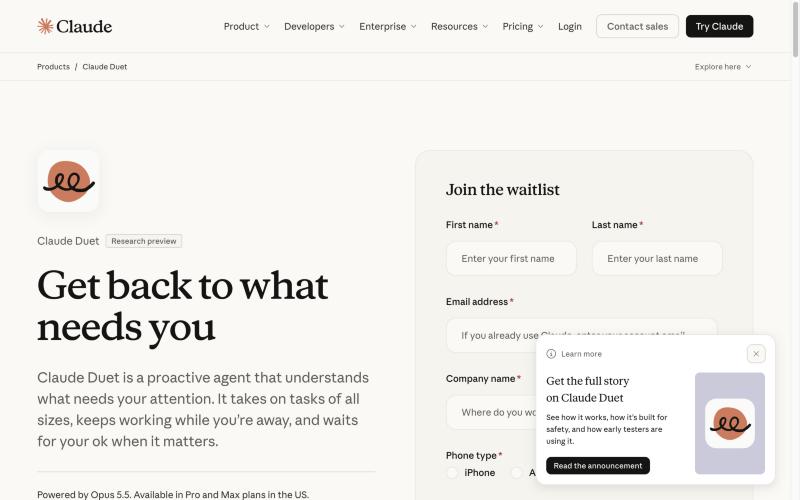
The difference from the Claude app, in Anthropic’s words, is who goes first. The Claude app waits for you to open a chat. Duet “comes to you”: it tells you each morning what needs attention, takes tasks by message, and reaches out when one is done or needs approval.[3]
| The Claude app | Claude Duet | |
|---|---|---|
| Who starts? | You open a chat and work alongside Claude. | Duet comes to you: a morning brief, then messages when something needs you. |
| Where does the work happen? | In the conversation you are watching. | In the background, on Duet’s own cloud computer, with a notification when done. |
| What does it know? | Your Claude account’s memory, skills and connectors. | The same: memory, skills and connectors carry over from your account. |
| Conversation shape | Many chats. | One ongoing thread, by typing or voice. |
| Where do you use it? | The Claude app. | A separate app on iOS and Android, and claude.ai on the web. |
From Anthropic’s product-page FAQ and announcement, condensed.
A day with it
Each morning Duet sends a short brief on the most important items across your connected apps. Through the day it keeps tabs on those apps and messages you only when something needs your attention. You can also hand it tasks of all shapes, from scheduling meetings to building dashboards with dozens of tools, creating financial or sales forecasts, prototyping and building web apps.[1]
- Morning
A short brief on the most important items across your connected apps.
- Through the day
It keeps tabs on those apps, checking every few hours, and messages you only when something needs attention.
- Any time
You hand it a task in a short message, by typing or voice. It works out the apps and steps itself.
- In the background
It works on its own cloud computer. You get a notification when the task is done or needs review.
- Before anything risky
It shows exactly what it is about to do and waits for your approval.
Illustration: our ordering of behaviours Anthropic documents. It is not a recording of a real day.
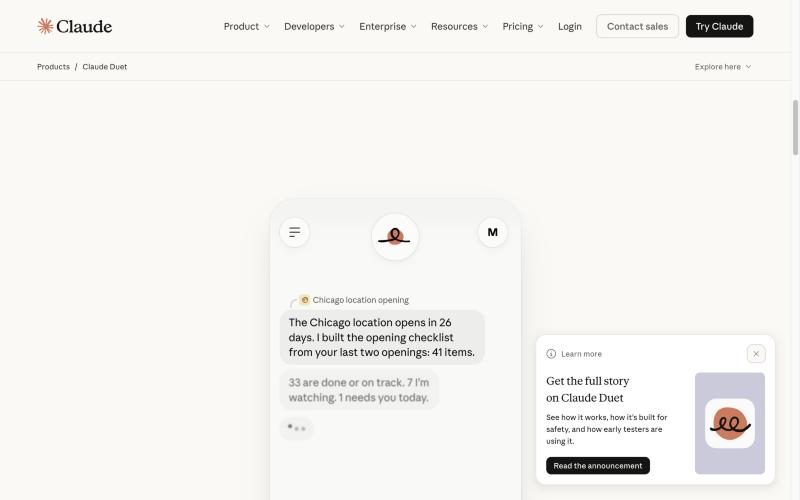
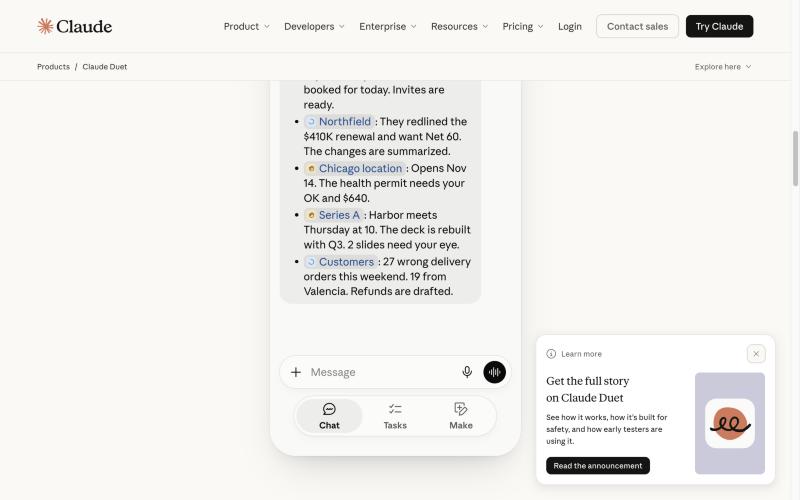
Anthropic’s product page runs a sample conversation in a phone mock-up. The sample shows Duet reporting on a Chicago location opening and listing items that need the user’s attention. It is Anthropic’s demonstration, not a real user’s account.[3]
Anthropic also published short stories from testers. A broker named Jess Provencher said Duet flagged, unprompted, a showing on her calendar on the wrong day, calling it “exactly the kind of thing I want caught without having to ask.” Amin Ebrahimi, owner of Shahs of Kabob, said of using it for accounting, customer support and marketing, “I don’t need to open up 100 tabs.”[1]
- Anthropic
Boris Cherny, leads Claude Code
Talks through his mental to-do list with Duet on walks.
- Anthropic
Chelsea Larsson, leads model and product behavior design
Hands Duet her to-do list before leaving to be with her kids and gets results in an evening report.
- Anthropic
Karan Ahuja, leads the Duet team
Schedules user interviews, builds prototypes and ships code with it.
- Owner
Jess Provencher, broker, Pro Homes
Duet flagged, unprompted, a property showing on her calendar on the wrong day.
- Owner
Mya Dalton, brand strategist
Duet prepared a call brief, noticed the call fell right before her flight and offered to move it.
All five are stories Anthropic chose to publish. The three “Anthropic” rows are Anthropic employees describing their own product.
How it works
Your context from Claude is the foundation. Duet carries over memory, skills and connected apps from your Claude account, so there is little to set up, and you message it by typing or voice in one ongoing thread.[1] It runs on a virtual machine with its own browser, which is why it does not need your laptop or phone to be on.[1] Anthropic’s X thread adds that it was designed around Claude Opus 5.5, which gives it the judgment to decide what needs you, what can wait, and when to check with you first.[2]
You
Typing or voice, one thread. Approvals and steering.
Claude Duet
Built around Claude Opus 5.5, which supplies the judgment about what needs you, what can wait and when to ask.
Your Claude account
Memory, skills and connected apps, carried over.
Its own cloud computer
A virtual machine with a browser. Approvals, logins and safety checks run here.
Your apps
Gmail, Slack, QuickBooks, Stripe and others through connectors.
Our diagram of what Anthropic’s announcement and product page describe. Anthropic does not publish an architecture diagram.
One detail shapes how you will use it. Duet “checks your connected accounts every few hours”, Anthropic says, because checking nonstop would use up your plan’s limits much faster.[1] The product page says plainly that it can miss something that arrives between check-ins.[3] It is proactive on a schedule, not a live alarm.
What it asks you first
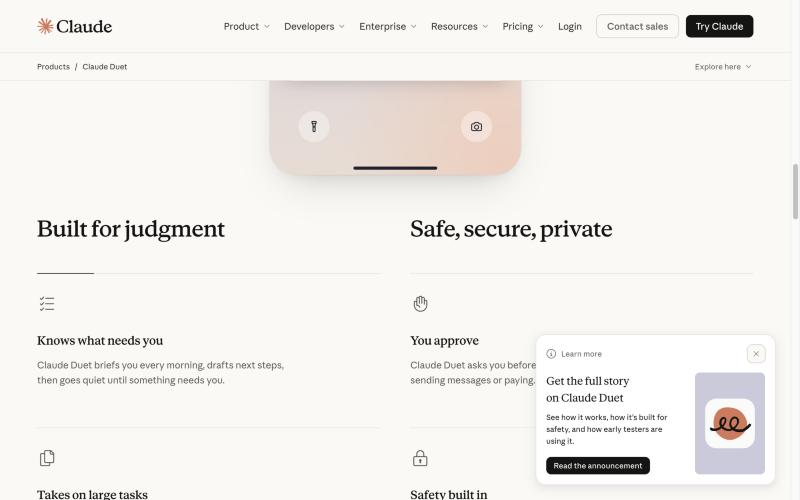
Duet reads, drafts and prepares work on its own. Before it sends a message, makes a payment, signs a document or deletes anything, it shows you exactly what it is about to do and waits for your approval.[1] Some things are off-limits even with your approval, such as trading securities or moving money between accounts.[1] You can also disconnect any app it has access to.[1]
Reads, drafts, prepares
Send, pay, sign, delete
Even with approval
Anthropic says “a few things” are off-limits and names these two. The full list is not published in the pages we read.
How it is kept safe
An agent that reads your email and acts on it is a target. Anthropic names five layers for Duet: its framework for trustworthy agents, a credential design that means Duet never directly sees your passwords or sign-in tokens, an auto mode classifier that approves actions, defences against hidden instructions in web pages and messages, and adversarial testing by red teams and an external firm, with Duet covered by its public bug bounty program.[1]
- Framework
Trustworthy-agents framework
The same framework that guides Claude Code and Claude in Chrome.
- Credentials
Never sees passwords or sign-in tokens
Handled the way Claude Managed Agents handles them.
- Actions
Auto mode classifier approves actions
The safeguard that stops Claude and Claude Code taking steps you did not ask for.
- Injection
Defences against hidden instructions
From Anthropic’s browser-use research on prompt injection.
- Testing
Red teams, an external penetration test, a bug bounty
Duet is covered by Anthropic’s public bug bounty program.
Anthropic’s five stated layers. These are claims in a launch post; Anthropic says it will publish more detail on Duet’s safety design.
The framework behind the first layer has five principles: keeping humans in control, aligning with human values, securing agents’ interactions, maintaining transparency, and protecting privacy.[4] Its authors say that as agents become more capable, the risks of misreading intent and of prompt injection both intensify.[4]
On credentials, Anthropic’s Managed Agents post explains the design Duet says it follows. In an older, coupled design, code Claude generated ran in the same container as credentials, so a prompt injection only had to convince Claude to read its own environment. The fix was to keep tokens out of the sandbox: OAuth tokens sit in a vault, and Claude calls tools through a proxy that fetches them, so the harness is never made aware of any credentials.[5]
Tokens in the same place as the code
Tokens kept outside the sandbox
From Anthropic’s Managed Agents post. Duet’s announcement says its credential handling follows this design.
On approvals, Anthropic’s auto mode post describes a classifier that decides whether an action matches what the user asked for. It was built for Claude Code, where it says users accept 93% of manual permission prompts anyway, which leads to approval fatigue.[6] Our reading, not Anthropic’s, is that a proactive agent makes this worse, because many small decisions arrive while you are not watching, so automated checks matter more than a prompt for every step.
Duet adds one new safeguard. Anthropic says it is releasing it with a dedicated classifier and a safety system prompt that check each message and guard against leaks of sensitive information. They are designed to reject requests to share the strictest tier, including credit card numbers and government identification. Other sensitive information, such as health or personal finances, goes through only when you have explicitly told Duet to send it.[1]
Requests to share are rejected
Shared only if you explicitly instruct it
The check is a new dedicated classifier plus a safety system prompt, run on each message. Anthropic does not publish how well it works.
The X thread says the same, that the important decisions stay with you, and promises more on safety soon.[2] Until that write-up appears, treat the design as stated intent. Anthropic has not published error rates for any of these checks in the pages we read.
What it can connect to
Duet can use the more than 6,000 connectors and plugins in the Claude Marketplace.[1] Anthropic’s examples run from finding missed Gmail and Slack messages, to checking QuickBooks or Stripe for unpaid invoices, to preparing payroll in Gusto, sending agreements through Docusign, and managing a Shopify store.[1]
- Inbox
Gmail and Slack
Find messages you missed and help you reply.
- Money in
QuickBooks and Stripe
Check for unpaid invoices and draft reminders.
- People
Gusto
Prepare and run payroll with hours, bonuses and reimbursements filled in.
- Hiring
LinkedIn
Draft a job posting and, once you edit and approve, post it.
- Contracts
Docusign
Help prepare agreements and send them for review and signature.
- Sales
HubSpot
Draft follow-ups from contact and deal history.
- Marketing
Canva
Turn a product launch into a social campaign.
- Store
Shopify
Set up, design and manage a store. A richer visual editor is listed as coming soon.
Anthropic’s examples from its announcement. It says Duet can use over 6,000 connectors and plugins in the Claude Marketplace; these eight are examples, not a complete list.
It can also buy things for your business. Duet confirms the item with you, and Link, Stripe’s digital wallet, asks you to approve the spend, then pays with a virtual card so your real card number is not shared. It can also use Shop Pay from Shopify at online stores. Signing in to sites with logins saved in 1Password is listed as coming soon.[1]
- 1
You ask Duet to buy something for your business.
- 2
Duet confirms the item with you.
- 3
Link, Stripe’s digital wallet, asks you to approve the spend.
- 4
It pays with a virtual card, so your real card number is not shared.
Also named: Shop Pay from Shopify for checking out at online stores. Signing in to sites with logins saved in 1Password is listed as “coming soon”.
Who can use it, and the cost
For the research preview, Duet is included in Pro and Max plans and uses the same usage limits as the rest of Claude.[1] The product page says Team and Enterprise plans are not included yet, and that on a computer you open it on the web at claude.ai.[3] The X thread repeats that it is a waitlist for Pro and Max in the US.[2]
Research preview, by waitlist
Team and Enterprise plans
Included in the plan
Waitlist form
As on Anthropic’s pages on 22 October 2026. A research preview can change quickly.
Usage deserves a plain warning. Duet’s background checks count toward your limits, and larger tasks like a financial model or deck need more model turns and background work.[1]
Background checks
Large tasks
Anthropic does not publish a number for how much of a plan Duet uses. Watch your own usage during the preview.
How to get ready and use it
You cannot use Duet yet unless Anthropic has let you off the waitlist, so this is a plan built from what Anthropic documents. We have not tried it. The waitlist form on the product page asks for your name, email, company, phone type and what you would hand off first, and Anthropic says it will email when Duet is ready for you.[3]
- 1
Join the waitlist on Anthropic’s page, if you are on Pro or Max in the US.
- 2
Before access arrives, tidy your Claude account: memory, skills and connected apps all carry over.
- 3
Connect only the apps you would hand over, and know you can disconnect any of them.
- 4
Pick a first task that is low risk and easy to check, such as a morning brief or drafting reminders.
- 5
Tell it what you want to hear about and how often.
- 6
Read every approval screen. It shows exactly what it is about to do.
- 7
Watch your usage during the first week.
Illustration: our suggested order, built from what Anthropic describes. We have not used Duet.
Anthropic says you can tell Duet what you want to hear about and how often, and that you describe a task in a short message and it works out the apps and steps.[1] So a good first message is short and concrete. Three examples of the sort of request Anthropic’s own examples suggest, written by us and not tested:
- “Each morning, tell me only about client emails and anything on my calendar that clashes.”
- “Check Stripe for unpaid invoices over 30 days and draft reminders for me to approve.”
- “Prepare a one-page brief before each external call this week.”
Limits and unknowns
Anthropic is candid that this is early. Duet may misread a thread or miscalibrate what is urgent, personal errands such as booking tickets are weaker than work tasks, and it cannot yet show you its browser. For now it lives in its own app, separate from the main Claude app.[1] The X thread repeats that it can still misjudge what is urgent.[2]
- Judgment
May misread a thread or miscalibrate what is urgent
Anthropic says this plainly, and that it will keep tuning it.
- Timing
Can miss something that arrives between check-ins
Checks are every few hours, not continuous.
- Errands
Personal errands are weaker than work
Booking tickets is Anthropic’s example. The core was built around work.
- Visibility
Cannot yet show you its browser
You can see what it has done and is doing, and steer it.
- Separate
Lives in its own app
Separate from the main Claude app for now.
All from Anthropic’s announcement and product-page FAQ.
Beyond those, there is much we cannot say. No independent test, error rate or measured usage figure appears in the sources we read, and the testimonials are chosen by Anthropic.
- Safety
The full safety write-up
Anthropic says it will share more about Duet’s safety design “in the coming days”. We did not find it in the pages we read.
- Numbers
How often it is right
No error rates, no measured false alarms and no independent test in the sources we read.
- Usage
How much of your plan it uses
Described in words only.
- Reach
Countries and plans beyond US Pro and Max
No dates given.
- Later
How it joins the main Claude app
Anthropic says early users will shape this.
What we could not find in Anthropic’s pages on 22 October 2026.
The message
Claude Duet is a bet that the next step after a chat assistant is one that comes to you: a morning brief, background work on its own cloud computer, and a firm habit of asking before it sends, pays, signs or deletes. Anthropic’s safety claims are detailed and consistent with its earlier agent work. What nobody outside Anthropic can yet tell you is how often it gets the judgment right.
Join the waitlist if you are on Pro or Max in the US, start with low-risk drafts and briefs, and read every approval screen.
Quick quiz
Tap a question to check your answer.
Q1What is Claude Duet, in one sentence?
A new Anthropic app where Claude works as a proactive agent: it brings what needs your attention, completes tasks, keeps working when you step away, and checks with you before it acts for you.
Q2Who can use it today, and what does it cost?
Pro and Max subscribers in the US, by waitlist, as a research preview. It is included in those plans and shares their usage limits. Team and Enterprise are not included yet.
Q3What must you approve first?
Sending a message, making a payment, signing a document or deleting anything. Trading securities and moving money between accounts are off-limits even with approval.
Q4Why does Duet not need your phone or laptop on?
It has a virtual machine with its own browser, so it works in the background and notifies you when a task is done or needs review.
Q5Name two limits Anthropic states.
It may misread what is urgent, and checks run only every few hours so it can miss something in between. Personal errands are weaker than work tasks, and it cannot yet show its browser.
References
The sources behind this article: original papers, official announcements and documentation. Each link was opened and checked on ; documentation without a fixed date is cited as it read that day.
- [1]
Anthropic (21 October 2026). Introducing Claude Duet. Claude (claude.com).
Announcement · Supports: What Duet is, the morning brief, background work, approvals and off-limits actions, the five safety layers, the sensitive-information classifier, connectors, purchases, availability, usage and limits
- [2]
Claude (@claudeai) (22 October 2026). We’re opening a research preview of Claude Duet…. X (a post and thread, read without logging in).
Announcement · Supports: The one-sentence description and video, the Opus 5.5 design, the safety post and the waitlist for Pro and Max in the US
- [3]
Anthropic. Claude Duet | Your personal AI assistant. Claude (claude.com, opened in a browser, 22 October 2026; nothing submitted).
Announcement · Supports: The FAQ: how Duet differs from Claude, the sample conversation, Team and Enterprise not included, the web at claude.ai, and that it can miss items between check-ins
- [4]
Anthropic (9 April 2026). Trustworthy agents in practice. Anthropic Research.
Announcement · Supports: The agent loop, the four components (model, harness, tools, environment) and the five principles of the trustworthy-agents framework
- [5]
Anthropic (8 April 2026). Scaling Managed Agents: Decoupling the brain from the hands. Anthropic Engineering.
Announcement · Supports: Why credentials are kept in a vault outside the sandbox and reached through a proxy, the design Duet says it follows
- [6]
Anthropic (25 March 2026). How we built Claude Code auto mode: a safer way to skip permissions. Anthropic Engineering.
Announcement · Supports: Approval fatigue (93% of manual prompts accepted) and the classifier that decides whether an action matches what the user asked
How this article was made
Researched and drafted with the help of AI assistants, checked against the sources above, and published by Mrinal Singh Raja as general information, not professional advice. Facts come from the sources listed and may change, so please check them before relying on them. Spotted a mistake? Tell us and we will correct it. Our editorial standards explain how AI is used here.
Claude and Claude Duet are made by Anthropic; X, Stripe, Shopify, Gmail and the other apps named are made by their own companies. MSRX is independent and is not affiliated with or endorsed by any of them. Anthropic’s pages and X thread were opened in a browser on 22 October 2026; nothing was submitted or entered, and the waitlist was not joined. Quotes are word for word from the linked sources. Facts were checked on 22 October 2026 and may change, because this is a research preview. Anthropic’s images are used to illustrate the product it announces; the app’s icon and screenshots belong to Anthropic.