The blackout on one page
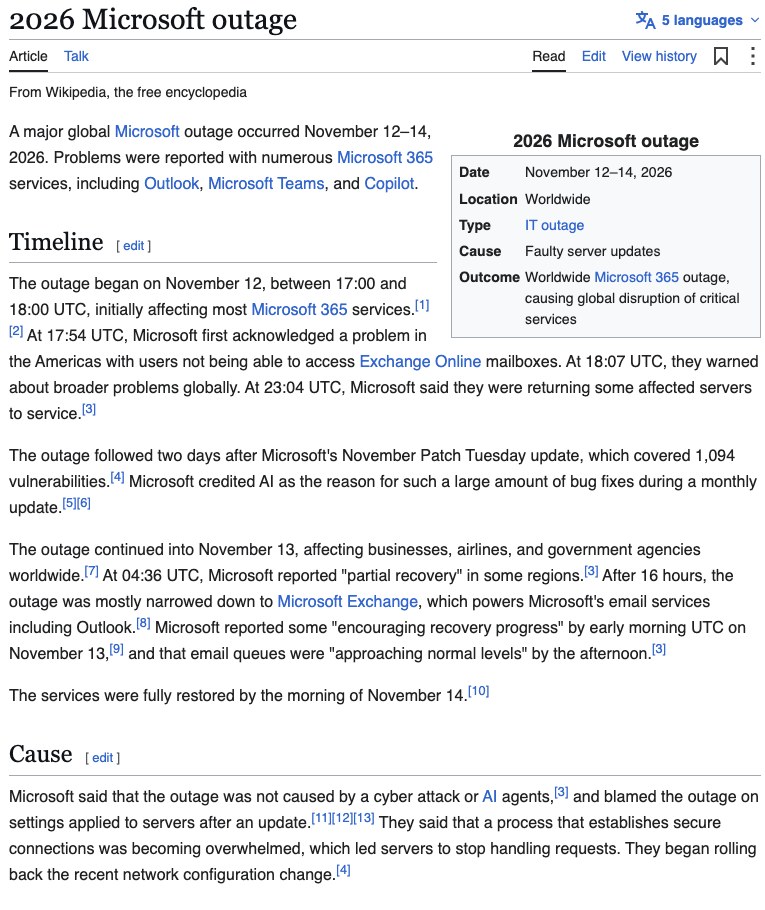
Between Thursday 12 and Friday 13 November 2026, email and a long list of other Microsoft 365 services stopped working for organisations around the world. Microsoft’s own incident record puts the start at 16:20 UTC on Thursday and the end of customer impact at 16:10 UTC on Friday, which is 23 hours and 50 minutes (our arithmetic).[1] That is the “24 hours” in the title. Outlook India also describes it as more than 24 hours.[2]
Users in the Americas were first to find they could not reach their Exchange Online mailboxes.[3] Microsoft’s status account soon warned that the problem could affect users in any region.[4] The disruption ran through the US morning on Friday and across the Asian and European working days, and CNBC says Microsoft reported on Saturday that service was restored to the remaining customers and regions.[5]
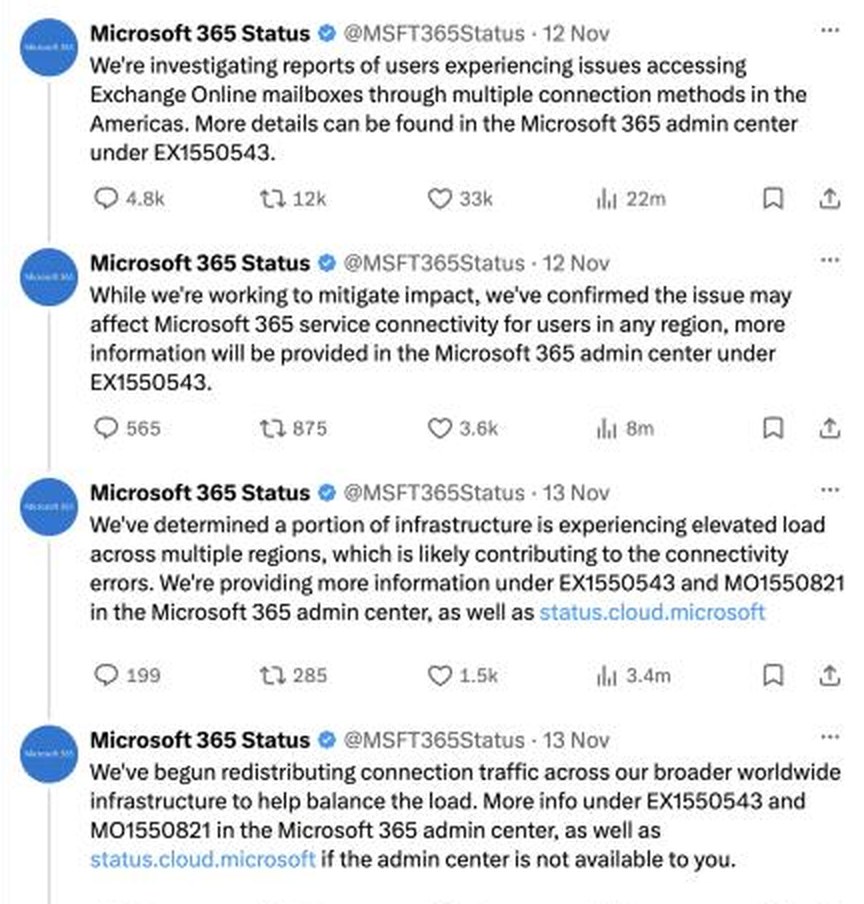
On Friday Microsoft apologised, saying it was “deeply sorry” for the disruption to customers and partners, and said the cause was a technical issue unrelated to cyber attack or AI agents.[6] It also said it restored service gradually, checking stability at each stage, and would publish a full post-incident report once its review is complete.[6]
Thu 12 Nov · 16:20 UTC
Impact starts
Start time in Microsoft’s incident record for EX1550543. Users in the Americas cannot reach Exchange Online mailboxes.
Thu · about 17:54 UTC
First public post
Microsoft’s status account posts that it is investigating, then warns within minutes that any region may be affected.
Thu · 18:57 UTC
Deployments paused
Deployments and configuration changes are halted while the team looks for the cause.
Thu evening
Servers failing checks
Many servers fail automated health checks and drop out. An alternative health-check method brings a first subset back.
Thu night to Fri 13 Nov
Rollback and capacity
A recent network change is reverted, capacity is added, a patch is applied and the email retry window is extended to 48 hours.
Fri · 11:01–13:00 UTC
Regions recover
Asia Pacific first, then Europe, then North America.
Fri · 16:10 UTC
Impact ends
End time in the incident record. Monitoring and the email backlog continue; a final status follows on Saturday.
Times are Microsoft’s own, as mirrored by Cloud Admin Hub, plus the first public post time from Wikipedia. Between the 16:20 start and the 16:10 end is 23 hours 50 minutes (our arithmetic). The mirror’s page header also shows a 10:05 start and “30h 5m”, which does not match its own details.
Nearly half a billion? Checking the headline
A headline number deserves a check, and this one fails it. Wikipedia’s outage article says around 430 million people globally use Microsoft 365.[7] Microsoft’s own January 2026 results put paid commercial seats above 450 million, up 6% on the year.[8] Both numbers describe the size of the customer base. Neither says how many people lost access.
≈ 430M
“People who use Microsoft 365”
Wikipedia’s figure; all users, not those affected
450M+
Paid commercial seats
Microsoft, January 2026: the total customer base
Not published
People actually cut off
Microsoft has given no count
The two big numbers describe how many people Microsoft 365 has, not how many lost access. A “seat” is a paid licence, not a unique person. The outage hit Exchange Online and the services that lean on it, and the status page said components that do not depend on Exchange Online stayed up.
Sources: Wikipedia (430 million), Tony Redmond’s report of Microsoft’s FY26 Q2 results (450 million paid commercial seats), SecurityWeek (components not dependent on Exchange Online stayed functional).
None of the reports I opened gives a count of affected users or organisations.[5] What the sources do give is geography: Wikipedia says issues were reported in more than 70 countries, and Outlook India says at least 74.[7][2] And the status page said components that do not depend on Exchange Online stayed functional, so “everything stopped” overstates it.[3]
What went down
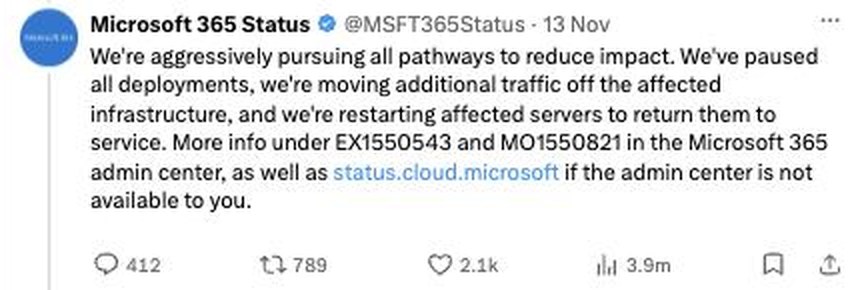
Microsoft tracked the problem under two incident numbers. EX1550543 covers Exchange Online mailbox connections; MO1550821 covers the wider Microsoft 365 impact.[3] Outlook on the web, the Messaging API, Exchange ActiveSync and the REST API were among the ways of connecting that failed, and mail flowing to or from on-premises systems may also have been affected.[1]
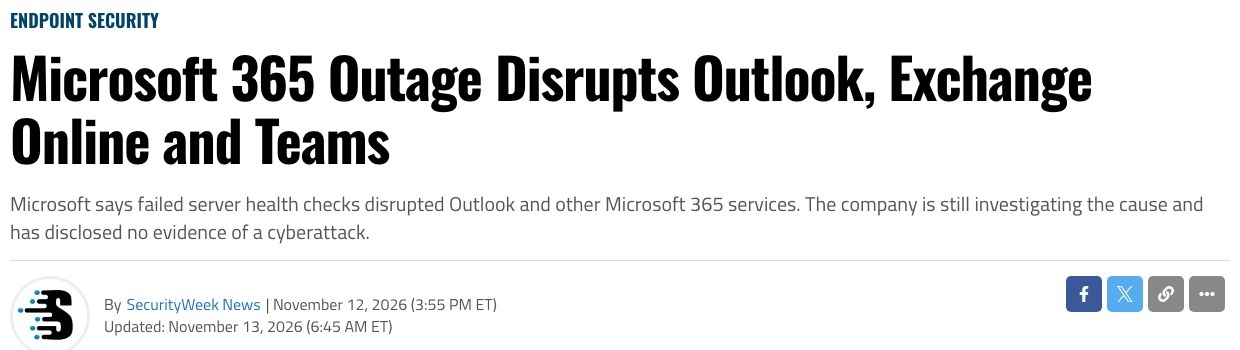
Teams, SharePoint Online, Microsoft 365 Copilot and Defender XDR were among the services hit because they interact with Exchange Online.[3] The Register adds Intune and the Microsoft 365 Apps Admin Center, which meant administrators lost some of the tools they would use to diagnose the problem.[9] SecurityWeek also notes that some Google Workspace users reported trouble reaching Google-hosted mail through Outlook clients.[3]
At the centre · incident EX1550543
Exchange Online mailboxes
Outlook on the web, MAPI, Exchange ActiveSync and the REST API; on-premises mail flow to or from Exchange Online too.
…and everything that leans on it (incident MO1550821)
Teams
CNBC, The Register, SecurityWeek
SharePoint Online
SecurityWeek, CNBC
Microsoft 365 Copilot
SecurityWeek, The Register
Defender XDR / Defender for Office 365
SecurityWeek, The Register
Intune
The Register
Apps Admin Center
The Register: admins lost tools to diagnose
Outlook.com, OneDrive, OneNote, To Do
Personal services, per Outlook India
Compiled from the sources named on each card. Not every service failed for every user; reports varied by region and hour.
What Microsoft says broke
Microsoft’s explanation, as of Friday, is that the incident was introduced by an issue during an earlier network capacity upgrade, which surfaced after a more recent network change.[6] A fuller, still preliminary, account appears in the incident text as mirrored by Cloud Admin Hub: a failure in the systems that establish secure connections to the service. Traffic shifts during routine network maintenance exposed a latent bug, so new connection requests could not complete and queued up; the affected servers then ran out of processing capacity and could no longer accept new connections.[1]
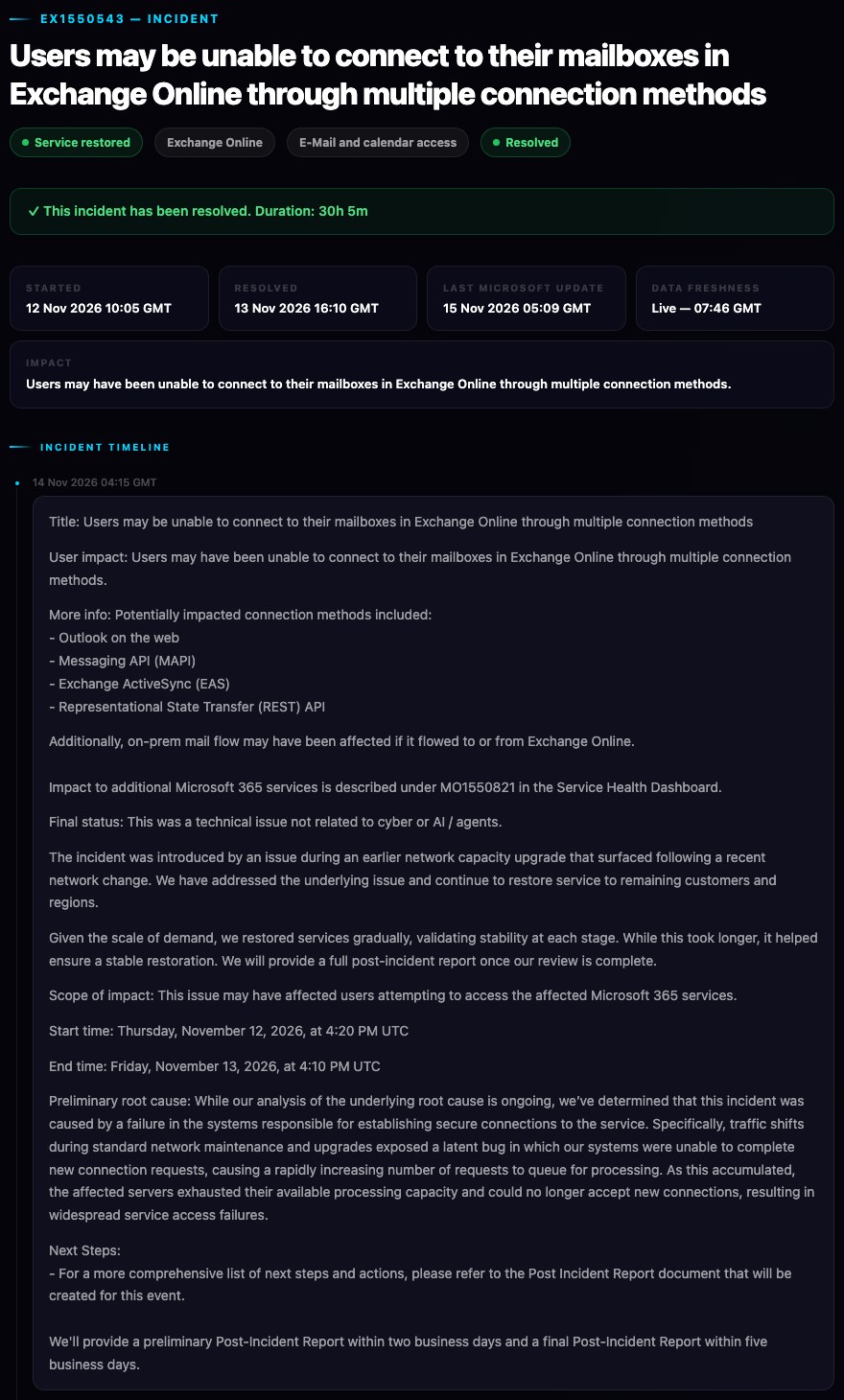
SecurityWeek’s description matches in outline: a process that establishes secure connections became overwhelmed, causing affected servers to stop handling requests, and Microsoft began rolling back a recent network configuration change that coincided with the start of the disruption.[3] Two outside write-ups of Microsoft’s text agreeing in outline is useful, but both rely on Microsoft to describe its own failure.
- 1
An earlier network capacity upgrade
Microsoft says the incident was introduced here. Nothing visibly broke.
- 2
A later network change shifts traffic
Traffic shifts during maintenance exposed what Microsoft calls a latent bug.
- 3
New connections cannot complete
The systems that set up secure connections stall, and requests queue up.
- 4
Servers run out of capacity
They stop accepting connections and fail automated health checks.
- 5
The rest carry more load
Microsoft says “a number of servers being unexpectedly unavailable” strained the remaining infrastructure.
Our illustration of Microsoft’s preliminary description. The steps and their order simplify what Microsoft wrote; the post-incident report may change the picture.
How the explanation changed, and one tension
Microsoft’s story moved through several steps in about a day. It began as mailbox connectivity errors in the Americas, became “elevated load” across regions, then a finding that the load came from servers being unavailable, then failing health checks, and finally the capacity-upgrade explanation.[4][6]
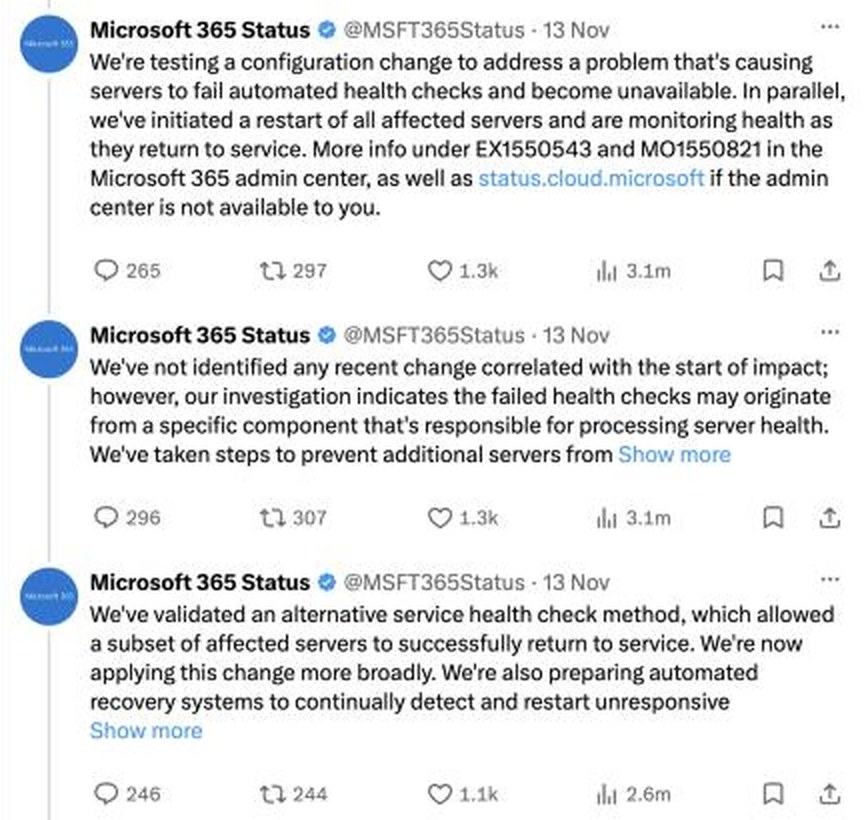
Microsoft says it is investigating mailbox access problems in the Americas, then that any region could be affected.
A portion of infrastructure has “elevated load” across several regions, which is likely adding to the errors.
The load is not from more traffic. Many servers are unexpectedly unavailable, which strains the rest.
Servers fail automated health checks and drop out; later, a core process on them is described as overwhelmed.
One post says no recent change lines up with the start of impact. Another says Microsoft is weighing a revert of a few recent configuration updates.
A technical issue, not cyber or AI. It began in an earlier network capacity upgrade and surfaced after a recent network change.
Paraphrased from posts by @MSFT365Status and The Register, in the order Microsoft made them. Changing an explanation as evidence arrives is normal in an investigation; it is not a sign of anything hidden.
There is one visible tension. The Register reports that Microsoft said it had not identified any system change that might have triggered the incident, while its status page also spoke of assessing a revert of a small number of recent configuration updates.[9] Microsoft later pointed to a network change. One way to reconcile them, and it is only our reading, is that the root fault sat in the earlier capacity upgrade rather than in anything recent. Microsoft has not said so, and the post-incident report is where this should be settled.
What is ruled out, and what is only unlinked
The first questions people ask after a global failure are whether it was an attack, whether AI was involved, and whether the latest update caused it. The honest answers differ in strength. On the first two Microsoft has spoken directly: it said at this stage there was no evidence of malicious activity, and that the incident was not related to cyber or AI agents.[3][6] That is Microsoft’s statement, not an outside finding.
The update question is murkier. The outage came two days after November’s Patch Tuesday, which fixed 1,094 vulnerabilities including an Outlook spoofing flaw Microsoft said had been exploited. Microsoft’s advisories have not linked that release to the outage.[3] Wikipedia’s infobox labels the cause “faulty server updates”, which is looser than Microsoft’s own wording about a network capacity upgrade and a network change.[7] Timing alone does not show cause.
A cyberattack
“No evidence of malicious activity associated with this incident” (status page, via SecurityWeek). Not independently verified.
AI or AI agents
“Not related to cyber or AI / agents.” Copilot was among the services that went down.
A surge in demand
Overall traffic had not increased; servers were unavailable (SecurityWeek, Microsoft’s posts).
The 10 November Patch Tuesday update
Fixed 1,094 vulnerabilities two days earlier. Microsoft’s advisories have not linked it (SecurityWeek). Timing alone proves nothing.
An AWS or Google outage
Some users reported problems elsewhere; Amazon said its services were operating normally (CNBC).
Network capacity upgrade plus a later network change
Preliminary. A full post-incident report is promised.
Where the evidence stands on 15 November 2026. “Microsoft says” means Microsoft’s own statement, not an outside finding.
Why it took a day to fix
Microsoft’s first fixes did not work. On Thursday it said its actions so far had not provided the anticipated relief.[9] A workaround that bypassed the component processing health checks brought some servers back,[3] but The Register reported that returned servers might stop responding again once traffic reached them.[9] Recovery therefore had to be slow: isolate part of the infrastructure, restart it, reintroduce traffic and confirm it is stable, then widen.[9]
Stop making changes
Deployments and configuration changes were paused on Thursday evening so nothing new could make things worse.
Move traffic away
Connection traffic was redistributed across the wider infrastructure and moved off the affected servers.
Restart and re-test
Microsoft described isolating a portion of infrastructure, restarting components and reintroducing traffic to confirm stability before widening.
Change the health check
An alternative service health check method let a subset of servers return, then was applied more broadly.
Rebuild, patch and add capacity
Servers were rebuilt on a previous configuration, capacity was added, and a patch was applied to a subset and then widened (Cloud Admin Hub’s mirror).
Protect the mail
The delayed-mail timeout was extended to 48 hours so queued messages would be retried instead of bouncing.
The incident record shows recovery arriving region by region: Asia Pacific first, then Europe, then North America, with capacity added and a patch applied first to a subset and then more widely.[1] The retry window for delayed mail was extended to 48 hours to preserve messages.[5] Microsoft’s own explanation for the pace was that, given the scale of demand, it restored services gradually, which took longer but helped ensure stability.[6]
Who felt it
CNBC reports that organisations affected included the UK’s NHS, the Swiss luxury group Richemont, which delayed its earnings, and Workhorse Group, which moved its results to 16 November; it also says Air India temporarily rerouted email.[5] Outlook India adds a Manchester court sending jurors home, a Colorado sheriff’s office asking people to post bond in person, some Japanese companies returning to fax, and email disruption at the airlines IndiGo and Akasa Air.[2] Wikipedia lists government departments in five countries and hospitals in Toronto.[7]
Health
UK NHS staff reportedly moved to paper records (Outlook India). Toronto hospital networks had difficulties and one declared a code grey; the NHS cancelled some operations (Wikipedia).
Courts and government
A Manchester court sent jurors home and a Colorado sheriff’s office asked people to post bond in person (Outlook India). Departments in Australia, Japan, the Philippines, Singapore and the US were affected (Wikipedia).
Business
Richemont delayed its earnings and Workhorse Group moved its results to 16 November (CNBC). Air India rerouted email; IndiGo and Akasa Air had email problems (CNBC, Outlook India).
Schools
Ofqual, the Department for Education and many schools in England had major disruption (Wikipedia).
Each claim names the outlet that reported it. Wikipedia is a crowd-edited summary and I did not open its underlying sources, so those lines are the least certain on the page.
One more detail keeps this in proportion: Microsoft’s shares traded largely flat on Friday, CNBC reports.[5] Amazon also said its services were operating normally after some users blamed it for the same problems, which is a reminder that during a big outage unrelated services get blamed too.[5]
Known and unknown, and the January outage
This was not Microsoft 365’s only big failure this year. On the evening of 22 January 2026 an outage hit North America for nearly 10 hours, with Microsoft blaming a portion of service infrastructure that was not processing traffic as expected.[10] The two incidents differ in size and in the causes Microsoft gave, and nothing in the sources links them.
| January | November | |
|---|---|---|
| Dates | 22–23 January 2026 | 12–14 November 2026 |
| Where | North America | Worldwide; more than 70 countries reported |
| How long | Nearly 10 hours (The Register) | About 24 hours of core impact; backlog and monitoring into 14 November |
| Services | Outlook, Defender, Purview; external mail largely blocked | Exchange Online, Teams, SharePoint, Copilot, Defender, Intune and more |
| Microsoft’s stated cause | A portion of North American service infrastructure “not processing traffic as expected” | A fault from an earlier network capacity upgrade, surfaced by a later network change |
January row from The Register’s report of 23 January 2026; November row from the sources in this article. The two causes are described differently, and nothing in the sources links them.
Exchange Online and related services failed from 12 November; Microsoft’s incident record puts impact from 16:20 UTC on 12 November to 16:10 UTC on 13 November (Microsoft’s record, via a mirror).
Microsoft apologised and said it was “a technical issue not related to cyber or AI / agents” (Microsoft’s own post; CNBC).
The cause: an earlier network capacity upgrade, a later network change, and a latent bug in the systems that set up secure connections. Microsoft calls the analysis ongoing.
Wikipedia says “faulty server updates”; Microsoft’s own wording is a network capacity upgrade and a network change. The incident page’s start time also disagrees with itself (10:05 against 16:20 UTC).
How many people or organisations were cut off. Microsoft has published no count; the 430 and 450 million figures are customer totals.
The final root cause and the fixes. Microsoft promised a preliminary post-incident report within two business days and a final one within five; I found neither published yet.
The cost. Wikipedia mentions an estimate of about $7 billion in lost productivity, attributed to Anderson Economic Group; I did not open that estimate, so I do not rely on it.
The summary is that the timeline and the headline cause are well documented, the exact mechanism is preliminary, and the scale, the cost and the fixes are not yet known. When Microsoft’s post-incident report arrives, check it first against three open points: whether the cause is the capacity upgrade alone, what the “recent network change” was, and what Microsoft will change so a single latent fault cannot take mail down worldwide.
What to do with this
If you use Microsoft 365
Delayed mail was kept and retried for up to 48 hours, so a missing message is not necessarily lost. Check the status page before reinstalling or resetting anything.
If you run IT
Microsoft’s own admin centre was hit too, and it pointed people to status.cloud.microsoft. Keep a contact route that does not depend on Microsoft 365, and rehearse working without email.
If you lead a team
Decide in advance how the team talks, signs off urgent work and reaches customers when email and chat are both down. General guidance, not a claim about any one company.
For a deeper look at how to read a big, fast-moving number without being fooled by it, see the previous article in this series, The $2.5 Trillion Day: What Really Happened When Wall Street Priced In an AI Slowdown. The same habit applies here: ask who said it, what it counts and when it was measured.
The message
The outage was real, global and about a day long, but “nearly half a billion cut off” is Microsoft’s whole customer base, not a count of victims: check what a big number actually counts.
Quick quiz
Tap a question to check your answer.
Q1How long did the core impact last, by Microsoft’s own incident record?
From 16:20 UTC on 12 November to 16:10 UTC on 13 November, which is 23 hours 50 minutes (our arithmetic). Monitoring and the email backlog continued afterwards.
Q2Why is “nearly half a billion users cut off” misleading?
The 430 million and 450 million figures describe Microsoft 365’s customer base (people who use it, and paid commercial seats). Microsoft has not published how many were affected.
Q3What does Microsoft say caused the outage?
A technical issue introduced during an earlier network capacity upgrade that surfaced after a recent network change. Preliminary text adds a latent bug in the systems that set up secure connections.
Q4Name two things Microsoft says it was not.
It said the incident was not related to cyber attack and not related to AI or AI agents, and that it had found no evidence of malicious activity.
Q5Why did mail not bounce back to senders during the outage?
Microsoft extended the delayed-mail timeout to 48 hours, so queued messages kept being retried.
References
The sources behind this article: original papers, official announcements and documentation. Each link was opened and checked on ; documentation without a fixed date is cited as it read that day.
- [1]
Cloud Admin Hub (mirror of Microsoft 365 service health text) (14 November 2026). EX1550543: Users may be unable to connect to their mailboxes in Exchange Online through multiple connection methods. Cloud Admin Hub.
Documentation · Supports: A third-party mirror of Microsoft’s incident text: start and end times, the preliminary root cause, the recovery steps, regional recovery order and the promised post-incident reports. Its header start time disagrees with its own details.
- [2]
Outlook India (14 November 2026). Microsoft Fixes 24-Hour Global Outage That Silenced Outlook and Teams Worldwide. Outlook India.
Reporting · Supports: The more-than-24-hours description, at least 74 countries, personal services affected, and examples such as a Manchester court, a Colorado sheriff’s office and Indian airlines.
- [3]
SecurityWeek News (12 November 2026, updated 13 November). Microsoft 365 Outage Disrupts Outlook, Exchange Online and Teams. SecurityWeek.
Reporting · Supports: Incident IDs EX1550543 and MO1550821, affected services, the no-evidence-of-malicious-activity statement, the overwhelmed secure-connection process, the rollback and the Patch Tuesday context.
- [4]
Microsoft 365 Status (@MSFT365Status) (12–13 November 2026). Status posts during the outage (this link: “We’re aggressively pursuing all pathways to reduce impact…”). X (formerly Twitter).
Announcement · Supports: Microsoft’s own running updates: the first warning, elevated load, servers failing health checks, paused deployments and restarts. The link is one post in the thread.
- [5]
Reid, J., Subin, S. and Keating, C. (CNBC) (12 November 2026, updated 14 November). Microsoft apologizes for massive outage that took down Outlook and other 365 services. CNBC.
Reporting · Supports: The timeline in US time, Microsoft’s apology, the Saturday restoration, affected organisations, the 48-hour mail retry window and Amazon’s statement that its services were normal.
- [6]
Microsoft 365 Status (@MSFT365Status) (13 November 2026). “We are deeply sorry for the disruption this incident has caused our customers and partners…”. X (formerly Twitter).
Announcement · Supports: Microsoft’s apology and final public explanation: not cyber or AI, an earlier network capacity upgrade surfacing after a recent network change, gradual restoration and a promised post-incident report.
- [7]
Wikipedia contributors (Accessed 15 November 2026). 2026 Microsoft outage. Wikipedia.
Reporting · Supports: A crowd-edited summary: the 430 million users figure, more than 70 countries, the first-acknowledgement time, and sector impacts. Used sparingly and flagged; I did not open its underlying sources.
- [8]
Redmond, T. (30 January 2026). Microsoft 365 Exceeds 450 Million Commercial Paid Seats. Office 365 for IT Pros.
Reporting · Supports: Microsoft’s January 2026 figure of more than 450 million paid commercial seats, up 6%, which is the customer base rather than the number affected.
- [9]
Sharwood, S. (The Register) (12 November 2026, updated 13 November). Microsoft struggling to fix massive cloud outage that’s taken down email and Intune. The Register.
Reporting · Supports: Services including Intune and admin tools, failing health checks, the not-yet-identified change versus the possible revert, and the stage-by-stage recovery approach.
- [10]
Speed, R. (The Register) (23 January 2026). Microsoft 365 outage drags on for nearly 10 hours during bad night for North American infra. The Register.
Reporting · Supports: The January 2026 North American outage, used as the comparison: date, duration and Microsoft’s stated cause.
How this article was made
Researched and drafted with the help of AI assistants, checked against the sources above, and published by Mrinal Singh Raja as general information, not professional advice. Facts come from the sources listed and may change, so please check them before relying on them. Spotted a mistake? Tell us and we will correct it. Our editorial standards explain how AI is used here.
Microsoft, Exchange Online, Teams, Outlook, Copilot, Amazon, Google, X and the publications named are independent of MSRX, and this article is not affiliated with or endorsed by any of them. Facts were checked on 15 November 2026 against the sources listed above. Screenshots are real captures from that date, cropped to leave out advertising, sign-in prompts and promotions.