The day on one page
On Thursday 5 November 2026, US technology shares fell so fast that CNN reported roughly $2.5 trillion of market value had been wiped from the Nasdaq Composite in one session, on fears that Democrats’ midterm gains could put the brakes on the AI buildout.[1] The Nasdaq closed 5.52% lower and, in the market’s own language, entered a “correction”, which means it was more than 10% below its record high, set on 6 October.[1]
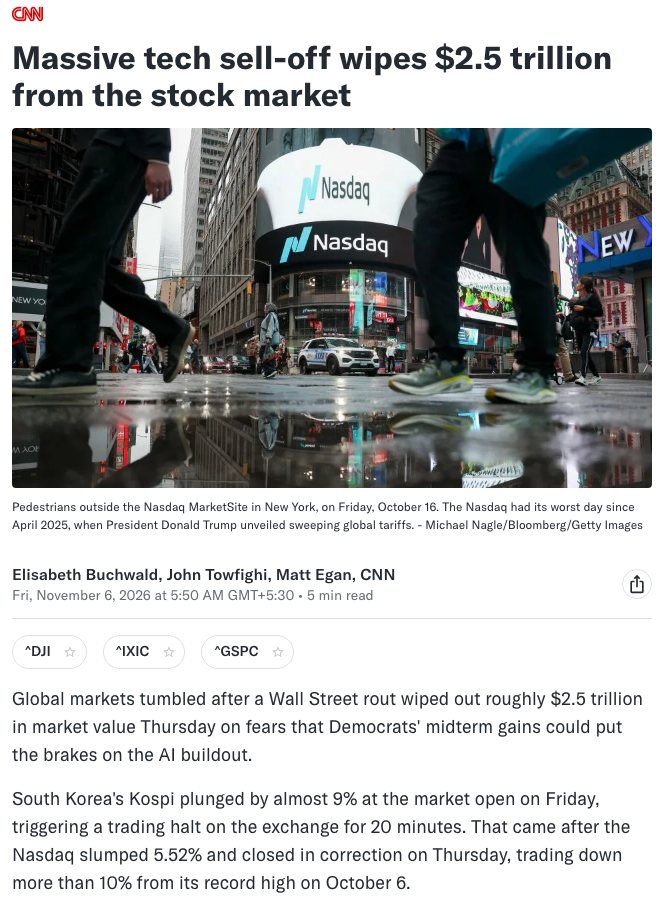
Three words do most of the work in this story, so here they are in plain language. An index is a single number that tracks a basket of shares, such as the Nasdaq Composite, which includes thousands of companies and leans toward technology. A correction is a fall of at least 10% from a recent high; NBC News defines it the same way.[2] And market value (or “market cap”) is a company’s share price multiplied by the number of shares, so when prices fall, value disappears on paper even though no cash has left anyone’s bank account.
The same session also hit the other big US indexes. According to ANI, relaying CNN, the S&P 500 fell 4.36% to 7,353.73 and the Dow Jones Industrial Average dropped 1,833.06 points, or 3.44%, to 51,523.06.[3] CNN says the S&P 500 and the Dow both had their worst day since April 2025, when President Donald Trump unveiled sweeping global tariffs.[1]
−5.52%
Nasdaq Composite
closed at 24,315.00 (ANI)
−4.36%
S&P 500
closed at 7,353.73 (ANI)
−3.44%
Dow Jones
−1,833.06 points, to 51,523.06 (ANI)
−6.36%
Nasdaq 100
worst day since March 2020 (CNN)
−12.3%
Chipmaker index
worst day in about 6½ years (CNN)
+70%
VIX “fear gauge”
roughly; biggest one-day jump in almost two years (CNN)
Thursday 5 November 2026, US closing figures as reported by CNN and by ANI (which cites CNN). The VIX measures expected volatility.
Whose $2.5 trillion? Checking the number
A headline number deserves a check. NBC News gave a different figure for the same day: the Nasdaq 100, a smaller index that includes major tech companies, fell 6.3% and erased $2.3 trillion, while the S&P 500 fell 4.4% and erased $2.8 trillion.[2] CNN’s $2.5 trillion refers to the Nasdaq Composite.[1] So three outlets gave three totals, and each was measuring a different group of companies.

Nasdaq 100
$2.3T
NBC News: index fell 6.3%
Nasdaq Composite
$2.5T
CNN: index fell 5.52%
S&P 500
$2.8T
NBC News: index fell 4.4%
None of these is wrong. Each adds up the value of a different group of companies, so the “$2.5 trillion” in the headline is the Nasdaq Composite’s figure, not the whole market’s.
Values as reported on 5–6 November 2026. “T” is trillion US dollars of stock-market value.
A quick calculation shows why. If you divide each reported loss by its percentage fall, you get the rough total value of the companies in that index. The Nasdaq 100’s works out near $37 trillion, the Nasdaq Composite’s near $45 trillion, and the S&P 500’s near $64 trillion (our arithmetic, from the reported figures).[2] The S&P 500 is the biggest pool, so even a smaller percentage fall removes more dollars.
| Index | Reported loss | Reported fall | Implied size before the fall |
|---|---|---|---|
| Nasdaq 100 | $2.3T | 6.3% | about $37T |
| Nasdaq Composite | $2.5T | 5.52% | about $45T |
| S&P 500 | $2.8T | 4.36% | about $64T |
Dividing each loss by its percentage fall gives the rough total value of the companies in that index. The S&P 500’s is larger, which is why its smaller percentage fall still removed more dollars.
Our arithmetic from the figures reported by CNN and NBC News: loss ÷ fall. Rounded to the nearest trillion; the reported percentages are themselves rounded.
Can the closing levels be trusted? ANI reported the Nasdaq Composite closing at 24,315.00.[3] The St. Louis Fed’s FRED database, an independent record, lists the Nasdaq Composite at 24,315.000 for 5 November 2026.[4] They match.

The S&P 500 check works through the percentage. FRED’s latest S&P 500 value when I captured the page was 7,688.62, for 4 November.[5] A fall to ANI’s 7,353.73 is (7,353.73 − 7,688.62) ÷ 7,688.62, which is −4.36% by our arithmetic. That is the same number the news reports gave.

The fear gauge can be checked the same way. CNN said the VIX, which measures expectations for volatility, surged roughly 70%.[1] FRED’s VIX close for 4 November was 16.61.[6] A 70% rise from 16.61 is about 28.2 (our arithmetic), consistent with a reading near 28. The page also shows the data had not yet caught up to Thursday.

Why it happened: elections, data centres and chip earnings
According to CNN, the sell-off extended a reversal. On Wednesday, after the midterm elections, the Dow gained 1,569 points and the Nasdaq rose 1.44% in what CNN called a historic rally. By Thursday’s close the Dow was 1,833 points lower, wiping out those gains.[1] Underneath Wednesday’s rise, CNN says, chipmakers and companies in the data-centre buildout were already falling.[1]
Tue 3 Nov
Midterm elections
Democrats make large gains and Gina Hinojosa wins the Texas governorship; JoongAng Daily reports they secured both houses of Congress (NBC News, CNN).
Wed 4 Nov
Relief rally
Dow +1,569 points, Nasdaq +1.44%. Amazon, Meta and Google rise; chip and data-centre stocks already fall underneath (CNN).
Wed night
Chip earnings
Qualcomm and Arm report. NBC News says investors viewed both as mixed; CNN says Qualcomm missed estimates.
Thu 5 Nov
The sell-off
Nasdaq −5.52%, S&P 500 −4.36%, Dow −1,833 points, erasing Wednesday’s gains (CNN).
Fri 6 Nov
Asia reacts
Kospi halted for 20 minutes after an opening drop of about 9%, then closes −6.02% (CNN, JoongAng Daily).
Sequence as reported by CNN and NBC News. Times of day are given only where the sources give them.
Wednesday 4 November
+1,569
Dow points, “historic” post-midterm rally. Nasdaq Composite +1.44%.
Thursday 5 November
−1,833
Dow points. That is 264 more than Wednesday’s gain (our arithmetic: 1,833 − 1,569), so the Dow ended the two days lower.
CNN described the Thursday close as wiping out all of Wednesday’s gains. The two-day net is our subtraction of the two reported point moves, not a figure from the sources.
Source for both days: CNN. Points are index points, not dollars.
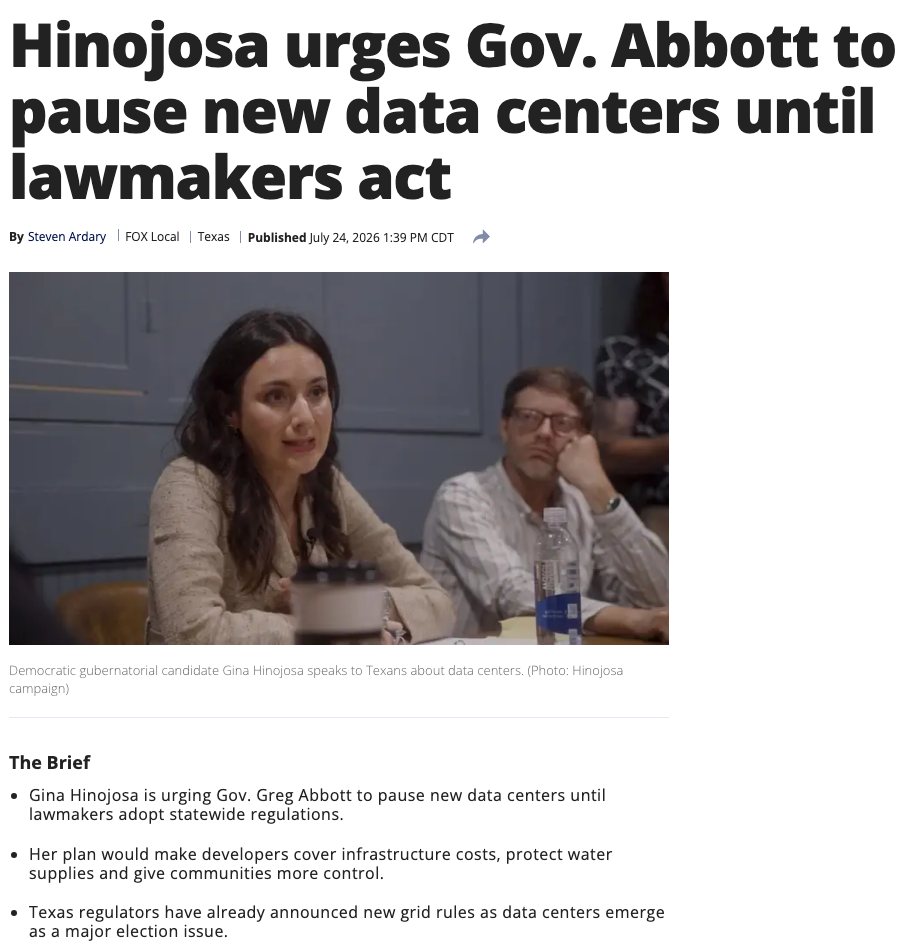
Both outlets point first to the elections. NBC News says markets had largely expected Democrats to win majorities but did not anticipate the scale of the victories, including the upset win of Gov.-elect Gina Hinojosa in Texas, the largest data-centre market in the country.[2] It reports that hundreds of candidates who pledged to rein in AI data centres have been elected, and names Texas, Ohio, Michigan and Georgia as markets of particular concern.[2] CNN says Hinojosa campaigned on a temporary data-centre moratorium and on eliminating certain tax incentives for such businesses.[1]
What did she actually propose? In a 24 July 2026 FOX 4 report, Hinojosa urged Governor Greg Abbott to pause new data centres until lawmakers adopt statewide regulations. Her plan would make developers cover infrastructure costs, protect water supplies and give communities more control.[7] She also said data centres are “guzzling up all our water” and electricity, in her words.[7] That is a campaign position reported in July. The sources do not describe any law passed since.
The election is not the only explanation in the sources. NBC News says the sell-off was triggered by two lacklustre earnings reports from the chipmakers Qualcomm and Arm Holdings on Wednesday night, which investors generally viewed as mixed.[2] CNN, by contrast, says Qualcomm missed estimates and that higher memory-chip costs are hurting its sales.[1] The two outlets use different words for the same results, and neither is a company filing. Whether the election or the earnings mattered more is not something the sources settle.
Who fell hardest
The damage was concentrated in the “picks and shovels” of the AI boom: the chips, memory and cloud capacity that data centres are built from. NBC News reports the Philadelphia semiconductor index fell 12.3%, its worst day since March 2020, and that an ETF tracking memory makers fell almost 18%.[2] CNN adds that Nvidia sank 9.3%, erasing its gains for the year, and that the neoclouds CoreWeave and Nebius, which rent out computing power, fell roughly 10% and 15%.[1]
SanDisk
−22%
“DRAM” memory ETF
≈ −18%
Micron, WD, AMD
−17%
Seagate
−16%
Nebius
≈ −15%
Arm Holdings
−13%
Chipmaker index
−12.3%
Tesla
−11%
Broadcom
−10%
CoreWeave
≈ −10%
Nvidia
−9.3%
Oracle
≈ −7%
One-day falls on 5 November 2026 as reported by NBC News (SanDisk, DRAM ETF, Micron, Western Digital, AMD, Seagate, Arm, chipmaker index), CNN (Nebius, Tesla, CoreWeave, Nvidia) and ANI (Broadcom, Oracle). “≈” marks sources that wrote “almost” or “roughly”. For Tesla, CNN says 11% and NBC News says “nearly 10%”; the bar uses CNN.
Two more details put the size in context. NBC News reports Nvidia fell 9.2%, its largest one-day decline since April 2025, and is down 15% over three months, while CNN gives 9.3%; the established cloud providers Alphabet, Meta, Amazon and Microsoft also fell, but less than the overall market, and Cisco and Caterpillar, both suppliers to AI data centres, dropped around 6%.[2] CNN adds that the sell-off was widespread: all 11 sectors in the S&P 500 closed lower.[1]
It crossed the Pacific
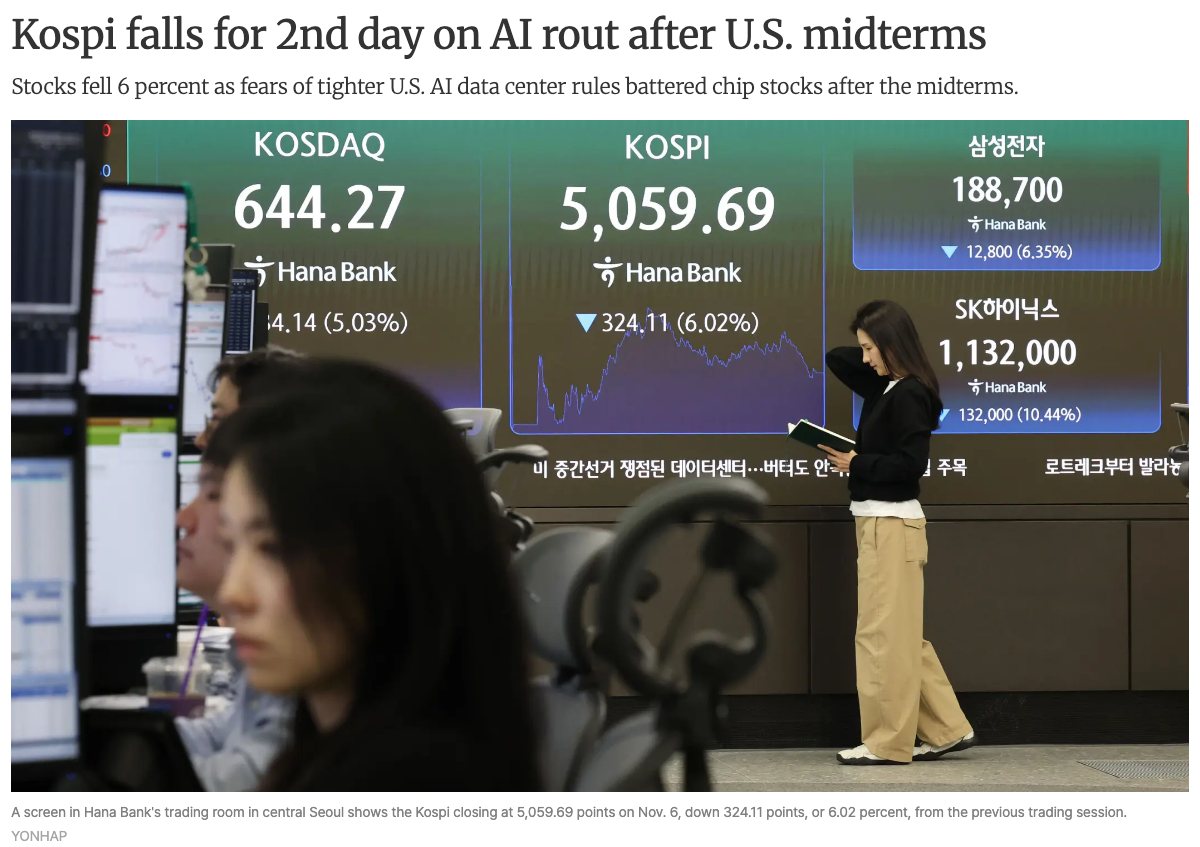
The next session was in Asia. CNN reports that South Korea’s Kospi plunged almost 9% at Friday’s open, triggering a 20-minute trading halt.[1] Korea JoongAng Daily, using a Yonhap report, puts it a little lower: the index fell more than 8% right after the opening bell, and closed down 324.11 points, or 6.02%, at 5,059.69, having fallen as low as 4,911.28.[8] It adds that Samsung Electronics fell 6.35% and SK hynix 10.44% at the close.[8]
NBC News adds that Japan’s Nikkei 225 fell as much as 6% and Taiwan’s TAIEX dropped 9%, Taiwan being home to chip supplier TSMC.[2] The sources I read did not report their final closes, so treat those two as early-session moves.
−8%+
Kospi at the open
20-minute market halt
−6.02%
Kospi at the close
5,059.69; low 4,911.28
−10.44%
SK hynix, close
Samsung −6.35% (JoongAng)
−9%
Taiwan’s TAIEX
Nikkei fell as much as 6% (NBC)
The same market fell by more than 8% at the open and 6.02% by the close. Quoting the open or the close tells a different story, so check which one a headline uses.
NBC News described the Nikkei and TAIEX moves from early Friday trading; their closing figures are not in the sources we read.
Other markets moved too. CNN says money flowed toward government bonds, with the 10-year Treasury yield falling to 4.84%, its lowest level in two months.[1] NBC News reports Brent crude rose 3.8% and US crude 2.7% after Wednesday’s drop, and that traders dialled back bets that the Federal Reserve would raise rates at its 8–9 December meeting, with odds now around 60%.[2]
11 of 11
S&P 500 sectors fell
CNN
4.84%
10-year Treasury yield
fell, lowest in two months (CNN)
+3.8%
Brent crude
rebounded; US crude +2.7% (NBC News)
≈ 60%
Odds of a December Fed rate rise
traders dialled back bets (NBC News)
Four ways to read it
The sources do not agree on what the day means, and that is useful to know. Ed Yardeni of Yardeni Research told NBC News: “I don’t think this is an AI bubble bursting.” He called it “an AI bubble losing some air very, very rapidly” and said that lowers the chance of a bursting bubble with damaging effects on the wider economy.[2] He told CNN that a slowdown is wanted because the buildout “was too frenzied and speculative.”[1]
Keith Lerner of Truist Advisory Services saw the week’s moves as more of a knee-jerk reaction than a real indication of how tech could fare under Democratic control of Congress, and said the risk-reward is improving for longer-term investors.[1] Daishin’s Lee called the reaction “excessive” and said the possibility that US legislators could completely suspend data-centre building is low.[8] President Trump wrote on Truth Social that the market suffered one of the worst days in history because of the election and blamed Democrats.[2]
Air coming out, not a burst
Told NBC News it is “an AI bubble losing some air very, very rapidly”, which lowers the chance of a bursting bubble with wider damage. Told CNN a slowdown is wanted.
A knee-jerk reaction
Sees the week’s moves as more knee-jerk than a real signal for tech under a Democratic Congress, and says risk-reward is improving for longer-term investors.
A reaction called excessive
Says a complete suspension of US data-centre building is unlikely and calls the market reaction excessive.
Blame for the fall
Wrote on Truth Social that the fall was based on the election results and blamed Democrats (NBC News).
Two numbers keep the day in proportion. NBC News says the Nasdaq Composite is still up more than 30% since Election Day 2024, despite the recent falls in chip, memory and cloud-linked stocks.[2] And CNN says that since their peaks on 6 October, the Nasdaq and S&P 500 are down roughly 12% and 6%, while the Nasdaq had closed in correction earlier in the year, in March, and recovered.[1] A single bad day, in other words, sits inside a rough year.
March
Correction
Nasdaq closed in correction.
Early June
Record highs
Nasdaq rallied back to records.
Late July
Near miss
Nasdaq stumbled and nearly fell into correction.
Sep–Oct
New records
Records reclaimed; the peak was 6 October.
5 Nov
Correction again
Nasdaq closed more than 10% below that peak.
As CNN described the Nasdaq’s year. Arrangement is ours; no index levels are implied by the spacing.
For the wider background, including why investors had become nervous about AI spending before the election, see the previous article in this series, Beyond the Hype: The AI Bubble Burst and Why a Massive Stock Correction Won’t Extinguish the Future of Technology. That piece was written on 1 November, before the vote. This one covers what happened after it.
What is known, what is not, and what to do
On 5 November the Nasdaq closed down 5.52% and in correction; the S&P 500 and Dow had their worst days since April 2025 (CNN, NBC News, ANI).
The Nasdaq Composite’s close of 24,315 matches the St. Louis Fed’s own record (FRED).
Why: sources link it to data-centre rules, but also to chip earnings, and Lerner and Lee call the reaction knee-jerk or excessive.
The size of the loss depends on the index: $2.3 trillion, $2.5 trillion or $2.8 trillion.
Whether laws restricting data centres will actually pass, and what they would cover. The sources describe pledges and campaign promises, not enacted rules.
Whether prices recover or fall further. No source we read can know that, and neither can we.
The honest summary is that one day’s numbers are well documented and the explanation is not. The Nasdaq’s close checks out against an independent source. The reason for the fall is plausible and contested. And what happens next, in Washington and on the stock market, is unknown.
If you read the news
Ask which index, which time (open or close) and who said it. Compare two sources before sharing a number.
If you invest
A one-day move is not a plan. Know why you hold what you hold, and speak to a licensed adviser about your own situation. This is not advice.
If you build with AI
Policy on data centres, power and water can change costs and timing. Keep your product working if a provider or region gets slower or dearer.
The message
“$2.5 trillion wiped out” is true of one index on one day: check which index, which time and who said it before you trust a big number.
Quick quiz
Tap a question to check your answer.
Q1Why do outlets give $2.3, $2.5 and $2.8 trillion for the same day?
They measure different indexes. NBC News gave $2.3 trillion for the Nasdaq 100 and $2.8 trillion for the S&P 500; CNN’s $2.5 trillion is for the Nasdaq Composite.
Q2What is a correction?
A fall of at least 10% from a recent high. The Nasdaq closed more than 10% below its 6 October record.
Q3How can you check a reported closing level?
Compare it with an independent record. The Nasdaq Composite’s 24,315 in the news reports matches 24,315.000 on the St. Louis Fed’s FRED database.
Q4Did the Kospi fall 9% or 6%?
Both are true at different times. CNN reports it plunged almost 9% at the open, triggering a 20-minute halt; JoongAng Daily reports it closed down 6.02%.
Q5Name two explanations the sources give for the sell-off.
Fears that Democratic election gains, especially in Texas, would slow AI data-centre building; and mixed or missed earnings from chipmakers Qualcomm and Arm on Wednesday night.
References
The sources behind this article: original papers, official announcements and documentation. Each link was opened and checked on ; documentation without a fixed date is cited as it read that day.
- [1]
Buchwald, E., Towfighi, J. and Egan, M. (CNN) (6 November 2026). Massive tech sell-off wipes $2.5 trillion from the stock market. CNN, as republished by Yahoo Finance.
Reporting · Supports: The $2.5 trillion figure, Nasdaq, S&P 500 and Dow moves, Wednesday’s rally, chip and AI-stock falls, the VIX jump, the Kospi halt and the Yardeni and Lerner comments.
- [2]
Kopack, S. and Canal, A. (NBC News) (5 November 2026). Stocks plunge as election outcome and AI worries crush tech shares. NBC News.
Reporting · Supports: The Nasdaq 100 ($2.3 trillion) and S&P 500 ($2.8 trillion) losses, the election context, the Qualcomm and Arm earnings, the memory-chip falls, Asian markets and President Trump’s comment.
- [3]
ANI (6 November 2026). Wall Street Loses $2.5 Trillion As AI Investment Fears Trigger Biggest US Stock Market Sell-Off Since April 2025. Free Press Journal.
Reporting · Supports: The closing levels of the Nasdaq Composite, S&P 500 and Dow, and the Broadcom and Oracle moves. The agency says it is relaying CNN.
- [4]
Federal Reserve Bank of St. Louis (5 November 2026). NASDAQ Composite (NASDAQCOM). FRED, Federal Reserve Economic Data.
Documentation · Supports: An independent record of the Nasdaq Composite’s 5 November 2026 close, 24,315.000, used to check the press figure.
- [5]
Federal Reserve Bank of St. Louis (4 November 2026). S&P 500 (SP500). FRED, Federal Reserve Economic Data.
Documentation · Supports: The S&P 500’s 4 November 2026 close, 7,688.62, the starting point for checking the 4.36% fall.
- [6]
Federal Reserve Bank of St. Louis (4 November 2026). CBOE Volatility Index: VIX (VIXCLS). FRED, Federal Reserve Economic Data.
Documentation · Supports: The VIX close on 4 November 2026, 16.61, the starting point for checking the reported 70% jump.
- [7]
Ardary, S. (FOX Local) (24 July 2026). Hinojosa urges Gov. Abbott to pause new data centers until lawmakers act. FOX 4 Dallas-Fort Worth.
Reporting · Supports: What Gina Hinojosa said and proposed about data centres during the campaign, before the election.
- [8]
Yonhap, via Korea JoongAng Daily (6 November 2026). Kospi falls for 2nd day on AI rout after U.S. midterms. Korea JoongAng Daily.
Reporting · Supports: The Kospi’s close, the 20-minute halt, Samsung and SK hynix moves, and the Daishin Securities view that the reaction was excessive.
How this article was made
Researched and drafted with the help of AI assistants, checked against the sources above, and published by Mrinal Singh Raja as general information, not professional advice. Facts come from the sources listed and may change, so please check them before relying on them. Spotted a mistake? Tell us and we will correct it. Our editorial standards explain how AI is used here.
Nasdaq, S&P Dow Jones Indices, CBOE, Nvidia, Broadcom, Qualcomm, Arm, Samsung, SK hynix, the St. Louis Fed and the publications named are independent of MSRX, and this article is not affiliated with or endorsed by any of them. Facts were checked on 6 November 2026 against the sources listed above. Screenshots are real captures from that date, cropped to leave out advertising and promotions.