The usage page
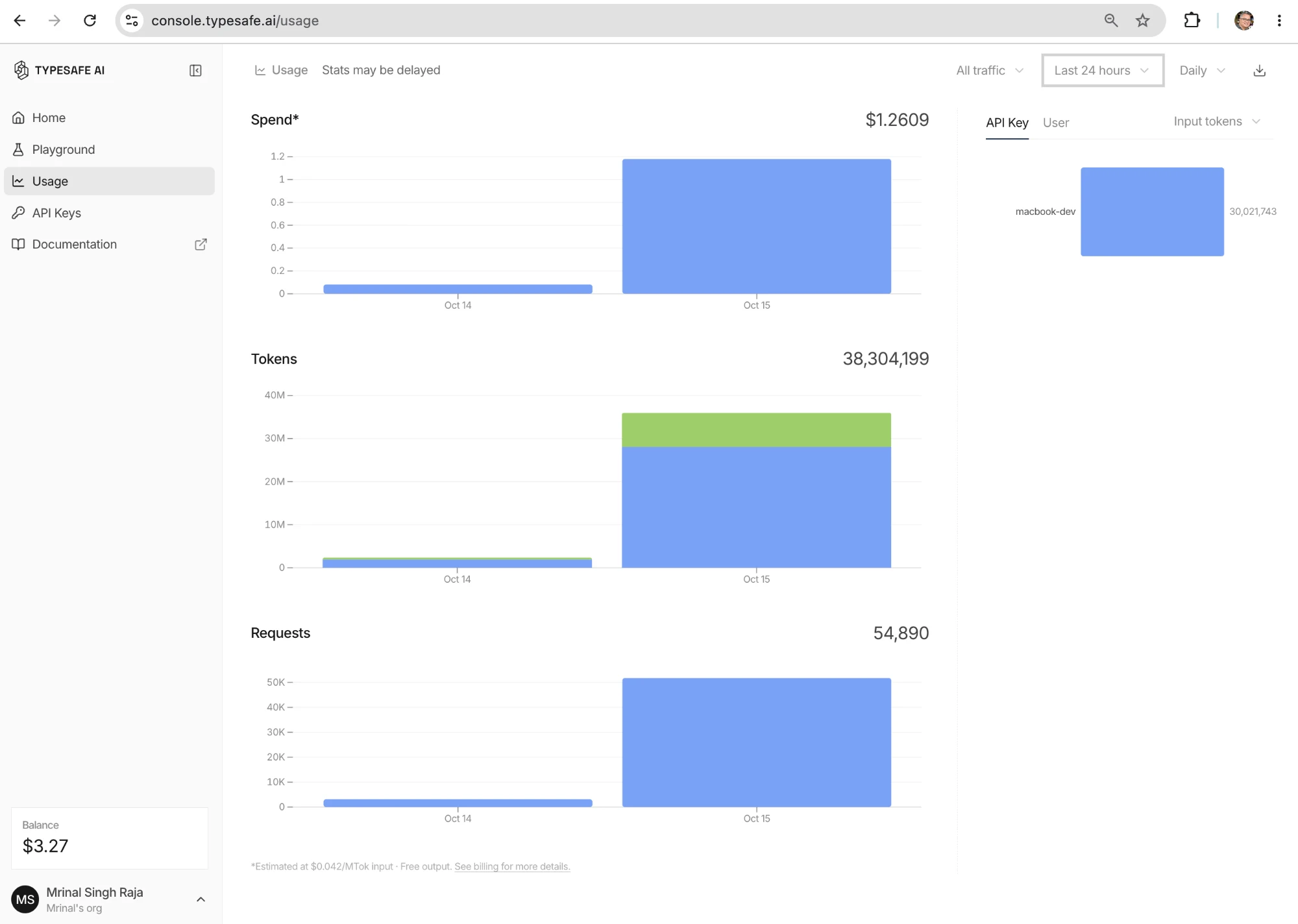
Over 24 hours, one developer machine made 54,890 requests to TypeSafe’s Jev model, used 38,304,199 tokens, and the console estimated the spend at $1.2609.[1]
That is the whole story in one sentence, and the screenshot below is where it comes from. It is the console’s Usage page, captured on 15 October 2026. We use it as raw material rather than as a boast: the aim is to show how to read such a page, what its numbers do and do not support, and what the same volume would have cost elsewhere.
$1.26
Spend
last 24 hours
54,890
Requests
38,304,199
Tokens
all kinds
30,021,743
Input tokens
one API key
Read off the console Usage page on 15 October 2026. The page marks spend with an asterisk: “Estimated at $0.042/MTok input · Free output”.
How Jev bills
Jev is priced per input token: $0.042 per million, or $42 per billion. Output tokens are free.[2] The Usage page repeats this in its footnote: “Estimated at $0.042/MTok input · Free output.”
That makes the bill easy to check. Multiply the input tokens on the page, 30,021,743, by the price.
The page shows $1.2609. Our sum matches to four decimal places, which tells us the bill is the input tokens alone, priced at the list rate, with nothing charged for output.
Price from TypeSafe’s Models page: $0.042 per million input tokens, output tokens free.
It comes to $1.2609, exactly the figure shown. So the spend is the input tokens alone, at list price. Two things follow. First, the page’s spend is an estimate, as its asterisk says. Second, because output is free, the cost of a Jev call depends on how much you send, not on how much comes back.
What a request weighs
Divide the totals by the 54,890 requests and a typical request is small: about 547 input tokens, and about 698 tokens of all kinds. At the estimated price each costs about two thousandths of a cent, and a thousand requests cost about two cents.
~547
Input tokens per request
on average
~698
Tokens per request, all kinds
$0.000023
Cost of one request
about 2 thousandths of a cent
$0.023
Cost of 1,000 requests
Averages: the page gives totals, not a per-request breakdown, so individual requests will vary. “Input tokens per request” uses the one API key shown.
The 8.3 million tokens that are not input, the difference between 38.3 million and 30.0 million, are presumably output, which Jev does not charge for. The screenshot does not label the two colours in the Tokens chart, so we treat that split as an inference.
The same tokens elsewhere
The natural question is what this would have cost on a general-purpose model. To answer it honestly we need real prices, not guesses. Anthropic publishes its list prices per million tokens: Claude Haiku 5.5 at $0.10 for input and $0.50 for output (for prompts up to 100,000 tokens), Sonnet 5.5 at $2 and $10, Opus 5.5 at $4 and $20, and Fable 5.1 at $10 and $50.[3] Applying these to the same 30.0 million input and 8.3 million output tokens gives the comparison below.
- TypeSafe Jev (measured)$1.26 · 1×
- Claude Haiku 5.5$7.14 · 5.7×
- Claude Sonnet 5.5$143 · 113×
- Claude Opus 5.5$286 · 227×
- Claude Fable 5.1$714 · 567×
Assumption: the same 30.0M input and 8.3M output tokens (total minus input; the split is not labelled on the page), at Anthropic’s standard list prices for prompts up to 100,000 tokens. Jev is measured; the others are arithmetic. No caching or batch discounts, which would lower them.
The spread is large and the honest reading is nuanced. Against Anthropic’s smallest model the same tokens would cost about $7.14, roughly 5.7 times as much. Against the larger models it is 100 times or more. Which one is the fair comparator depends on what job you would otherwise give the model.
| Model | Input $/M | Output $/M | Same tokens |
|---|---|---|---|
| Jev | 0.042 | free | $1.26 |
| Claude Haiku 5.5 | 0.1 | 0.5 | $7.14 |
| Claude Sonnet 5.5 | 2 | 10 | $143 |
| Claude Opus 5.5 | 4 | 20 | $286 |
| Claude Fable 5.1 | 10 | 50 | $714 |
Anthropic’s list prices as read from its pricing page on 15 October 2026. Haiku 5.5 is $0.10 and $0.50 for prompts up to 100,000 tokens. Prices change; check the page before you rely on a number.
A price comparison also leaves a lot out. It assumes the other model would use the same number of tokens, that discounts do not apply, and, most importantly, that the answers are equally good.
- Quality
Price says nothing about whether each answer was as good. A cheaper model that is wrong more often is not cheaper.
- Different output
Jev returns typed answers and probabilities, not text. A general model used for the same job may emit more or fewer tokens than Jev did.
- Discounts
Prompt caching and batch processing lower general-model prices. We ignored both, so those figures are upper bounds.
- Engineering time
Switching has a cost, and so does tuning thresholds. A dollar figure alone leaves that out.
Why a call is cheap
Jev is described by TypeSafe as the first “System One” model: built for fast, structured decisions that software can use directly, returning typed answers and probabilities rather than generated text.[4] It does not write replies, produce code or explain its reasoning.[4] It answers closed questions: pick one of these options, rate this against these levels, or give the probability that this is true.
That narrow job is the reason a request can be small and the output free. The docs’ advice follows from it: keep your code in control of the workflow and give the model narrow, structured decisions.[5]
Is this ticket a refund request? Which team gets it? How urgent is it?
Jev: a typed judgment, fast and cheap
Add up the amounts, compare dates, apply the policy rules
Your code: exact and free
Write the reply to the customer; explain a decision in words
A general LLM: Jev does not generate text
Answer is uncertain, or the stakes are high
Confidence gate: escalate to a person or a larger model
An illustration of the division of labour the docs recommend: code keeps control and the model gets narrow, structured decisions.
The second cost lever is batching. Jev reads the state once and evaluates every question against it in parallel. TypeSafe’s cookbook runs 13 questions over a long article both ways and reports that one batched call was 12.2 times cheaper and 10.0 times faster than 13 separate calls, with no change in answers.[6] The reason is plain: with separate calls the document is paid for again each time.
13 calls, document sent 13 times
Every request carries the same document, so you pay for it again each time, and each call is a round trip.
1 call, document sent once
Jev reads the state once and evaluates every question against it in parallel. TypeSafe’s benchmark reports answers did not change.
12.2×
Cheaper
TypeSafe’s benchmark
10.0×
Faster
TypeSafe’s benchmark
From TypeSafe’s “Parallel questions” cookbook: 13 questions over a ~54,000-character article, run on an earlier model version (jev-1.12). TypeSafe’s own numbers, not ours.
We cannot tell from the Usage page whether the 54,890 requests were batched. If your own workload asks many questions about one input, batching is the first thing to check.
What about speed?
It is tempting to say Jev made the work faster, and it may well have. But the Usage page does not show latency or time saved, so it cannot support a number. What we have is TypeSafe’s own benchmark for batching, and the method for getting your own.
- Not shown
The Usage page
Shows spend, tokens, requests and keys. It does not show latency or time saved.
- Attributed
TypeSafe’s benchmark
One call with all questions was 10.0× faster than one call per question, on one cookbook task.
- Measure
Your own timings
Log a start and end time around each call, and compare with what you used before on the same inputs.
The fair test is simple: take a fixed sample of real inputs, run it through both setups, record start and end times for each call, and compare the medians and the slowest cases. Compare answers on the same sample at the same time. A fast wrong answer is not a saving.
Where it does not fit
Cheap and fast are only useful if the model is right for the job. TypeSafe’s own documentation lists the weak spots plainly: Jev reads literally, struggles with numeric precision and counting, handles dates poorly as ordered quantities, loses accuracy with indirection and with large amounts of irrelevant state, and does not generate text.[7]
Literal reading
Answers the words you wrote. Write the exact condition.
Math and counting
Not a calculator. Keep arithmetic in code; ask one question per item and add up.
Dates and times
Extract the parts, compare in code.
Indirection
Double negatives and multi-hop questions lose accuracy. Ask directly.
Large, noisy state
Accuracy falls with irrelevant detail. Filter first.
Generation
Does not write replies, code or explanations. Use a generative model.
Condensed from TypeSafe’s “Jev 1.13 jaggedness” page, last reviewed 2 October 2026. Jev 1.14 became available on 14 October 2026; read the current page for the model you use.
Each has the same remedy: do the exact or generative part elsewhere. Count and compare in code, filter the state before sending it, and hand writing to a generative model. The docs also note that accuracy depends on staying inside the context limits, 64k tokens per request and 32k per question by default.[2]
Do the sum yourself
You do not need our figures. You need your own page and six steps.
- 1
Open the Usage page and set the window you care about.
- 2
Note spend, input tokens, total tokens and requests.
- 3
Divide: spend ÷ requests is your cost per request; input tokens ÷ requests is your average request size.
- 4
Check: input tokens × price per million should equal the spend shown.
- 5
Price the same tokens at the other model’s list price, input and output separately.
- 6
Compare answers on a sample, not just prices, before you move anything.
Claims, checked
Posts about cost savings travel fast and lose their qualifiers on the way. These are the claims you are most likely to see about a page like this, and what the evidence supports.
- Measured
“54,890 requests for $1.26.”
Read directly from the Usage page. The spend is an estimate at list price.
- Depends
“Jev is 100 times cheaper than a normal LLM.”
Depends on which model. At Anthropic’s published prices the same tokens cost about 5.7× (Haiku 5.5) to about 570× (Fable 5.1) as much, before discounts and without a quality comparison.
- Not shown
“Ten times faster.”
Not from this page. TypeSafe reports 10.0× for batching on one task; your own timing is not in the screenshot.
The message
$1.26 for 54,890 requests is a real number from a real page, and it is cheap on any list price we could read. How much cheaper than the alternative depends on the alternative, from about six times against a small model to hundreds of times against a large one. What the page cannot tell you is whether every answer was good enough, or how much time you saved. Those are yours to measure.
Use the small, calibrated model for the narrow judgments and keep the big model, and your code, for everything else. Then check the meter.
Quick quiz
Tap a question to check your answer.
Q1How is a Jev call billed?
Per input token, at $0.042 per million. Output tokens are free.
Q2How do you check that a usage page’s spend is right?
Multiply the input tokens by the price per million. Here 30.02 million × $0.042 ≈ $1.26, which matches the page.
Q3Why is the comparison with a general model a range and not one number?
Because general models span a wide price range. At Anthropic’s list prices the same tokens cost about 5.7× to about 570× as much, from Haiku 5.5 to Fable 5.1.
Q4What does the usage page not show?
Latency, time saved, answer quality, and which model version served each request.
Q5Why does batching questions cut cost?
The document or state is sent and paid for once instead of once per question. TypeSafe’s benchmark reports 12.2× cheaper and 10.0× faster on one task.
References
The sources behind this article: original papers, official announcements and documentation. Each link was opened and checked on ; documentation without a fixed date is cited as it read that day.
- [1]
TypeSafe AI (captured 15 October 2026). Usage (console), last 24 hours. TypeSafe console (login required; shown as a real screenshot in Figure 1).
Documentation · Supports: Spend $1.2609, 38,304,199 tokens, 54,890 requests, 30,021,743 input tokens; the page’s own footnote on price
- [2]
TypeSafe AI. Models. TypeSafe documentation.
Documentation · Supports: $0.042 per million input tokens, output free; Jev 1.14 available from 14 October 2026; context limits
- [3]
Anthropic. Pricing. Claude Platform Docs.
Documentation · Supports: List prices per million tokens for Haiku 5.5, Sonnet 5.5, Opus 5.5 and Fable 5.1
- [4]
TypeSafe AI. System One. TypeSafe documentation.
Documentation · Supports: What a System One model is, that it returns typed answers and does not generate text
- [5]
TypeSafe AI. How to build with TypeSafe. TypeSafe documentation.
Documentation · Supports: Keep code in control; give the model narrow, structured decisions
- [6]
TypeSafe AI. Parallel questions. TypeSafe cookbooks.
Documentation · Supports: 13 questions batched in one call: 12.2× cheaper and 10.0× faster, run on jev-1.12
- [7]
TypeSafe AI (last reviewed 2 October 2026). Jev 1.13 jaggedness. TypeSafe documentation.
Documentation · Supports: Literal reading, numbers, dates, indirection, large noisy state and generation as weak spots
How this article was made
Researched and drafted with the help of AI assistants, checked against the sources above, and published by Mrinal Singh Raja as general information, not professional advice. Facts come from the sources listed and may change, so please check them before relying on them. Spotted a mistake? Tell us and we will correct it. Our editorial standards explain how AI is used here.
TypeSafe AI, Anthropic and Mintlify are independent of MSRX; this article is not affiliated with or endorsed by any of them. The usage figures are from the author’s own TypeSafe console. Anthropic makes Claude, which is among the AI assistants used to draft this article. Quotes are word for word from the linked sources. Prices and documentation were checked on 15 October 2026 and may change. The spend figure is the console’s estimate at list price; the comparison figures are our arithmetic from published list prices, not quotes or measurements.